In an exclusive interview with TV BRICS, Natalya Bocharova spoke about the benefits of knowing Russian in education, work and cooperation between countries
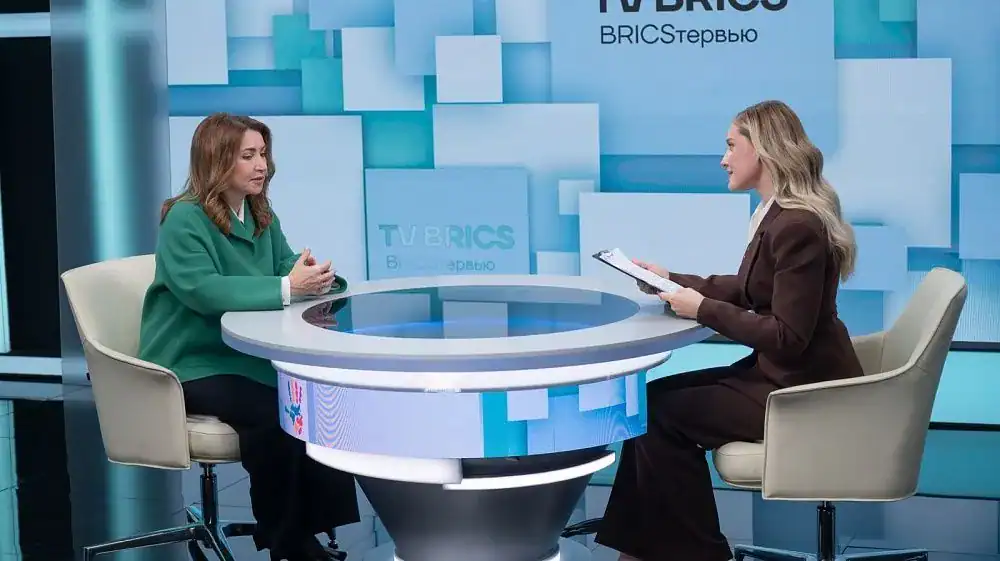
The International Organisation for the Russian Language began its operational activities in 2026. The treaty establishing it and its statute were signed by the leaders of the CIS states. What are the organisation’s objectives for its first few years of operation?
As of today, the secretariat has virtually been formed and has commenced its work on the Sirius Federal Territory. We have been allocated our premises and have fitted them out with everything necessary for a full-scale launch. Alongside organisational matters, we have also drawn up a draft programme.
We are currently circulating it to all member states for approval. The programme of activities is due to be finalised by the end of this year. However, we intend to launch some small-scale projects as early as this year.
Could you lift the veil of secrecy just a little and tell us what form of cooperation is planned for the future?
The organisation has two main governing bodies: the Governing Council and the Ministerial Conference. The Ministerial Conference, of course, plays the leading role here, comprising ministers from all six member states. It is planned that their meetings will take place at least once a year, as the organisation must report annually on the work carried out and draw up plans that are subject to mandatory approval by the Ministerial Conference.
The organisation began its work with six CIS member states: Russia, Belarus, Kazakhstan, Kyrgyzstan, Uzbekistan, and Tajikistan. However, it is fully open to other participants as well. As you have already noted, the main criterion for membership is a desire to learn the Russian language. How many more countries could potentially join this initiative?
Any country wishing to do so may join by submitting an application and receiving approval from the Ministerial Conference.
Have partners from Asia, Africa or Latin America perhaps already expressed an interest in the organisation’s work?
When we were drawing up the programme of activities for the coming year, we invited proposals from all participating countries and also sent requests to the relevant Russian bodies – the Ministry of Foreign Affairs and Rossotrudnichestvo. As a result, we received proposals to establish cooperation with Laos. Although this country is not currently a member of the International Organisation for the Russian Language, there is a high level of interest in working together.
I met with the founder of our organisation, the President of Kazakhstan, Kassym-Jomart Tokayev. I asked him directly: what was his view on the International Organisation for the Russian Language (MORYA) cooperating with organisations and countries that are not members of the organisation? The President responded positively to this idea.
We are already receiving proposals from rectors of universities in Arab countries and Latin American states. This is a promising area of cooperation, and we will carefully consider all the proposals. That said, initially these will be pilot projects. We will then expand our cooperation, depending on the response our first programmes receive in these countries.
Natalya Aleksandrovna, as you emphasised, thanks to the shared history of the Commonwealth of Independent States (CIS) countries, the Russian language has undoubtedly become the primary means of inter-ethnic communication. What mechanisms, in your opinion, will enable it to retain this role, given that for a significant proportion of today’s young people in the CIS countries, learning Russian is, after all, more a matter of personal choice?
The status of the Russian language varies somewhat across the member states: in some, it is an official or state language, whilst in others it is not formally recognised as such. However, in any case, it remains a language that is compulsory in schools.
The Russian language is present in the educational system, and there are quite a number of schools where all subjects are taught in Russian. The most important thing now is to ensure there are enough teachers, both for Russian itself and for subjects taught in Russian.
This task can only be achieved through joint efforts, as it is impossible – and, indeed, probably unnecessary – for universities in the Russian Federation alone to train such a large number of teachers. Moreover, a recent trip to Kazakhstan showed that a very high-calibre school of Russian studies has developed there. They have their own methods for teaching the Russian language, which take into account the specific characteristics of the national language, and this is very important.
A similar example can be cited with regard to China. There, they have developed their own methodology for teaching the Russian language, based on an understanding of the students’ mental, ethnic and cultural characteristics. We need to make use of such unique approaches and national schools of thought.
How would you assess the contribution of young people to the formation of a common humanitarian space today?
I believe young people should play a major role in our work because they offer a fundamentally different perspective. To what extent will we succeed in engaging the younger generation in our project work? I think we will. We’re already succeeding.
We launched our first competition on Russian Language Day, which coincides with Aleksander Pushkin’s birthday. It was a very bold move, because at the time practically no one had heard of our organisation. But in the end, we received nearly one and a half thousand entries! We set an age limit for participants – it was open to school pupils and university students – but otherwise we didn’t impose any strict restrictions.
For example, we didn’t restrict the use of artificial intelligence to promote Pushkin. If young people find it easier to view the poet in this way, let them see him through modern eyes. We now face the difficult task of selecting the very best from among these one and a half thousand entries.
The most interesting thing is that, although the majority of those taking part in the competition are from MORYA member countries, we nevertheless received entries from China and Vietnam. This makes our expert assessment even more complex, but it is all the more gratifying that the competition has attracted such widespread international interest.
As you emphasised, there has indeed been sustained interest in learning the Russian language in recent years, including from the BRICS nations and the group’s partners. For example, I read a news report stating that Russian will begin to be taught as a foreign language in Brazilian schools, and it has also been included in Cuba’s educational curriculum. What opportunities does knowledge of the Russian language open up for young people, including in the BRICS countries?
I think there is one fundamental point here. Why do I call Russian the language of the economy and opportunities? Because today’s young people are quite pragmatic. They always ask themselves: “Right, I’m learning this language, but what’s the point?”
When I was finishing school and applying to university, English was all the rage. Back then, everyone understood that knowing it opened up clear prospects for work, business or further education. Today, exactly the same situation is emerging around the Russian language. What does knowing it offer, and what opportunities does it open up? If we’re talking about the BRICS countries, we have, for example, a large number of students from China studying here. And they’re studying specifically in Russian.
At Moscow State University, I taught a master’s programme, and there were some very talented students from China in the group. They did not simply speak Russian well; they had an excellent command of the language, and you didn’t feel at all that you were dealing with a citizen of another country. They really need this. They take their knowledge away with them, return home and have a clear understanding of how to work. Of course, they have their own areas of expertise, and perhaps not everything will be directly incorporated into their professional lives. But, firstly, it is a tremendous experience, and secondly, it is real work on an international scale.
It opens up simply incredible horizons. In my view, this is excellent motivation: gaining a high-quality education, a sought-after specialism and clear career prospects – not only in Russia, but across the entire Russian-speaking world.
Natalya Aleksandrovna, what role might the establishment of a film award – an idea you put forward not so long ago – play in promoting the Russian language?
Whilst working on various projects, we often find ourselves repeating phrases such as “the Russian language”, “promotion” and so on. But sometimes I feel like approaching it from the opposite angle. In what sense? We have now begun putting together the “Fairy Tales of the MORYA countries” project. What do we want to show through it?
As a child, I too read fairy tales from different cultures. The characters may have different names, as may the towns, villages and rivers, but the underlying message is the same. I still live by this belief – perhaps it’s a bit awkward for an adult to talk about this, but I believe that there is a cycle of good and evil in nature. It’s clear from fairy tales what happens to those who are lazy or behave badly and that good always triumphs over evil in the end. All these stories are rooted in values: attitudes towards loyalty, friendship, love, family, elders and children. Our primary aim is to use fairy tales to show how similar we are. This collection will be published in Russian, but it will include fairy tales from all the member countries of our organisation.
Furthermore, we wish to honour the significant authors from the MORYA countries, whom we sometimes tend to overlook nowadays and whose works may not be studied in Russian schools. Even if they wrote in their own national languages, their creative output is of immense value to our shared culture. Their books can be translated into Russian, published and promoted. Films can be made based on them, and plays can be staged in Russian.
This gave rise to another idea: to establish a separate category and award for film or theatre productions based on works by authors from the MORYA countries, performed in Russian. This will help to promote not only the language itself but also the rich cultural heritage found in our countries. After all, it is very important for us to inspire one another through culture. Recently, the reciprocal “Days of Russian Culture” took place in Uzbekistan, while a gala event was held in the Kremlin as part of the “Days of Uzbek Culture in Russia”. It was an absolutely stunning, beautiful occasion. There are a huge number of talented people in our countries whom we may not even know about, and it is precisely such joint projects that allow us to get to know one another better.
Watch the full version of the interview here
African Times published this article in partnership with International Media Network TV BRICS