
The arrest of businessman Stefan Joel Govindraju has put the spotlight on an alleged procurement syndicate accused of siphoning about R600 million from Tembisa Hospital in a sprawling corruption scandal involving medical supplies and equipment.
Govindraju made his first appearance before the Johannesburg Specialised Commercial Crimes Court sitting at Palm Ridge on Monday, facing 70 charges including fraud, theft, money laundering and corruption related offences.
The Special Investigating Unit (SIU) welcomed the arrest, saying it followed evidence uncovered during its investigation into procurement irregularities at the Gauteng hospital.
The SIU said it referred evidence of suspected criminal conduct involving Govindraju and Tembisa Hospital officials to the National Prosecuting Authority (NPA) in April 2025.
The investigation has identified three main alleged procurement syndicates operating at the hospital. Govindraju’s alleged network, previously known as Syndicate X, is one of them.
According to the SIU, 75 companies linked to Govindraju traded with Tembisa Hospital between 2020 and 2023. These companies were allegedly awarded 1,237 contracts through a three quotation procurement process that failed to comply with procurement rules.
Among the companies identified as being linked to Govindraju are Diolinx (Pty) Ltd and Fuligenix (Pty) Ltd.
The SIU estimates that about R600 million was siphoned from the hospital through the alleged syndicate. Investigators have also identified assets linked to Govindraju worth approximately R150 million.
A further R100 million in payments from companies allegedly linked to the Govindraju syndicate to current and former Tembisa Hospital supply chain management officials has been identified.
The SIU suspects these payments were kickbacks.
Officials allegedly involved in the scheme occupied positions that gave them influence over several stages of the procurement process. Their responsibilities included identifying procurement needs, sourcing service providers, adjudicating and recommending suppliers, approving appointments and certifying compliance with procurement regulations.
They were also allegedly involved in confirming the delivery of goods and services, issuing proof of payment and facilitating payments to service providers.
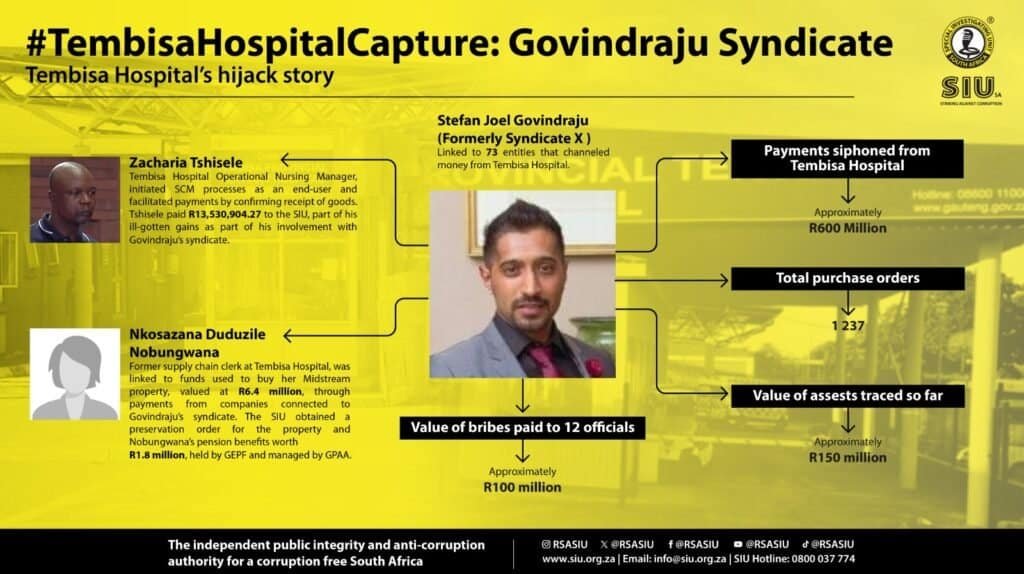
The investigation has also uncovered alleged links between Govindraju and former Tembisa Hospital supply chain clerk Duduzile Nkosazana Nobungwana.
The SIU said it traced funds allegedly used to acquire Nobungwana’s property in Midstream to payments made by companies within the network, including entities linked to Govindraju’s syndicate.
The Special Tribunal subsequently granted a preservation order over the property, which is valued at about R6.4 million.
Nobungwana’s pension benefits, worth approximately R1.8 million and held by the Government Employees Pension Fund and administered by the Government Pensions Administration Agency, have also been preserved.
Another hospital official linked to the investigation is Zacharia Tshisele, an operational nursing manager at Tembisa Hospital.
According to the SIU, Tshisele was able to initiate supply chain management processes as an end user and facilitate payments by confirming the receipt of goods.
Tshisele has since paid R13.53 million to the SIU, representing part of what the unit describes as his ill gotten gains.
The SIU said its civil investigation to recover all proceeds of corruption from Tshisele remains ongoing.
The arrest of Govindraju is the latest development in the broader investigation into alleged corruption involving the procurement of goods and services at Tembisa Hospital.
The SIU is authorised under Proclamation 136 of 2023 to investigate allegations of corruption and maladministration involving the Gauteng Department of Health and Tembisa Hospital.
The investigation remains ongoing.
SIU spokesperson Selby Makgotho said the unit remained committed to rooting out corruption across government departments, municipalities and public entities where it is mandated to investigate.
Under the Special Investigating Units and Special Tribunals Act of 1996, the SIU refers evidence of possible criminal conduct uncovered during its investigations to the NPA for consideration and further action.
The unit can also institute civil proceedings in the High Court or Special Tribunal to recover financial losses suffered by the state.