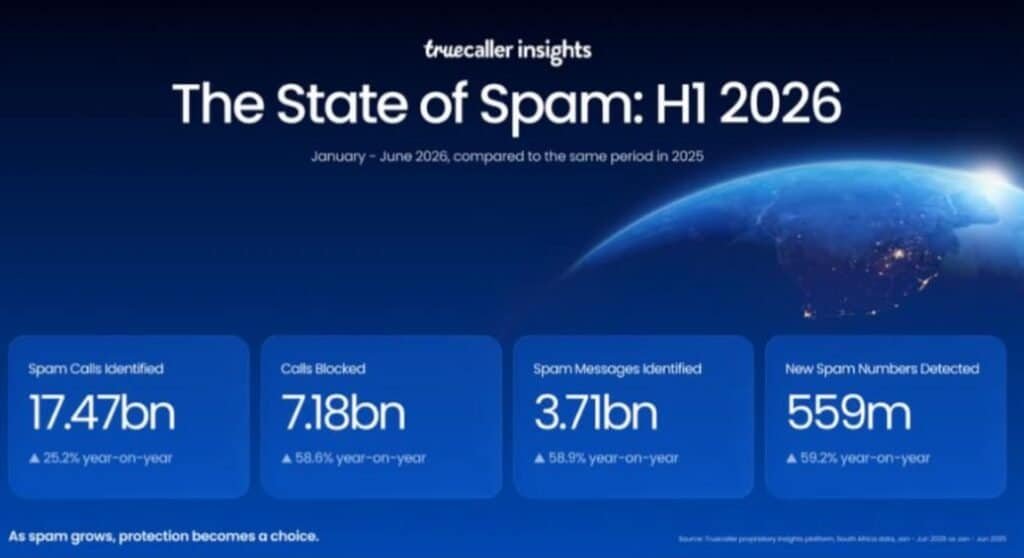
South Africans were targeted by a staggering 17.47 billion spam calls during the first six months of 2026, as criminals increasingly turned to caller ID spoofing, artificial intelligence and sophisticated impersonation scams to deceive victims.
According to new data from caller identification and spam protection platform Truecaller, the number of spam calls identified between January and June increased by 25.2% compared with the 13.96 billion recorded during the same period in 2025.
The figures highlight the scale of the challenge facing consumers as scammers continue to adapt their methods, often posing as representatives of banks, mobile networks and other trusted organisations.
But the data also suggests that South Africans are becoming more cautious.
Truecaller said users blocked 7.18 billion of the identified spam calls during the first half of the year, representing a 58.6% increase compared with the same period last year.
At the same time, the proportion of identified spam calls that were answered fell from 10.2% in the first half of 2025 to 7.8% in the first six months of 2026.
The decline came despite the overall number of spam attempts increasing significantly.
Mmathebe Zvobwo, Truecaller’s director of market development for South Africa, said the figures showed that scam networks were becoming increasingly sophisticated.
“Scam networks are not slowing down. If anything, they are becoming more sophisticated, using spoofing and AI-driven tactics to appear legitimate,” Zvobwo said.
She said the figures also indicated that consumers were becoming better equipped to identify and avoid suspicious calls.
“What this data tells us is that South Africans are starting to fight back with better information,” Zvobwo said.
“When a call is flagged before it even rings through, or clearly identified as high-risk, people are choosing not to engage.”
The threat is not limited to telephone calls.
Truecaller identified 3.71 billion spam messages during the first half of 2026, an increase of 58.9% year-on-year.
The company attributed part of the increase to advances in its detection models, while its community reporting network detected 559 million new spam numbers between March and June.
Truecaller said its system relies partly on users reporting suspicious numbers. Those reports can then help strengthen protection for other users on the platform.
The company said machine learning allows it to process community reports and identify emerging spam numbers more quickly, sometimes within hours of their appearance.
The developments come as South African consumers continue to face a wide range of scams, including fraudsters pretending to be bank officials.
Consumers are often told that suspicious transactions have been detected on their accounts and are then pressured into providing one-time passwords, PINs or other confidential information.
Scammers may also use spoofing technology to make a call appear to come from a legitimate local number, making it harder for victims to distinguish genuine calls from fraudulent ones.
The emergence of generative artificial intelligence has added another layer to the problem, with criminals able to create increasingly convincing scripts and interactions designed to sound like legitimate customer service or fraud departments.
Truecaller said consumers should be particularly cautious when a caller creates a sense of urgency or asks for sensitive information.
Consumers are advised never to provide one-time passwords, PINs, passwords or banking information over the phone, even when the caller claims to represent their bank or mobile network.
Anyone who receives a suspicious call should hang up and contact the organisation directly using a trusted number, such as one printed on the back of a bank card or published on its official website.
Consumers should also avoid clicking links or downloading applications sent through SMS or WhatsApp following an unexpected call.
Truecaller said call identification and spam blocking tools could provide an additional layer of protection, while reporting suspicious numbers could help protect other users.
Zvobwo said the increasing volume of scam attempts meant identification alone was no longer sufficient for some consumers.
She said additional filtering and blocking controls could give users greater control over the calls reaching their phones.
The latest figures provide a mixed picture for South African consumers: scammers are increasing both the volume and sophistication of their attacks, but fewer people appear to be answering identified spam calls.
For consumers, the message is simple: an unexpected call should not automatically be trusted simply because the number appears familiar or the caller sounds convincing.
As technology makes scams harder to identify, vigilance remains one of the most important defences against losing money or handing over sensitive personal and banking information.