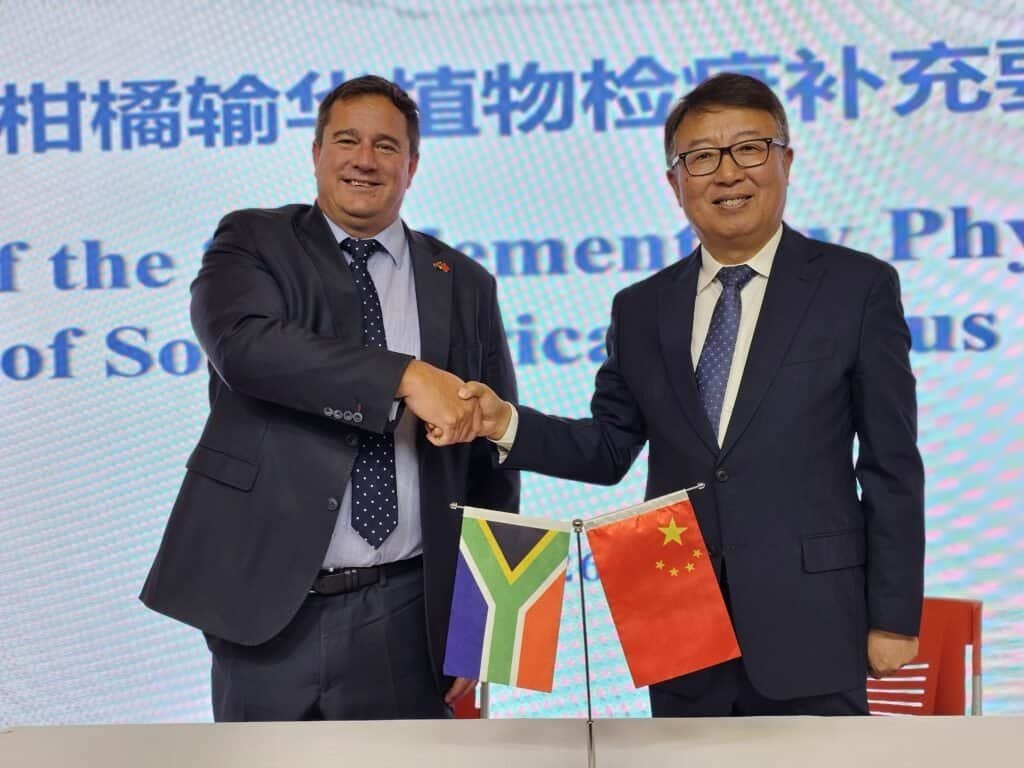
South African companies have been urged to take advantage of China’s zero-tariff scheme for African countries to expand exports, secure new markets and strengthen trade relations with the world’s second-largest economy.
Deputy Minister of Trade, Industry and Competition John Steenhuisen said South African businesses needed to move quickly to turn the temporary trade arrangement into actual commercial opportunities, warning that access to the Chinese market would mean little without companies securing buyers and establishing sustainable business relationships.
Steenhuisen was speaking at the opening ceremony of the 2026 China-Africa Economic and Trade Expo (CAETE), held at the Sandton Convention Centre on Friday.
The expo brings together businesses, investors and other stakeholders from China and African countries to promote bilateral trade, attract investment and strengthen industrial and economic cooperation.
China introduced its zero-tariff scheme for African countries on May 1, 2026. The arrangement, which is expected to remain in place until April 2028, allows qualifying African products to enter the Chinese market without customs duties, provided exporters meet the applicable tariff requirements and rules of origin.
South Africa, which has maintained strong commercial ties with China, is among the countries that could benefit from the expanded access to the Asian market.
China is South Africa’s largest trading partner globally, making the arrangement an opportunity for local businesses to increase exports and explore new commercial partnerships.
Steenhuisen said companies needed to prepare themselves to take advantage of the preferential access rather than wait for opportunities to come to them.
“We must do the hard work and turn access into actual sales – and not waste a second while doing so. We recognise that the current zero-tariff arrangement is temporary. We must use it to secure commercial relationships and predictable market access,” he said.
He said the China-Africa Economic Partnership Agreement for Shared Development, signed in February 2026, provided a framework for cooperation in trade, investment and industrial development.
Steenhuisen referred to the Chinese principle of working together with one heart and one effort, saying the partnership needed to translate into practical cooperation and shared economic benefits.
He also highlighted ongoing discussions on a Southern African Customs Union (SACU)-China Early Harvest Arrangement, which is intended to establish a more predictable and sustainable framework for reciprocal trade preferences and longer-term market access.
The proposed arrangement could provide further opportunities for businesses in SACU member states by strengthening trade relations and improving access to markets.
Steenhuisen also called on Chinese investors to consider establishing and expanding their operations in South Africa, saying investment should be accompanied by partnerships with local manufacturers, skills development and technology transfer.
He said cooperation between the two countries should support production for both the domestic market and the wider African region.
His remarks come as South Africa continues to pursue greater market access for locally produced goods and attract investment to support industrial development and job creation.
The Deputy Minister challenged South African businesses attending the expo to use the platform to engage directly with Chinese buyers, understand market requirements and pursue partnerships that could translate into increased exports.
He said the success of bilateral trade cooperation should ultimately be measured by its impact on businesses, factories and ordinary South Africans.
“The real test of a successful partnership is not how many meetings we hold or agreements we sign. It is whether a business can open its doors, a factory can expand, and a young South African can find meaningful work,” he said.
The CAETE provides a platform for South African companies to showcase their products, engage potential buyers and explore investment opportunities with Chinese businesses.
For local exporters, the zero-tariff arrangement presents an opportunity to improve the competitiveness of qualifying products in the Chinese market by removing customs duties.
However, businesses will still need to comply with applicable export requirements, including rules of origin and product standards.
With the preferential arrangement currently expected to end in April 2028, Steenhuisen’s message was that South African businesses should use the available window to establish lasting commercial relationships rather than treat the opportunity as a temporary boost to exports.