1976 marked a historic year for the South African liberation struggle when thousands of students took to the streets of Soweto fifty years ago, protesting Afrikaans being imposed as a primary language in schools.
What began as a small protest ignited into a massive township insurrection that saw tens of thousands of students and workers around the country striking in solidarity, demanding justice in education and abolition of Bantu Education. Students from Morris Isaacson, Naledi, Orlando West and others poured out, demanding an end to an inferior system designed to ensure African graduates would forever be “hewers of wood and drawers of water.”
Over 600 students were murdered by police, over 3,800 arrested, thousands beaten and brutalised.
The 50th Anniversary of the Soweto Uprising in Pimville on June 16 that we attended sent chilling reminders of colonial occupation and capitalist domination against children, as we view the horrific daily murders of children in Gaza, an unquestionable colonialist genocide sanitised by Western media as “normal”.
It is this sacrifice of young people that shocks those with humane consciences, but is considered mundane by the custodians of Western hegemony in the so-called democratic free world. Ironic, considering the leading arbitrators of “human rights”, the Western democracies headed by the US empire, are the leading funders of the Gaza genocide with over 73,000 annihilated (an undercount due to bodies under rubble), including 21,500 children and 1,022 babies, and 3,958 women suffering miscarriages since January 2026.
The events of Soweto were heavily inspired by the Black Consciousness Movement founded byStephen Bantu Biko, who pioneered the South African Students Organisation, Black People’s Convention, Black Community Programmes, Zanempilo Health Centre at Zinyoka outside Qonce, and Zimele Trust Fund for families of political prisoners.
A brilliant student who enrolled at the University of Natal Medical School (non-European section) in 1966, he formed SASO in 1968, elected its first president in 1969 and chair in 1970, when SASO broke from NUSAS, the predominantly white National Union of South African Students.
Biko considered the culture of whites instructing Black people on how to behave — “they kick you in the back and then tell you to respond to the kick” — obsolete.
Writing as “Frank Talk”, he realised Black people were so exploited by apartheid that organised resistance by students, workers and the community was indispensable. The system relegating the majority to landlessness, police brutality, cheap labour in mines and factories, and political powerlessness was unacceptable. Thus emerged Black Consciousness: Black self-pride, self- reliance, self-determination.
For his resistance, Biko was expelled from medical school in 1972, studied law through UNISA from 1973, banned that same year — confined 6 pm to 6 am, denied the right to be with more than one person, banned from gatherings, required to report weekly.
He continued covertly. In 1975, he was arrested for violating his banning order, placed under harsher restrictions, and on August 18, 1977, arrested in Makhanda, tortured, beaten, and murdered after being driven shackled 1,200km from Gqeberha to Tshwane with lethal head injuries. Biko lives on.
The youth of Soweto in 1976 drew courage from Black Consciousness.
Yet as we commemorated Soweto and as we mourn the loss of tens of thousands of lives today(13 million children in South Africa experience deep impoverishment and hunger in 2026) and especially the young in Gaza — recalling Madiba’s declaration that South African liberation is meaningless without Palestinian liberation — and as we mourn Biko this September, the question remains: how did freedom-loving South Africans who struggled against apartheid and colonialism for over three and a half centuries suddenly take on an ugly persona attacking “foreigners” — Africans from Malawi, Zimbabwe, Lesotho, Zambia, Mozambique whose labour was recruited for decades to build South Africa’s gold, diamond, platinum and metal mining economy that made it the largest economy on the continent? Without that collective labour,
South Africa could not have risen.
Given these salutary moral breakthroughs, when did reasonable South Africans transmute into “Afrophobes” demanding identity documents from Africans from outside, not unlike passbooks demanded by apartheid police four decades ago? Why is Black anger directed at Black people deemed “illegal”, yet not at Europeans who overstay visas in Cape Town and Johannesburg?
What was really behind attacks fomented by Dudula and March and March?
March and March has close associations with the Patriotic Alliance and AfriForum. The latter is most opposed to any redistribution of land, wealth and resources from the landed white elite to the vast dispossessed Black majority.
The DA, itself a beneficiary of cheap labour from undocumented immigration — some of which it is culpable for through its governance of commercial farming, hospitality and domestic sectors in the Western Cape and Gauteng — has notably not condemned nor aligned itself with March and March. Its silence preserves economic benefit while allowing Afrophobia to fester and diverting attention from white monopoly capital and landlessness.
What is palpably evident is that March and March is heavily influenced by escalating racist attacks on people of colour deemed “undocumented” by the US empire. This inhuman movement has grown through ICE, Border Patrol and Homeland Security, detaining and deporting over 465,000 people, mostly of colour, from 2025-2026, an average of 1,250-1,400 per day, many productive workers with families and US-born children, at times including
Indigenous Tohono O’odham and Yaqui from Mexico.
The US is a European settler-colony like South Africa, established after exterminating almost 25 million Indigenous people and enslaving millions of Africans. It continues to deny land and economic rights to Indigenous and African people. It is no surprise that AfriForum, with close ties to the racist white establishment in the US, abets March and March with the purpose of destabilising and polarising Southern Africa and Africa.
What lessons from June 1976, September 1977, and March and March May 2026 to present?
Firstly, there is no struggle without casualties. Biko taught that liberation is never handed from coloniser to colonised, even when it appears so as in the 1990 negotiated settlement. The ANC foolishly accepted a settlement where dispossessed lands remained in white settler hands, pursued monopoly capitalism entrenching white elite domination, and retained English and Afrikaans at all levels with Eurocentric education that devalues Indigenous African scientific, technological, medical and agricultural knowledge, reinforcing inferiority among Black children.
Land and economic restoration can only materialise through protracted struggles including occupation, strikes, boycotts and mobilisations. Zimbabwe, Angola, Mozambique, Cuba, Vietnam, Iran, Nicaragua serve as illustrations, albeit with contradictions.
Recent struggles in the Alliance of Sahel States — Burkina Faso, Mali, Niger — offer optimism. Iran shows sustainability requires training successors amid assassination threats.
Dispossessed
Africans can no longer beg for what is ours. Liberation must be taken. Biko and the students of 1976 understood this, as do Palestinians, Yemenis, Iranians and Iraqis today.
Secondly, selfishness has no place in a just society. As Jonathan Ngangwa sings, “Freedom for some is freedom for none… the whole world is watching…” South Africa is one of the most unequal societies: 8 billionaires, 41,100 millionaires, top 10% receiving 77% of national income, bottom 50% earning 6%. The majority eke out existence on paltry grants while a minority lives high. The circle of justice is reflected in the African village and the Universe — Sun, Moon, Earth,
Stars — are distant in 2026 and must be reinstated.
Finally, the oppressed can become oppressors. Dudula, March and March, and its endorsement by Patriotic Alliance and AfriForum, and the DA’s calculated silence as beneficiary of cheap undocumented labour, demonstrate how gullible the oppressed can be.
Black people still reflect self-hatred and distrust of what is African because we have been brainwashed that “white is right, white is best.” This is not to dismiss European contributions but to correct how flawed and one-sided they have been. As Biko reflected, Africa would yet give the world a more humane face — a healthy Indigenous socialist alternative.
With global crises of genocide, ecocide, geopolitical conflict, economic strangulation, imperialist pursuits, climate instability and social fragmentation, Biko’s call for Africa to rise to this noble vision from timeless generations should be heeded. Now is the time to live Biko’s selfless principles. We are the people we’ve been waiting for.
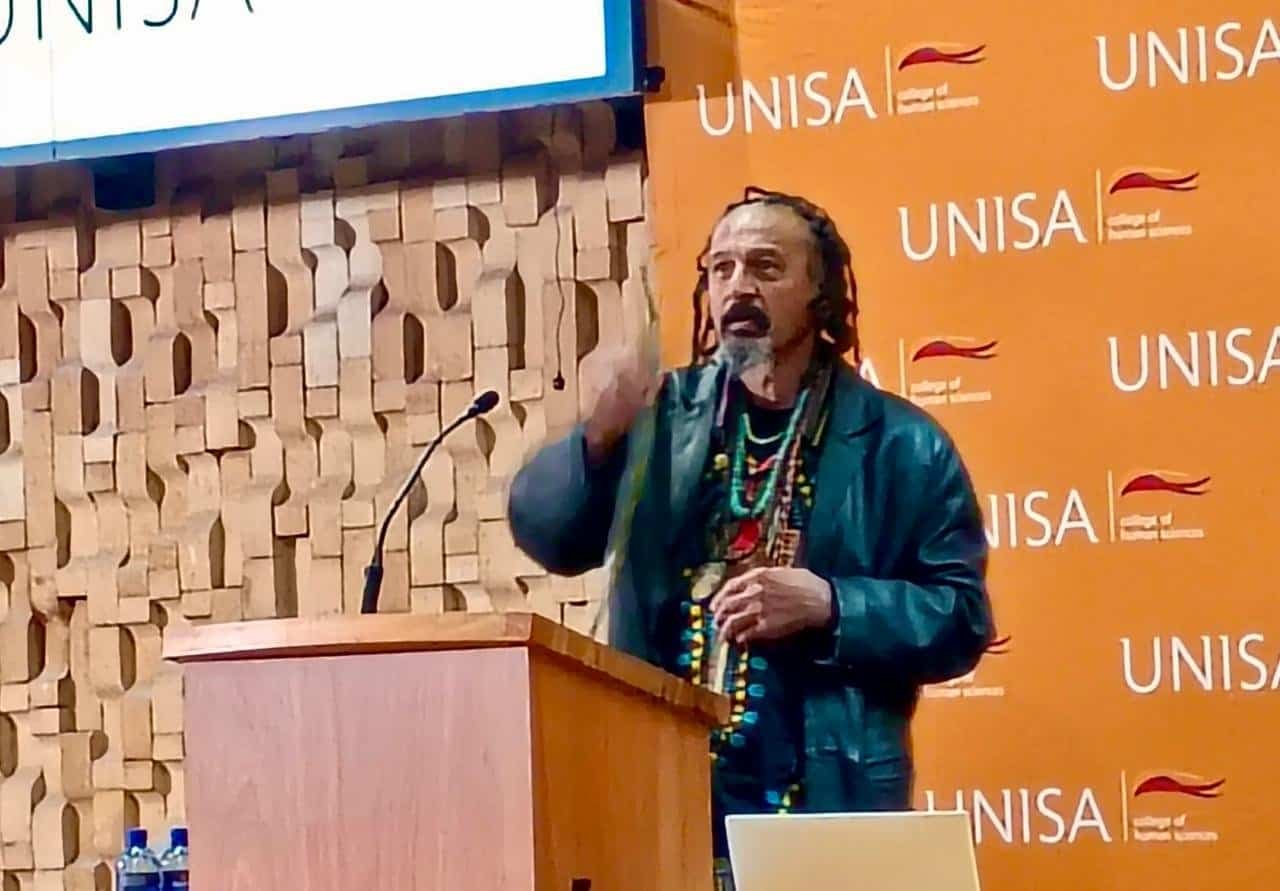
Julian Kunnie is a professor, activist, researcher, author and advocate for Earth Mother and Indigenous peoples. His books include The Earth Mother and the Assault of Capitalism (2025), The Cost of Globalisation (2015), and Is Apartheid Really Dead? (2000). He works with the Black Consciousness Movement and AZAPO, Black Alliance for Peace, Indigenous Peoples’ Movement, Abahlali baseMjondolo and the Palestine solidarity movement.