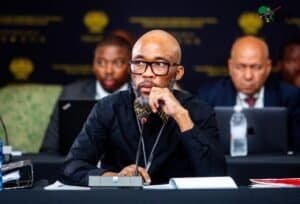
Suspended Minister of Police Senzo Mchunu appeared before Parliament’s Ad Hoc Committee on Thursday morning, delivering long-awaited testimony in the inquiry probing allegations of political interference and corruption within the South African Police Service (SAPS).
The committee was established to investigate claims made by KwaZulu-Natal Police Commissioner Lieutenant General Nhlanhla Mkhwanazi, who accused Mchunu and other senior officials of meddling in high-profile investigations, including the operations of the controversial Political Killings Task Team (PKTT).
Mchunu, who was placed on special leave in July amid mounting pressure, used his appearance to refute allegations that he acted improperly or attempted to shield political figures implicated in politically motivated murders.
“I have come here to tell the truth under oath,” Mchunu said in his opening remarks. “The accusations made against me are baseless and unfounded. I have no reason or desire to interfere in any lawful investigations.”
During his testimony, Mchunu drew a distinction between what he described as legitimate police “units” and ad hoc “task teams,” asserting that the PKTT had never been part of the official SAPS structure.
“The Political Killings Task Team was never part of the SAPS organogram,” Mchunu said. “There is a clear distinction between a permanent unit and a task team. The PKTT, as constituted, operated outside formal structures, effectively without legal standing.”
This claim adds a new layer to the ongoing dispute about the task team’s legitimacy. The PKTT was established in the wake of a surge in political assassinations in KwaZulu-Natal, with dozens of councillors and political figures killed over the past decade.
However, Mchunu is accused of ordering the disbandment of the team in December last year, a move critics say hampered investigations and emboldened criminal networks. Mchunu maintains that his decision was based on administrative and legal considerations, not political motives.
“I was not targeting anyone,” he told the committee. “I acted in accordance with the law and the advice I received from relevant structures within the department.”
Knowledge About the Task Team Before Appointment
When questioned by evidence leader Adv Norman Arendse SC about whether he knew of the PKTT prior to becoming Police Minister in June 2024, Mchunu admitted he did, but only through routine cabinet discussions during his tenure as KwaZulu-Natal Premier and later as a national minister.
“Well, I did in a way,” he said. “I would have served in Cabinet in 2019, and there would be reports in Cabinet from relevant ministers and other related discussions. You listen to colleagues reporting on their departments, and you become aware of what’s happening even in portfolios that you don’t personally oversee.”
He added that upon assuming office, he took time to familiarise himself with departmental structures and policies. “After my appointment, I made it my duty to interact with various divisions and to understand standard operating procedures and documents,” he said.
Asked whether he had prior dealings with Commissioner Mkhwanazi during his time as KZN Premier, Mchunu responded: “No, I did not know him personally. Perhaps other people did, but not me.”
Claims of Political Collusion
The testimony comes months after Mkhwanazi’s explosive allegations that Mchunu and senior SAPS officials colluded with criminal syndicates and political figures to manipulate investigations. In July, the commissioner publicly accused Mchunu and suspended Deputy National Commissioner for Crime Detection, Shadrack Sibiya of having ties to alleged underworld figures Brown Mogotsi and Vusimizi “Cat” Matlala.
Mchunu dismissed these claims outright. “There is no evidence, none whatsoever, linking me to any criminal element,” he said. “I have served this country with integrity both as a Premier and as a Minister. These accusations are politically motivated.”
Committee member Hon. David Skosana described Mchunu as a “high-profile witness,” saying his appearance could help clarify “important issues waiting to be resolved.”
“Our people deserve answers and accountability for the misuse of public funds,” Skosana told the committee. “This inquiry is not about politics — it’s about the integrity of our institutions.”
Social Media Divided
As Mchunu testified, social media platform X (formerly Twitter) lit up with sharp public reactions. Many South Africans voiced scepticism over the minister’s explanations.
“The proof provided by General Mkhwanazi is enough. Senzo Mchunu must be arrested!” one user wrote. Another commented, “Funny enough, all these criminals suddenly plead innocent.”
Others questioned Mchunu’s assertion that the PKTT was illegal, arguing that such reasoning should also implicate higher offices.
“Mchunu should not peddle nonsense,” one user posted. “If the PKTT was illegal, then President Ramaphosa should take the fall for endorsing an illegal structure since 2022.”
Another wrote: “So, the SAPS CFO and legal services approved an illegal task team? The president was not aware? What level of nonsense is this?”
Committee Awaits Next Steps
The Ad Hoc Committee is expected to continue its hearings, with senior SAPS officials and legal advisers from the Ministry of Police scheduled to appear. The inquiry aims to conclude before the end of October, after which a report will be tabled in Parliament.
Analysts say Mchunu’s testimony could determine his political future and shape President Cyril Ramaphosa’s next steps as he faces growing calls to act decisively against corruption within his Cabinet.
One analyst said the testimony underscores the ANC government’s internal fractures. “This case reflects deeper instability within the state security apparatus,” the analyst noted. “Whether Mchunu survives politically will depend on whether the committee finds him culpable or merely a scapegoat in a broader institutional crisis.”
For now, Mchunu insists he has nothing to hide. “I remain confident that the truth will prevail,” he said as proceedings adjourned. “My conscience is clear, and my record speaks for itself.”