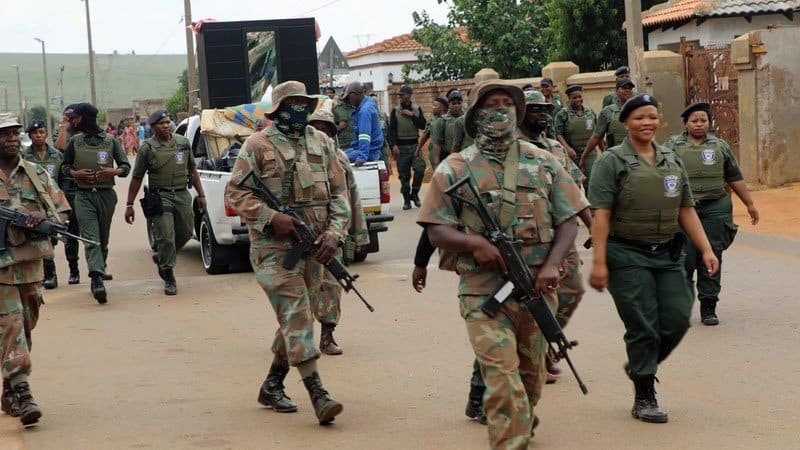
I am writing this op-ed not as a political scientist but as a decolonial scholar, rooted in organic intellectualism. I was born in Soweto and now reside in a neighbourhood where the state remains invisible, arriving silently in the form of a rates bill or a traffic fine, never as a boot through the door. This duality shapes how I interpret the State of the Nation Address and observe 550 soldiers being deployed to our townships for a year-long operation. This is not governance; it is a confession.
Two Worlds, One Country
There is a concept in decolonial thought that distinguishes between two categories of human existence: the humanitas, those whose rights are presumed, whose dignity is safeguarded, whose doors cannot be breached without consequences, and the anthropos, those who exist at the margins, whose bodies are managed rather than governed, and whose streets become battlegrounds when the state runs out of ideas. South Africa has never fully resolved this division. It merely redecorated it.
In the suburbs, the front door is solid and opaque, acting as a barrier of dignity that the state is expected to respect. In Riverlea, Westbury, and Eldorado Park, however, that same door is translucent. It shatters at the will of men in camouflage during “door-to-door” searches that would be deemed unconstitutional the moment they crossed into a gated estate. This is not merely a metaphor. It reflects the daily lived reality of townships that have been told, thirty years into democracy, that the answer to their suffering is a soldier. The spirit of Collins Khosa, murdered in his own Alexandra yard by soldiers during the 2020 lockdown, should haunt every official who celebrates this deployment as progress.
The FBI Costume
The government has described this militarisation as South Africa’s “FBI moment.” The phrase is important, not for what it explicitly says, but for what it reveals. It is a form of epistemic mimicry, disguising a colonial impulse with borrowed American imagery, in the hope that the image of federal law enforcement will hide the brutality of deploying war machinery against civilians. A soldier is trained to neutralise an enemy. When the township becomes the battlefield, every inhabitant becomes, at least in essence, a target. Section 201 of our Constitution assigns the military the role of national defence. But which nation is truly being protected here, and from whom?
The Shadow State We Created
The state points to gangs. It points to drugs. It points to the bodies of young men whose futures were lost before they even began. And it is not wrong that these things exist and cause destruction. But it must be asked: who created the conditions in which the gang became the only visible authority and the drug trade the only accessible economy? When the formal economy is a closed door, the informal one opens. When the state abandons a community for three decades, offering no investment, no land, no credible opportunity, it does not leave a vacuum. It leaves a shadow state. And now it wants to send infantry to fight the government it created through neglect. Deploying a battalion of soldiers without a battalion of social workers, developers, and urban planners is not a solution. It is a performance. It tells the township: we find it easier to manage your despair than to end it.
Who Pays, and Who Profits
The contradiction at the core of this deployment is financial. In parliamentary debates, the state repeatedly cites fiscal constraints when faced with demands for land redistribution, adequate housing, or effective public health. Yet, when the political repercussions of township unrest become too apparent to ignore, resources are suddenly available. Security infrastructure is expanded. Surveillance systems are purchased. Private contractors are brought in.
The township shifts from being a community to a laboratory, a space monitored and contained rather than developed and invested in. The drone over Riverlea is not primarily there to protect its residents; it aims to safeguard everyone else from them. Meanwhile, the soldiers being deployed are themselves products of the same systemic neglect. The SANDF has long faced well-documented budgetary pressures and operational strain over successive financial years, drawing heavily from the same marginalised communities it is now tasked with policing. They are not a solution but a symbol, presented by a state acting as a crisis manager because it has forgotten how to be a government.
The Silence That Votes
Letta Mbulu’s words stay with me: Not yet Uhuru. Her song was never just a lament. It was a diagnosis, a warning that liberation is not a flag-raising event, but the complete, structural absence of the state’s boot from the neck of the marginalised. The middle class remains largely silent about what is happening in these townships. That silence is not neutral. It is a vote. Safety feels real when the barrel is pointed at someone else’s door. But the one-year countdown is ticking. When it reaches day three hundred and sixty-six, if the structures of hunger, addiction, and landlessness remain untouched, the only thing that will have changed is the mileage on the Casspirs.
Conclusion
Safety is not found in rifles or drones. It appears when the translucent door becomes opaque for every South African, whether the boy from Soweto or the man in the leafy suburb, sharing the same constitutional breath and ontological security. Until then, the promise of 1994 remains unfulfilled. The state’s shift to the military is not a sign of strength but an admission that it has forgotten how to govern by consent. Shadows are growing longer. When camouflage becomes the only face the state shows to the poor, we are no longer witnessing governance but experiencing the slow twilight of democracy. It is wise to consider whose sunrise we are waiting for.

Mothoagae is a Professor in the Department of Gender and Sexuality Studies at the Unisa College of Human Sciences. He writes in his personal capacity.