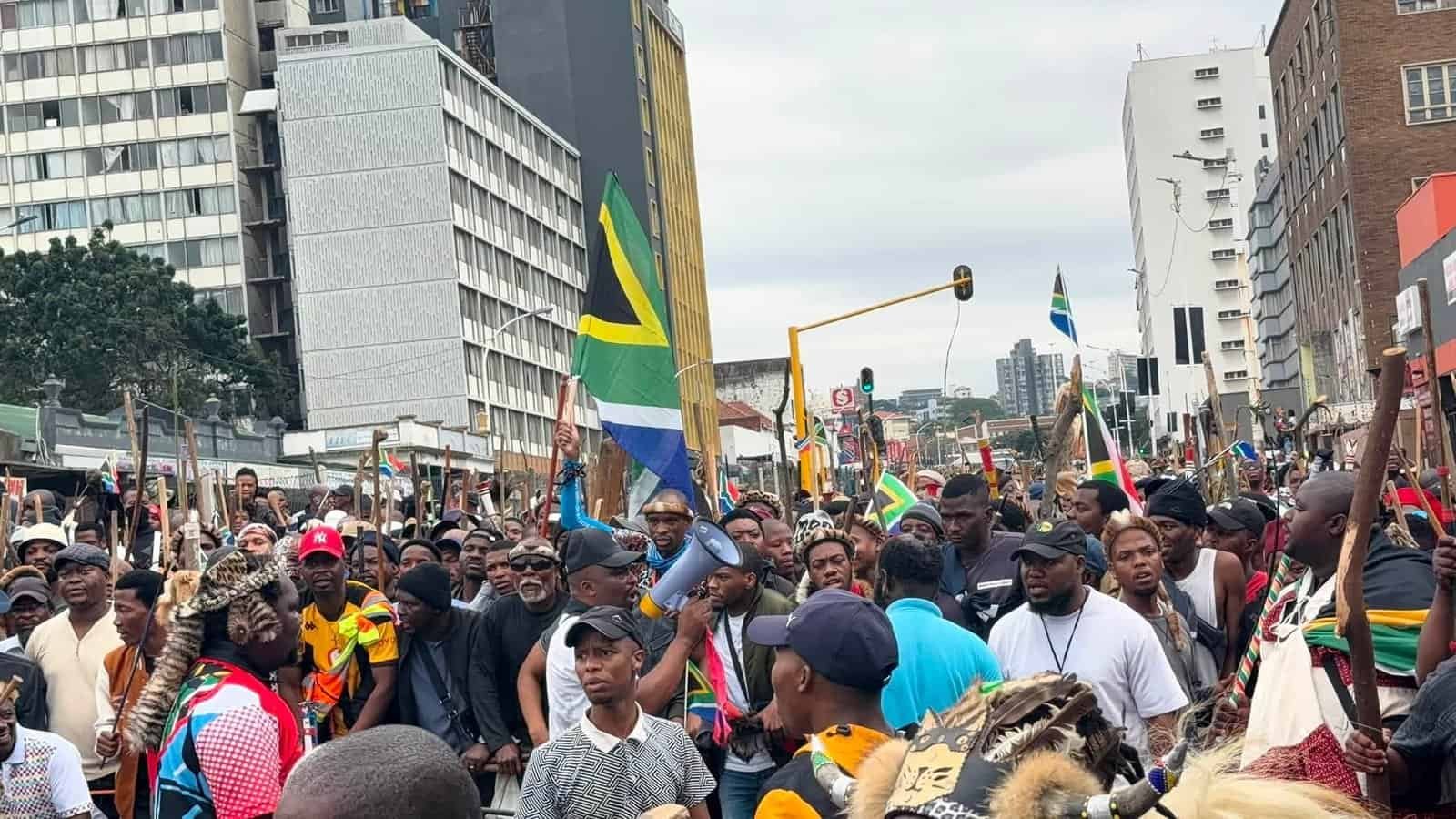
Thousands of South Africans flooded the streets across the country on Tuesday as the long-awaited 30 June anti-illegal immigration protests gained momentum, with demonstrators calling on the government to deport undocumented migrants while insisting their campaign was not directed at foreign nationals who are legally in the country.
From Johannesburg and Durban to Cape Town and several smaller towns, crowds carrying South African flags marched through city centres, chanting slogans demanding tighter border controls and stricter enforcement of immigration laws.
Despite weeks of concern over possible violence, the demonstrations remained largely peaceful throughout the day, with organisers repeatedly urging participants not to attack people or businesses.
“We are here peacefully. We are not fighting anyone. We want undocumented migrants to go back home and help rebuild their own countries,” several protesters said during the Johannesburg march.
In the Johannesburg CBD, protesters marched towards Kwa Mai Mai before making their way through Hillbrow and on to Constitution Hill.
Traditional spaza shops, many owned by foreign nationals, remained closed in several areas as traders opted not to open amid fears that the demonstrations could turn violent.
A similar picture emerged in Durban and Cape Town, where many migrant-owned businesses shut their doors for the day.
The Durban march gathered significant support as hundreds of AmaZulu regiments, known as amabutho, joined protesters marching through the Durban CBD after assembling in Berea.
One organiser addressed the crowd before the march, urging discipline.
“We are not going to be violent. We want government to hear our message. We want undocumented migrants to leave South Africa peacefully.”
In Soweto, large groups of amabutho also joined thousands of demonstrators participating in the nationwide action.
Meanwhile, Operation Dudula supporters and members of the March and March movement gathered outside the Western Cape Provincial Parliament before beginning their demonstration through Cape Town.
Authorities mounted one of the country’s biggest coordinated security operations in anticipation of the protests.
Police helicopters equipped with advanced surveillance technology continuously circled above Johannesburg, Durban and Cape Town, while sophisticated drones monitored crowds and transmitted live footage to joint operational centres.
On the ground, heavily armoured Nyala vehicles, armoured police carriers and South African National Defence Force vehicles were strategically deployed across identified hotspots, transport hubs, shopping districts and informal trading areas.
Public Order Police, metro police, mounted units, tactical response teams and intelligence officers maintained a visible presence throughout the day, while roadblocks were established at several key routes.
Earlier, Minister Mmamoloko Kubayi and Gauteng Premier Panyaza Lesufi monitored security operations from the province’s Joint Operations Centre alongside senior police commanders.
Authorities reiterated that peaceful protest is protected by the Constitution but warned that intimidation, looting, xenophobic attacks and acts of violence would be dealt with swiftly.
Police said anyone found breaking the law would be arrested.
The demonstrations come amid growing public frustration over illegal immigration, crime and unemployment.
ActionSA leader Herman Mashaba expressed support for the demonstrations, saying South Africans had reached a point of desperation.
“It is deeply painful that 32 years into our democracy South Africans feel they have to march because they have been crying for help for more than 20 years,” Mashaba said.
He argued that concerns about undocumented immigration had been ignored for years despite repeated warnings.
Away from the demonstrations, hundreds of migrants gathered at temporary processing sites in parts of Johannesburg, Durban and Cape Town, hoping to secure transport or assistance to return to their home countries.
One Zimbabwean woman said she entered South Africa legally in 2020 but had been working without a permit.
“I came with a passport but I don’t have a work permit. I worked as a domestic worker. That is why I am going home,” she said.
She added that her family was worried about her safety following the nationwide calls for undocumented migrants to leave South Africa.
“Our families are worried because we are sleeping outside in the cold. We need help to go back to Zimbabwe,” she said.
However, not all migrants were prepared to leave.
Several foreign nationals interviewed during the protests said they had no intention of returning to their countries despite the demonstrations.
“We are going nowhere,” one migrant said. “We have built our lives here, we work hard and we are not criminals.”
Another migrant said people in neighbouring countries were being misled into believing foreigners were being attacked.
“Our families are scared because of what they hear, but nobody is murdering us. Many of us are simply trying to earn an honest living,” the migrant said.
The contrasting views highlighted the deep divisions surrounding South Africa’s immigration debate, with protesters demanding stricter enforcement against undocumented migrants while many foreign nationals insisted they should not be blamed for the country’s social and economic challenges.
Africa Diaspora Forum chairperson Vusimuzi Sibanda criticised governments in the region, saying they had failed to properly manage migration.
“These governments need to be responsible and be held accountable,” Sibanda said.
As the marches continued into the afternoon, law enforcement authorities reported that demonstrations across the country had remained largely peaceful, with thousands exercising their constitutional right to protest under the watch of an extensive police and military security operation.