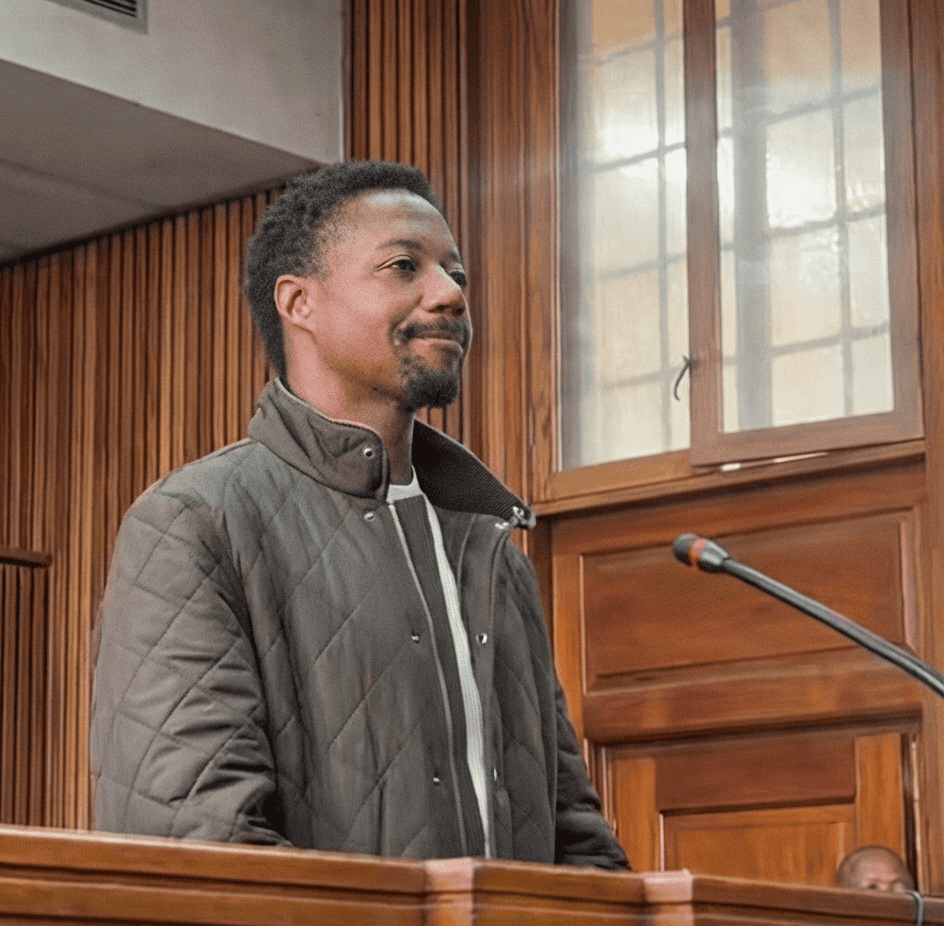
UK triple murder accused Ndodana Mkhanyisi Tshuma has pleaded guilty to charges relating to the unlawful possession of a firearm and ammunition and contravention of South Africa’s Immigration Act.
Tshuma appeared under heavy police guard at the Johannesburg Magistrate’s Court on Tuesday, where his guilty plea was entered in terms of a Section 105A agreement between the State and the defence.
The 46-year-old British citizen faces a separate extradition process in South Africa after British authorities accused him of murdering his wife and two daughters in Bedfordshire, England.
The National Prosecuting Authority confirmed on Monday that it was ready to proceed with both matters against Tshuma after receiving the outstanding documentation from UK authorities and finalising the ballistic report relating to the firearm and ammunition.
Tshuma was arrested in Kensington, Johannesburg, on 10 July following an international manhunt and a request from UK authorities to trace and apprehend him.
According to the NPA, the request followed the issuing of a warrant of arrest by the Westminster Magistrates’ Court. British authorities are seeking his extradition to face three counts of murder.
The extradition matter and the South African firearm case are being dealt with separately.
Tshuma has now pleaded guilty to all four counts relating to the unlawful possession of a firearm and ammunition. He also pleaded guilty to the immigration charge, which relates to his presence in South Africa while wanted as a fugitive in the UK.
The firearm case stems from a weapon police found in Tshuma’s possession after his arrest. Police previously said he had acquired the unlicensed firearm after arriving in South Africa.
National police spokesperson Brigadier Athlenda Mathe said in July that investigators were probing how Tshuma obtained the weapon and who supplied it to him.
Tshuma entered South Africa through OR Tambo International Airport on 5 July, according to the NPA. His immigration status subsequently changed following the UK authorities’ request for his arrest.
The NPA said that under the Immigration Act, Tshuma is regarded as both a prohibited and undesirable person and is therefore considered to be in South Africa illegally.
The charges in South Africa follow the discovery of the bodies of Tshuma’s wife, Nothabo Zandile Tshuma, 42, and their daughters, Natalie, 15, and Nala, five, at their home in Great Denham, near Bedford.
The bodies were discovered on 6 July after police forced entry into the family home following concerns that the family had not been seen for several days.
British authorities subsequently authorised three murder charges against Tshuma.
He had already left the UK by the time the bodies were discovered. Reports said he travelled from London Heathrow Airport before eventually arriving in South Africa on 5 July.
South African police arrested him five days later in Kensington, Johannesburg in an operation involving the SAPS Interpol National Central Bureau, Crime Intelligence and the Organised Crime Investigation Unit.
Tshuma has remained in custody since his arrest. He abandoned a bail application during an earlier court appearance while the extradition process continued.
The NPA said the UK had provided the documentation required to support the extradition proceedings and that the State had furnished Tshuma’s defence team with the relevant documents.
The extradition proceedings are scheduled to continue separately from the firearm and ammunition case.
Tshuma’s guilty plea in the South African matter does not amount to a plea to the three murder allegations in the UK. Those allegations remain the subject of the extradition proceedings and will have to be dealt with by the British courts if Tshuma is extradited.
The NPA said it would continue prosecuting the South African matters in accordance with the law while ensuring the proceedings are dealt with without unnecessary delays.