I write this not just as a South African, but as an African. A child of a continent whose borders were carved by outsiders, whose people have always been more connected than divided. I write with anger, with sorrow and with a deep sense of betrayal. Many who walk the streets of South Africa today carrying foreign passports did not abandon their homes lightly. They were driven out – by poverty that suffocates hope, by political instability and tribalism that crush dreams, by violence that makes survival itself a daily gamble.
They came here not to take, but to live. To breathe. To rebuild. And yet, what have they found? Flames. Flames consuming their shops. Flames devouring their livelihoods. Flames licking at the fragile dignity they carried across borders. And behind those flames, something even more disturbing: the slow burning away of Ubuntu.
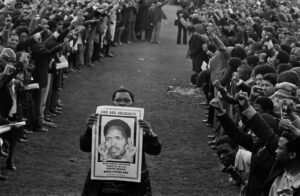
We, as South Africans, have always claimed Ubuntu as our moral compass – “I am because we are.” It is a philosophy that the world came to admire through voices like Desmond Tutu, who taught us that our humanity is bound together, that we cannot be whole while others are broken.
Ubuntu is not meant to be convenient. It is not meant to apply only when it is easy or when it benefits us. It is meant to define us, especially in moments like these. But today, I must ask: where is that Ubuntu? Because what we are witnessing is not just violence – it is a rejection of who we are supposed to be. The looting of foreign-owned shops, the burning of properties, the attacks on bodies and identities – these are not just criminal acts. They are a moral collapse. They are unsavoury. They are un-African. And they are certainly un-South African.
And let us confront the lies we tell ourselves to justify this cruelty. Not all Nigerians are drug dealers. Many are academics, scholars, and businesspeople contributing meaningfully to society. Not all Zimbabweans are criminals or “nuisances.” Many are responsible, hardworking individuals trying to support their families with dignity. Not every foreigner is stealing jobs – some are creating them. They open businesses, employ South Africans and stimulate local economies.
Some are not strangers at all, but part of our families – mothers raising South African children, husbands and wives building homes with South African partners, woven into the very fabric of our communities. To reduce all these lives to stereotypes is not only false – it is dangerous. It dehumanises. It justifies violence. It turns neighbours into targets. At the same time, let us speak honestly and without fear: crime is real, and it must be confronted. Those – whether South African or foreign – who engage in crime must be held accountable. Justice cannot be selective. Lawlessness cannot be excused. But justice must never become an excuse for collective punishment. We cannot condemn entire nationalities for the actions of a few. That is not justice – that is prejudice. As a Pan-Africanist, this pain cuts deeper. Africa is not a collection of isolated nations; it is a family. The lines that separate Zimbabwe from South Africa, Nigeria from Mozambique, Somalia from the Congo – these are artificial divisions imposed on us. Before they existed, we were one people. We shared land, culture, struggle and destiny.
Xenophobia, then, is not just hatred of the “other.” It is self-hatred. It is Africa turning against itself. Let us not forget: during the dark days of apartheid, South Africans were not alone. Our brothers and sisters across the continent opened their doors. They sheltered our exiles. They trained our freedom fighters. They fed our hope when our own land tried to starve it. They believed in our freedom when we could barely see it ourselves.
And now? Now we repay that solidarity with suspicion, with violence, with fire? There is a deeper battle unfolding beneath the flames and the chaos – a war that cannot be measured in numbers or statistics. It is a spiritual war. A war for the soul of a nation. A war between who we are and who we are becoming. A war between Ubuntu and hatred. Between memory and amnesia. Between the Africa that once stood together and the Africa now turning against itself. Because before a shop is burned, something inside us has already been set alight. Before a foreigner is attacked, their humanity has already been denied.
The violence we see is only the surface – the visible outcome of an invisible collapse. Yes, the frustrations are real. Poverty is real. Unemployment is crushing. Inequality is a daily wound. But let us be honest – foreign nationals did not create these problems. Burning a migrant’s shop will not create jobs. Attacking a fellow African will not fix broken systems. It only deepens the crisis, distracting us from the real sources of our suffering. We are angry – but we are angry at the wrong people. Ubuntu demands more of us. It demands that we see the foreigner not as a threat, but as a reflection of ourselves. It demands that we reject lazy stereotypes and confront uncomfortable truths. It demands that we remember who we are. And there is something else we must remember – something older than borders, older than politics, older even than the nations we now claim. What goes around comes around. History has a memory.
Humanity has a way of returning what it is given. The same continent that once carried South Africans in exile, that protected them, that fed them, that stood with them – will remember how it is treated now. The same pain we inflict today has a way of finding its way back tomorrow, in forms we may not expect. If we choose violence, we should not be surprised when violence finds us again. If we choose hatred, we should not be shocked when it grows and turns inward. But if we choose Ubuntu – if we choose humanity, dignity, and solidarity – then perhaps that, too, will return to us.
This is a moment of reckoning. Will we allow fear to redefine us? Will we let desperation turn us into the very thing we once resisted? Or will we rise – as Africans, as South Africans, as human beings – and reclaim the values that once made us a beacon of hope? Because if Ubuntu dies, something far greater than a philosophy is lost. We lose our identity. We lose our moral centre. We lose each other. And if we lose each other, then what, truly, do we have left?

Zenoyise John is a communications practitioner and former journalist. She writes in her personal capacity