One of Africa’s top museums has been officially opened in Egypt, signalling the intention to tell and document the continent’s history with renewed vigour.
The University of South Africa (UNISA) hosted a live screening of the Grand Egyptian Museum (GEM) opening ceremony from Cairo on 1 November.
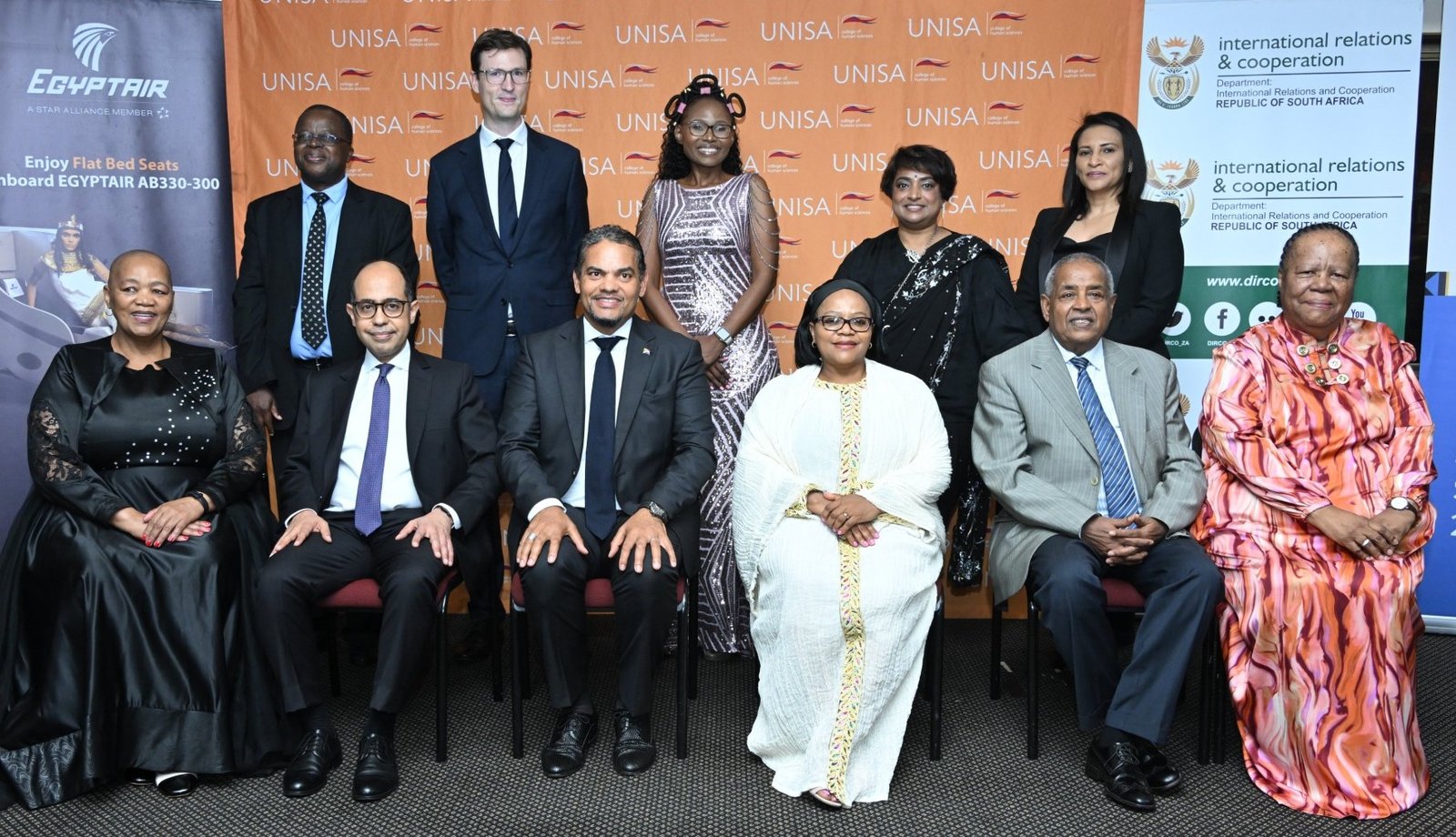
Held at the UNISA main campus in Pretoria, the event was graced by high-profile dignitaries, including His Excellency Ahmad Sharief, the Ambassador of Egypt to South Africa.
In her opening address, Dr Matsheliso Molapo, Acting Vice-Principal: Strategy, Risk and Advisory Services, highlighted the joint commitment between South Africa and Egypt to celebrate a shared story of ancient civilisation and enduring innovation.
Dr Molapo described the GEM as a “bridge of knowledge” and a living chronicle of humanity’s intertwined heritage. She emphasised the importance of cross-border scholarly engagement, joint research, and the circulation of ideas, drawing inspiration from Dr Naledi Pandor’s call for active academic collaboration.
She concluded her address with the resonant Sotho phrase, “Moeng e tla ka gae re je ka wena,” extending a heartfelt welcome and symbolising the shared feast of knowledge that the collaboration represents.
Ambassador Ahmad Sharief acknowledged UNISA’s partnership and detailed the GEM’s significance. “The GEM is the world’s largest museum of its kind,” he stated. “Beyond being a suite of galleries, it is a scientific complex for research, conservation and education. It houses 100 000 artefacts, including the Tutankhamun Collection, which is now complete for the first time.”
He extended a warm invitation to all South Africans, especially students and scholars, to visit Egypt and explore the origins of art, science, and culture.
Delivering the keynote address, Alvin Botes, Deputy Minister of International Relations and Cooperation, rooted the event in Africa’s legacy. He celebrated the continent as the cradle of civilisation and highlighted the GEM’s unique purpose as a centre for scientific research and knowledge exchange.
“Africa speaks in one voice, the voice of memory, the voice of pride and of an awakening of Africa,” said Botes. He further indicated that the inauguration of the GEM is “a declaration that Africa will no longer whisper its history to others, but will say it properly in its own mother tongue”.

The event’s highlight was the live stream of the official GEM opening in Cairo, attended by Egyptian President Abdel Fattah El-Sisi and global luminaries from the seven continents. The ceremony featured historical narratives, live performances, and fireworks that brought Egyptian heritage to life for the international audience. It drew powerful analogies between the figures of Isis and Osiris, the grandeur of the ancient pyramids, and the foundational ideals upon which the GEM is built. As a cradle of cultures, the event’s theme proclaimed, “Our peace today is the civilisation of tomorrow”, encapsulating the enduring mission of the museum.
In his address, President El-Sisi presented the GEM as a new chapter in the service of humanity. “This majestic edifice is not merely a repository for precious antiquities; it is, rather, a living testament to the genius of the Egyptian people,” he said. “The Grand Egyptian Museum stands as a living embodiment of a people who have inhabited the land of the Nile since the very dawn of history.”
The ceremony concluded at UNISA with a vote of thanks from Professor Thomas Pooley, the programme director, who acknowledged Unisa Principal and Vice-Chancellor, Professor Puleng LenkaBula and team for advancing this collective dream of collaboration on African soil.