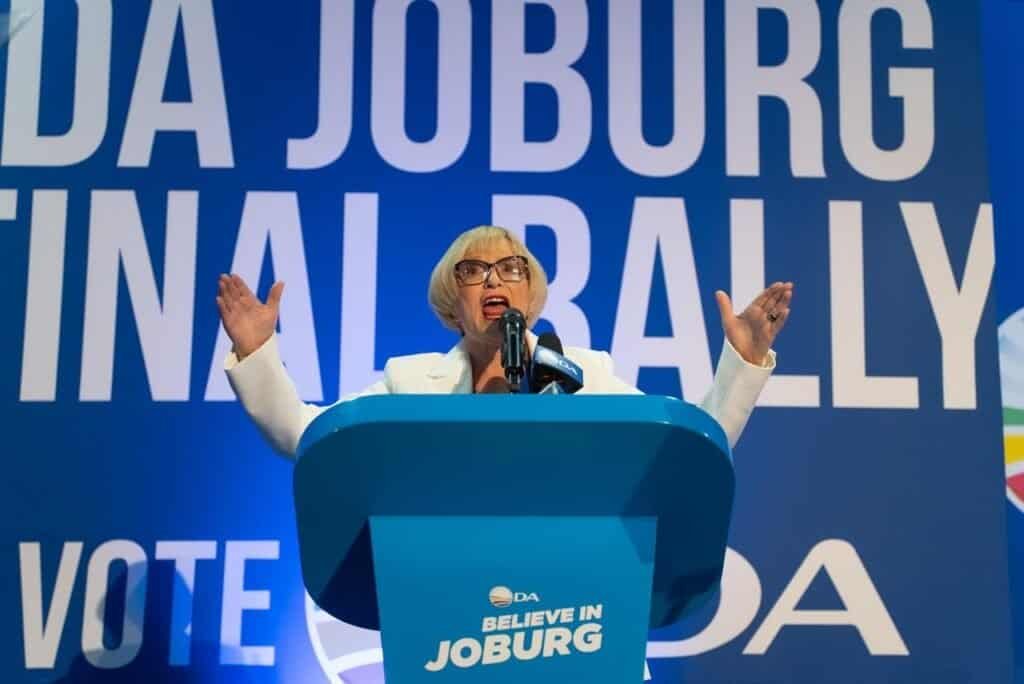
The Democratic Alliance (DA) must turn its strong local election showing into a stable Johannesburg administration, with mayoral candidate Helen Zille saying the city’s finances must be repaired before residents can expect service improvements.
The DA secured the most votes in five of the country’s eight metropolitan municipalities, but won an outright majority only in Cape Town. In Johannesburg, the party emerged in first place without a majority, leaving it dependent on negotiations with other parties to form a government.
Speaking to Newzroom Afrika on Wednesday, Zille said the process should focus on residents, adding that she had relocated to Johannesburg because its success was critical to South Africa’s progress.
Zille is not part of the DA’s negotiating team, a decision she said was guided by the party’s conflict-of-interest principles. Those who could personally benefit from the outcome should recuse themselves.
The DA’s federal executive sets the negotiating principles, while provincial teams handle talks. Affected individuals may be consulted but recuse themselves from decisions involving them.
The bigger test, she said, would be whether a new administration could stabilise Johannesburg’s finances and rebuild its failing infrastructure.
“Before people see any improvements, we first have to fix the finances, because you can’t fix anything and make things better, improve anything without money,” Zille said.
She pointed to a broken billing system, entrenched corruption and mounting municipal debt, saying National Treasury had drawn a line and the city could no longer continue as before.
The first formal step would be an adjustment budget, which municipalities must prepare by the end of January. Zille said this would allow the city to reallocate up to 10% of its revenue to other priorities, but warned that “10% of zero is zero”.
She said water infrastructure should be a top priority and that Joburg Water needed R3 billion a year, as requested by the entity, to repair its network.
City Power also needed to ensure that money collected from electricity customers was directed towards maintaining and upgrading infrastructure after debt obligations to Eskom had been met.
She warned that initial work behind the scenes might not immediately produce visible changes.
On unemployment and inequality, Zille argued that the answer was attracting investment and creating jobs, not focusing on middle-class residents moving between cities.
Investors could choose where to put their money, and Johannesburg had to show it was competently governed to attract businesses and create local jobs there.
She claimed that Cape Town had created more jobs over the past decade than Johannesburg, Soweto, Ekurhuleni, eThekwini, Nelson Mandela Bay, Buffalo City and Mangaung combined.
When challenged about a reported 67% increase in informal settlements in Cape Town over the past decade, Zille acknowledged continued urban migration but argued that settlements differed in service levels, contrasting areas with water, electricity, sanitation, refuse removal and road access with those lacking basic services.
Zille rejected the idea that the state could build a formal house for every person, saying South Africa’s tax base could not sustain such a commitment alongside other public responsibilities. Government, she argued, should provide access to land and bulk services, while households should increasingly take responsibility for building their homes as employment opportunities improve.
She also said the DA opposed land invasions, arguing that some informal settlements were established on privately owned land and could create pressure for the state to buy that property.
As an alternative, Zille promoted public-private partnerships combining state land and subsidies with private-sector construction. She cited a Cape Town development where discounted public land and infrastructure subsidies helped enable thousands of affordable housing units.
She said Johannesburg had significant land that could be used for similar mixed-use developments, combining affordable homes with shops and other businesses.
The coalition talks will determine whether the DA can put those proposals into practice in Johannesburg. Zille’s message was that residents should not expect quick fixes: restoring the city’s finances, she argued, is the necessary first step towards repairing services, attracting investment and creating jobs.