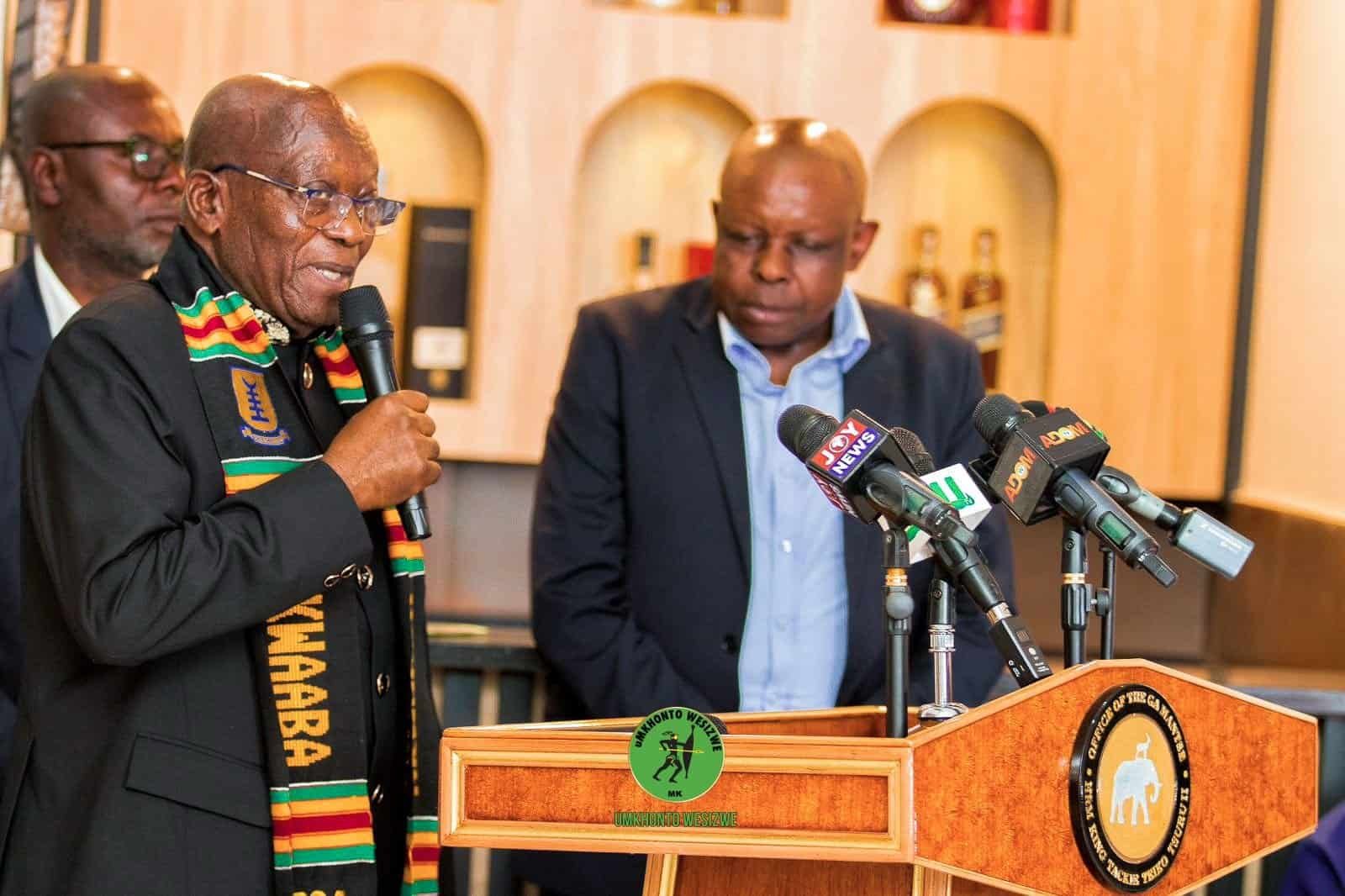
Former South African president and uMkhonto weSizwe (MK) Party leader Jacob Zuma has called for Africa to complete its liberation struggle by freeing itself from what he termed “economic slavery” tied to Western-controlled financial systems.
Delivering a fiery lecture at the University of Professional Studies, Accra (UPSA) – one of Ghana’s leading public universities known for training future leaders in business, law, and governance – Zuma said Africa must urgently embrace de-dollarization and strengthen its ties to the BRICS bloc as a pathway to economic sovereignty.
The lecture, titled “The Geopolitics and Geoeconomics of De-dollarization: BRICS Currency Strategy, Lessons for Africa’s Common Currency and Beyond”, was read on Zuma’s behalf by former Western Cape Judge President John Hlophe. Zuma, who was in Ghana at the invitation of UPSA and the Ga Mantse Traditional Council, framed his visit as a contribution to Africa’s broader conversation about economic independence and Pan-African unity.
A Call to Finish the Liberation Struggle
Zuma reminded the audience that while Africa won political independence decades ago, the continent remained shackled by financial dependency. Citing Ghana’s founding president, Dr Kwame Nkrumah, Zuma declared:
“Political independence without economic independence is slavery in disguise.”
He argued that Western powers still dictate Africa’s economic direction through their control of currencies, loans, and trade systems. “We are free in flag and anthem,” Zuma said, “but our currencies are hostage.”
He linked today’s struggles to Africa’s painful history, noting that the continent transitioned from slavery to colonialism and then to what he called “financial colonialism” – an exploitative system of debt, resource extraction, and economic dependency.
De-dollarization as a Liberation Strategy
Central to Zuma’s speech was the push for de-dollarization. He warned that the U.S. dollar is “not money, it is a chain,” arguing that reliance on the currency leaves African states vulnerable to sanctions, exchange-rate manipulation, and external control.
Zuma praised the BRICS alliance – comprising Brazil, Russia, India, China, and South Africa – as a rebellion against this system. He credited BRICS with creating alternatives like the New Development Bank (NDB), which he said funds infrastructure and trade without the “humiliation” of structural adjustment programmes imposed by the IMF and World Bank.
“Africa does not need aid,” Zuma declared. “Africa needs allies.”
He further warned that Africa’s wealth – from the cobalt of the Democratic Republic of Congo to Ghana’s gold and West Africa’s cocoa – continues to enrich foreign powers while leaving local communities impoverished.
Lessons for Africa’s Common Currency
The former president reiterated his long-standing call for Africa to move toward a single common currency. Drawing inspiration from the late Libyan leader Muammar Gaddafi’s vision of a gold-backed African dinar, Zuma said such a move would transform Africa from “54 vulnerable states begging for trade crumbs” into a negotiating bloc of 1.4 billion people.
He praised recent political shifts in the Sahel, describing military takeovers in Mali, Burkina Faso, and Niger not as coups but as “acts of liberation” against Western domination.
“One Africa. One Currency. One Destiny,” Zuma said, earning loud applause from students and academics at UPSA.
Commending Ghana and Strengthening Ties
Zuma’s visit also highlighted strengthening diplomatic ties between South Africa and Ghana. He applauded Accra for its “bold leadership” in backing Morocco’s autonomy plan over Western Sahara, framing the decision as a refusal to let Africa be divided for foreign convenience.
He also welcomed the Morocco Atlantic Initiative, which seeks to connect landlocked Sahel states to the Atlantic Ocean through ports, railways, and energy projects.
According to Zuma, such projects should serve as economic and currency bridges into BRICS.
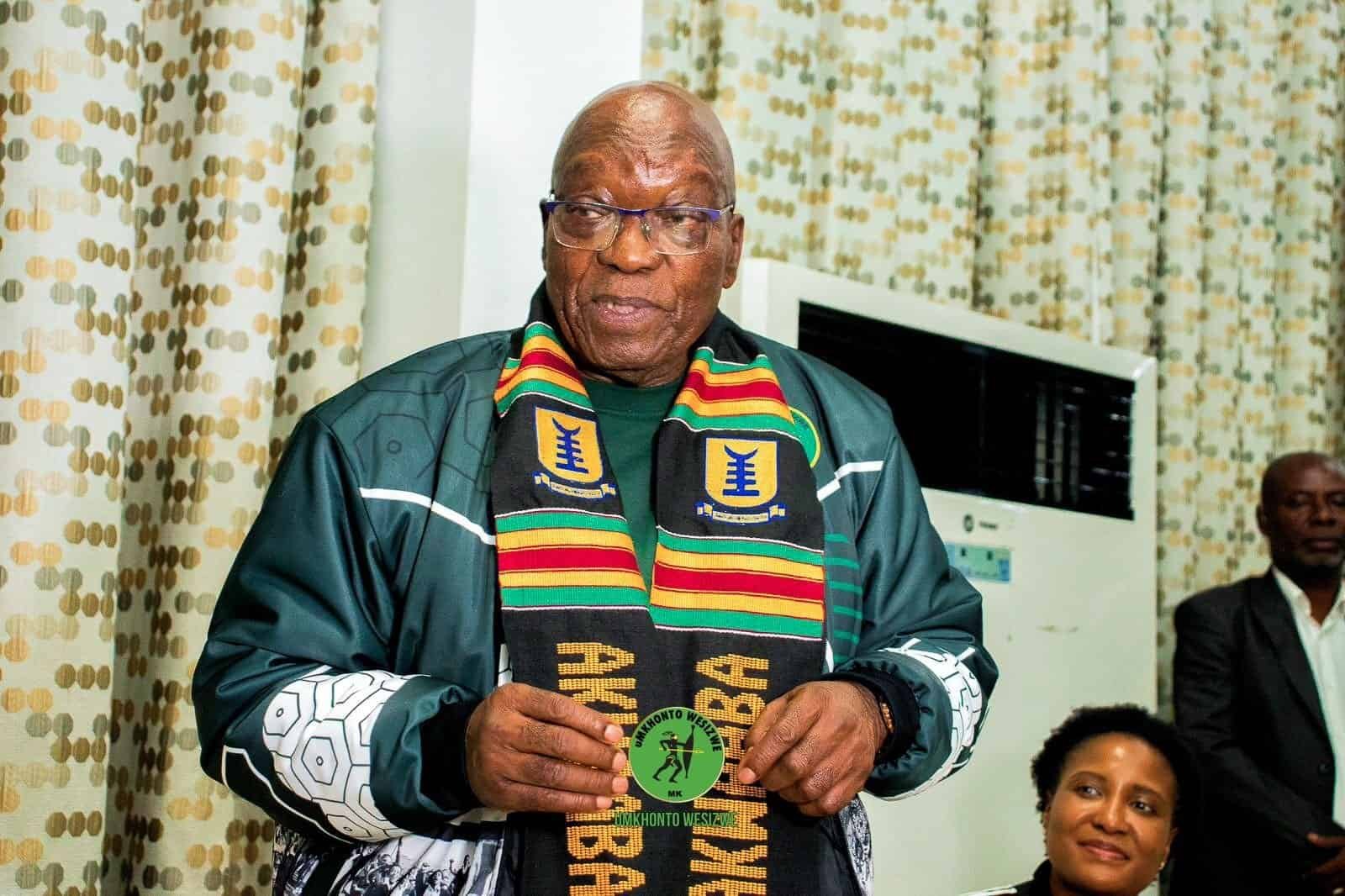
During his stay, Zuma was also hosted by His Royal Majesty King Tackie Teiko Tsuru II of the Ga Mantse State, who reminded African leaders that dignity and mineral wealth go hand in hand.
MK Party’s Vision
Zuma used the lecture to link his international message to domestic politics. He outlined the MK Party’s “People’s Mandate,” an eight-pillar manifesto that includes reclaiming land, mineral resources, sovereignty, and economic power for South Africans.
He dismissed South Africa’s Government of National Unity(GNU) as a “compromise” with neo-colonial forces, positioning the MK Party as the true custodian of the liberation struggle.
A Call to Africa’s Youth
Closing his address, Zuma directed his message to young Africans, urging them to lead the fight for economic independence through innovation, scholarship, and activism.
“De-dollarization is not simply an economic debate,” Zuma said. “It is the new liberation struggle.”
He challenged African universities like UPSA to become “workshops of sovereignty,” producing economists, engineers, and leaders capable of designing independent systems for the continent.
“We are not beggars at the world’s table,” Zuma said. “We are builders of a new table. The power of Africa is in its unity – it is now or never.”
Background: Why UPSA?
Founded in 1965, the University of Professional Studies, Accra has grown into a hub for leadership and governance studies in West Africa. Its Annual Leadership Lecture series is designed to expose students to leading voices shaping African and global policy. Zuma’s lecture forms part of UPSA’s broader commitment to fostering debate about Africa’s place in a shifting global economy.
For many, his words resonated with Ghana’s own history as the first sub-Saharan African country to gain independence. For others, they reignited debates about whether de-dollarization and BRICS can truly deliver the economic freedom Africa has long sought.