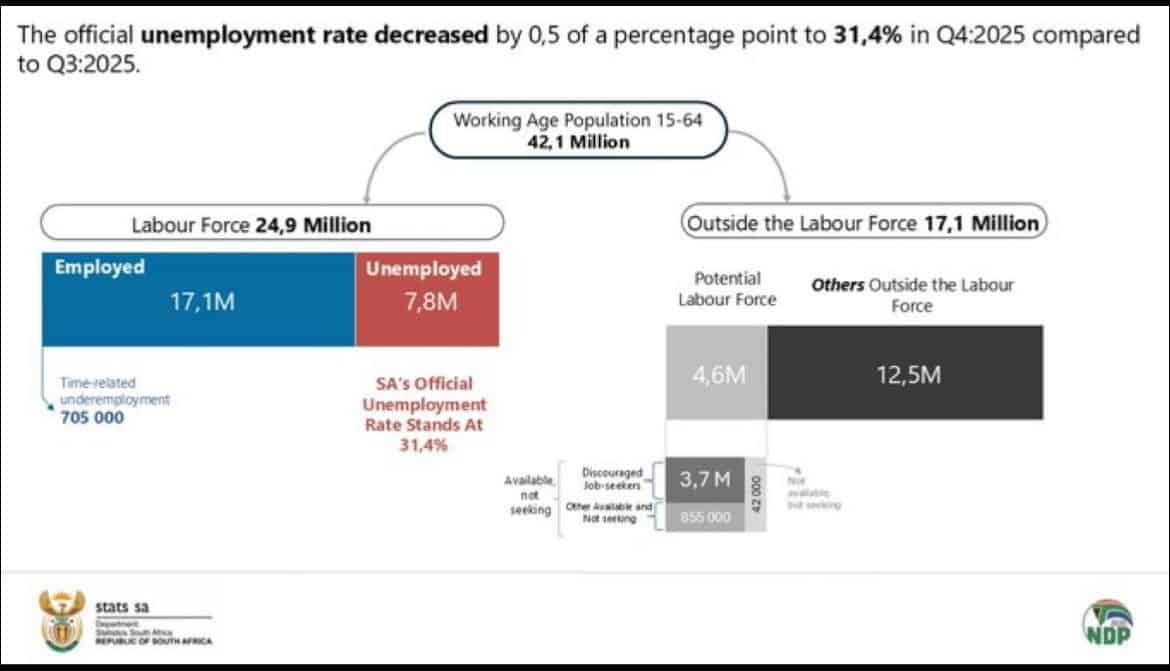
South Africa’s official unemployment rate declined to 31.4% in the fourth quarter of 2025, reflecting a modest improvement in the country’s labour market, according to the latest Quarterly Labour Force Survey (QLFS) released on Tuesday.
The figures, published by Statistics South Africa and presented by Statistician-General Risenga Maluleke, show that there were 172,000 fewer unemployed people in Q4:2025 compared to Q3:2025.
The unemployment rate decreased by 0.5 of a percentage point from 31.9% in the third quarter to 31.4% in the fourth quarter of 2025.
According to the report, the number of employed persons increased by 44,000 to 17.1 million during the period under review. At the same time, the number of unemployed persons declined by 172,000 to 7.8 million. This resulted in an overall decrease of 128,000, or 0.5%, in the labour force between the two quarters.
Despite the improvement in the official unemployment rate (LU1), other indicators paint a more complex picture of the labour market.
Discouraged work-seekers – individuals who want to work but have stopped looking for jobs – increased sharply by 233,000 to 3.7 million. Other available job-seekers decreased by 110,000 to 855,000, while unavailable job-seekers declined by 41,000 to 42,000. This led to a net increase of 82,000 in the potential labour force population, which now stands at 4.6 million.
The number of people classified as “other outside the labour force” also rose by 165,000 to 12.5 million. In total, those outside the labour force increased by 248,000 to 17.1 million in Q4:2025.
Broader measures of labour underutilisation showed slight improvements. The combined rate of unemployment and time-related underemployment (LU2) decreased by 0.6 of a percentage point to 34.3%. The combined rate of unemployment and potential labour force (LU3) declined by 0.3 of a percentage point to 42.1%.
The composite measure of labour underutilisation (LU4), which includes unemployment, time-related underemployment and the potential labour force as a proportion of the extended labour force, stood at 44.5% in the fourth quarter of 2025.
Sectoral data revealed mixed trends. Formal sector employment increased significantly by 320,000 jobs, while informal sector employment declined by 293,000.
The largest gains in industry employment were recorded in Community and Social Services (46,000), Construction (35,000), and Finance (32,000). However, notable job losses were reported in Trade (98,000), Manufacturing (61,000), and Mining (5,000).
Provincially, employment rose in the Western Cape (93,000), Mpumalanga (37,000), North West (36,000), and Northern Cape (17,000). The biggest employment declines were recorded in Gauteng (54,000), KwaZulu-Natal (41,000), and Eastern Cape (32,000).
Youth unemployment remains a major concern. Among those aged 15 to 34, the number of unemployed youth decreased by 84,000 to 4.6 million. However, employed youth also declined by 113,000 to 5.8 million. As a result, the youth unemployment rate edged up slightly by 0.1 of a percentage point to 43.8% in the fourth quarter of 2025.
While the drop in the headline unemployment rate signals some improvement, the rise in discouraged job-seekers and persistently high youth unemployment underline the structural challenges facing South Africa’s labour market.