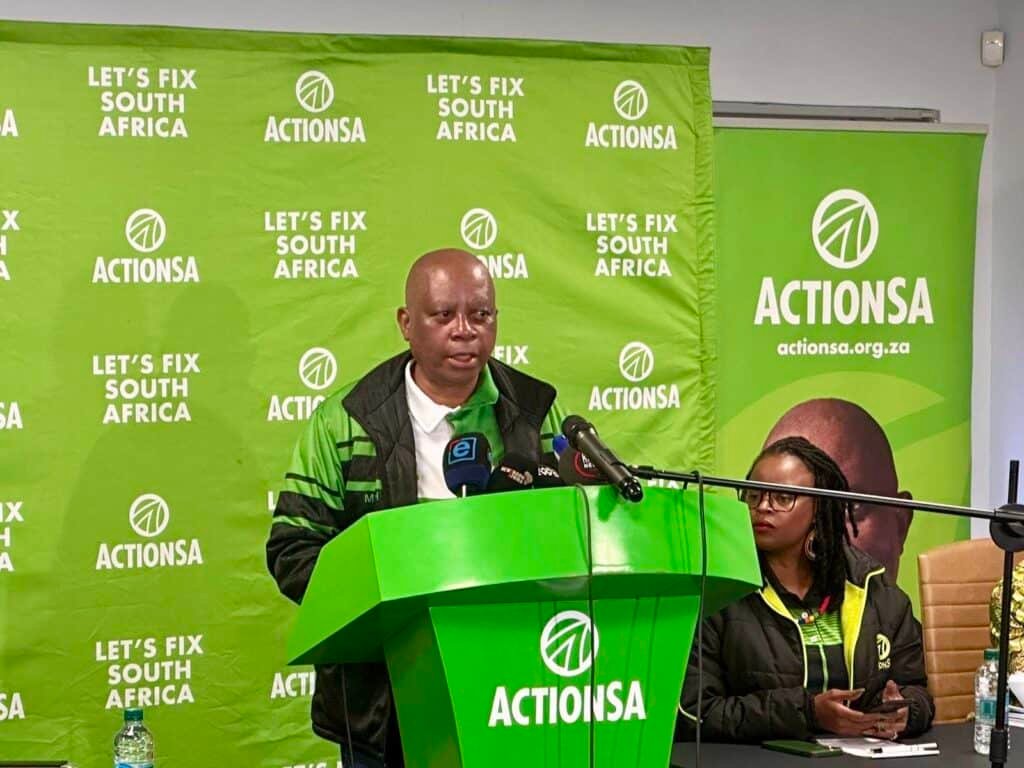
ActionSA has announced that it is preparing a legal challenge to force the unsealing of the Independent Police Investigating Directorate’s (IPID) report into the conduct of Presidential Protection Unit (PPU) members linked to the Phala Phala matter, after the document was classified as “Top Secret”.
In a statement issued on Tuesday, ActionSA said it had begun drafting legal papers to challenge IPID’s decision, accusing the watchdog of deliberately obstructing access to a report that the party believes is critical to public accountability.
“This decision follows an appeal filed by ActionSA last month, which IPID ignored in what has become a pattern of obfuscation,” the party said.
ActionSA said its attempts to access the report date back to April 2025, when it first began the process of requesting the findings of IPID’s investigation. According to the party, the request was met with repeated delays, including explanations from IPID that its email system had been offline.
The report in question deals with the conduct of members of the PPU following the burglary at President Cyril Ramaphosa’s Phala Phala farm. The Public Protector has already found that the actions of the PPU amounted to an “improper and unauthorised investigation”, rising to the level of maladministration, after members allegedly investigated a crime without opening an official police docket.
The party said its legal challenge would take a three-pronged approach. Firstly, it will challenge the constitutionality of the Minimum Information Security Standards (MISS) Cabinet policy, which governs how state documents are classified. Secondly, it will challenge the rationality of IPID’s decision to label the report “Top Secret”. Thirdly, it will ask the courts to compel IPID to hand the report over to ActionSA.
“The MISS Policy is obscene in the wide-ranging powers it gives a large number of state officials to classify a report as Top Secret,” ActionSA said. “When tested against the constitutional requirement for transparency, it will not hold muster.”
The party also criticised the policy’s wording, which allows documents to be classified if their release “can seriously damage the operational relations between institutions”.
“It is ridiculous that a wide number of state officials are free to keep government reports out of public scrutiny if a report may offend another government institution,” the statement said.
ActionSA argued that the decision to classify the IPID report as Top Secret is unlikely to withstand scrutiny by the courts, noting that such classification should be reserved for matters that could, among others, “result in the declaration of war”, “lead to the discontinuation of diplomatic relations between states”, or “disrupt the effective execution of information operational planning”.
In response to a parliamentary question submitted by ActionSA, the Police Minister revealed that the report was classified on the basis that it “can seriously damage the operational relations between institutions and/or can disrupt the effective execution of information operational planning and/or plans”.
The party dismissed this reasoning, saying the possibility that the report might offend the Presidency or the South African Police Service was not a valid justification for keeping it from the public.
“To claim that disclosing the report may disrupt operational planning is to imply an ongoing investigation that IPID will have to prove six years after the robbery,” the party said.
ActionSA described the IPID report as “the last beachhead” in efforts to ensure accountability for the Phala Phala matter. It argued that after what it called a “whitewashed” Public Protector’s report and the South African Reserve Bank clearing the President of breaching exchange control laws, IPID’s findings remain the final opportunity to hold President Ramaphosa to account.
“At the heart of this fight is the knowledge that those entrusted to protect the President were seized by the need to protect him from legal exposure more than they were seized by the need to investigate a crime,” the statement said.
The party also took aim at Parliament and the Government of National Unity (GNU), saying accountability would not come from a legislature where opposition parties were weak and governing parties dominated.
“Accountability will have to come from an unofficial opposition led by ActionSA, speaking for countless South Africans who want to live in a constitutional democracy where all South Africans are equal before the law,” ActionSA said.
The party said it would continue to update the public on the progress of the case and vowed not to rest “until the truth in this matter is known to all South Africans.”
At the time of publishing, IPID had not commented.