The planet most similar to Earth has 98 per cent similarity to our world
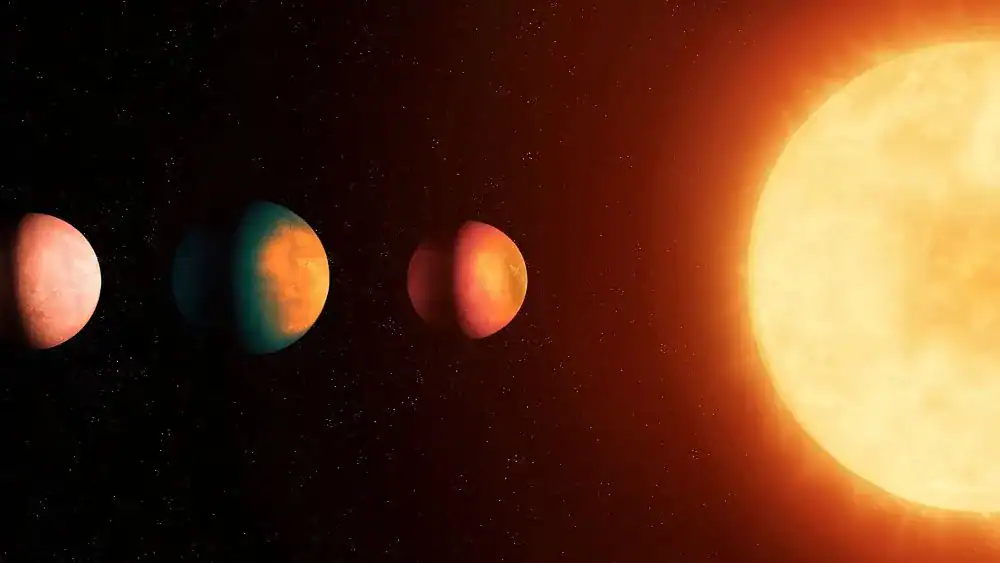
Brazilian researcher Fabio Calabria Evangelista da Silva has identified eight exoplanets outside the Solar System that may have liquid water. The scientist analysed data from more than 6,000 exoplanets, studying their radius, density and distance from the star they orbit. From this dataset, he selected planets that are similar to Earth in terms of radius and density and are also located within the habitable zone. This was reported by Agência Brasil.
“The habitable zone is an area that allows liquid water to exist because it is not too hot – closer to the star – and not too cold – farther away from the star. In other words, it is the ideal zone. We call it the Goldilocks Zone,” Silva explains.
The planet most similar to Earth – GJ 1002b, discovered in 2022 – has 98 per cent similarity to our planet. It is located 16 light years from Earth and orbits a red dwarf star. One revolution around the star takes only 10 days.
The possibility of life beyond Earth has been discussed since ancient times: even in Ancient Greece, thinkers considered the possibility of life on the Moon. The search intensified in the 1950s and 1960s but initially focused on the Solar System – the Moon and Mars. The first exoplanets, Poltergeist and Phobetor, were discovered in 1992.
Directly studying these planets is impossible due to distances measured in light years. Scientists study exoplanet atmospheres using telescopes that analyse the light of a star when a planet passes in front of it and detect changes caused by the interaction of light with the atmosphere.
Scientists search for biosignatures – substances or combinations of substances that are usually produced by living organisms on Earth. A recent study led by an international university detected methane, carbon dioxide and a possible signature of dimethyl sulphide in the atmosphere of exoplanet K2-18b. On Earth, this compound is produced only by living organisms, such as phytoplankton. However, many biosignatures can also occur through abiotic processes – as a result of geological activity or radiation.
Even organic molecules, which are called the ingredients of life, are not considered proof of extraterrestrial life: they can form through abiotic processes (a process that occurs without the involvement of living organisms) over hundreds of millions of years.
African Times published this article in partnership with International Media Network TV BRICS