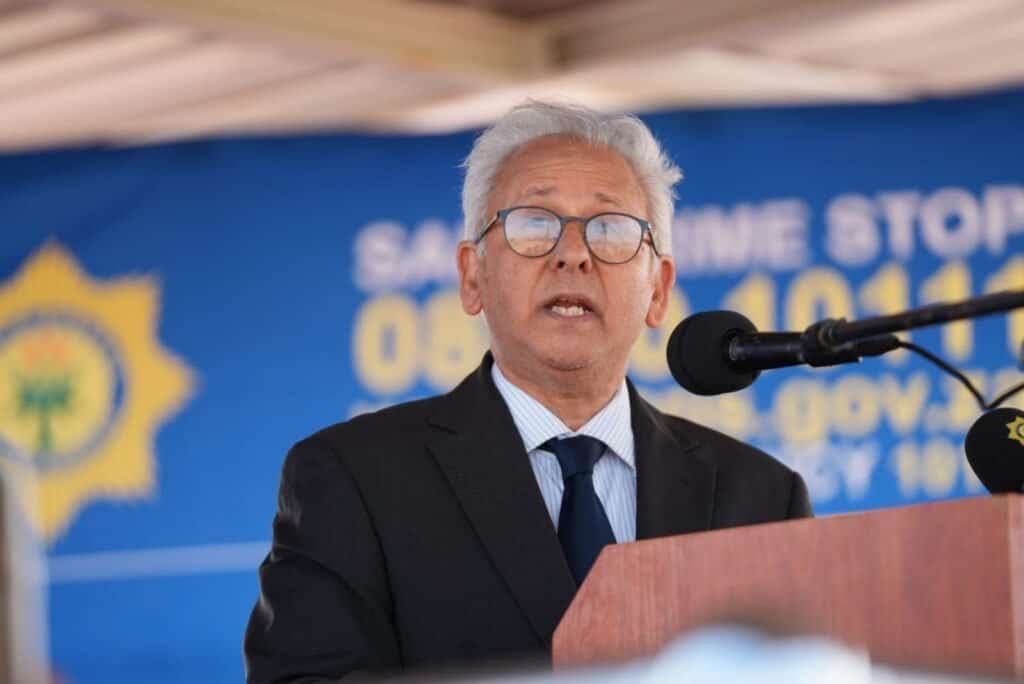
South Africa recorded declines in murder, carjackings, business and residential robberies and cash-in-transit robberies during the first quarter of the 2026/27 financial year, but Acting Police Minister Firoz Cachalia has warned that gang violence, extortion and illegal mining are becoming increasingly entrenched in communities.
Cachalia released the crime statistics for April to June 2026 in Pretoria on Friday, describing the decreases in several serious contact crimes as significant progress while stressing that the country cannot afford to become complacent.
“We have recorded notable decreases in several of the country’s most serious contact crimes,” Cachalia said.
He said murder had declined, marking another consecutive quarter in which the crime had shown a downward trajectory.
Carjackings, residential robberies, business robberies and cash in transit robberies had also recorded significant reductions.
Cachalia said many of these crimes were committed by organised and heavily armed criminal groups, while others were interpersonal crimes involving people known to their victims.
He attributed the improvements to intelligence-led policing, targeted operations and increased cooperation between law enforcement agencies.
However, he warned that the reductions did not change the reality that too many South Africans continued to lose their lives to violent crime.
“Every murder remains one too many. Every victim deserves justice,” he said.
Cachalia also highlighted crime categories that had increased during the reporting period, particularly those affecting women, children and other vulnerable people.
He said gender based violence and femicide remained an urgent national priority and required sustained investment in prevention, victim support, investigation and prosecution.
The minister said crime remained highly concentrated, with a relatively small number of police precincts accounting for a disproportionate amount of violent crime.
He said the Police MinMEC had therefore resolved to prioritise interventions in 140 high crime police station precincts across the country.
The targeted stations will receive operational support, enhanced oversight and improved resource allocation.
Cachalia said the MinMEC resolutions also focused on strengthening coordination between national, provincial and local government, improving intelligence capabilities and detective services and accelerating the fight against organised crime, extortion, illegal mining and gang-related violence.
He warned that gang violence, extortion and illegal mining were “taking root in societies”, requiring sustained interventions rather than short-term operations.
Joint operations between SAPS and the South African National Defence Force have continued during the quarter.
Cachalia said these deployments were producing results in specific areas but cautioned that deployments alone could not permanently transform troubled police precincts.
“Sustained deployments hold ground; they do not by themselves transform a precinct,” he said.
He said the government had learnt that problems could return when security forces were withdrawn without permanent local capacity being built.
The minister also identified alcohol as a major driver of violent crime.
According to Cachalia, SAPS senior leadership reviews the crime picture every Monday to assess trends and determine whether resources are being deployed effectively.
He said violence was concentrated during weekends and at night, particularly around liquor outlets, including unlicensed establishments.
A substantial proportion of murders and serious assaults involved people who had been drinking and were often known to their victims, he said.
Cachalia said addressing this form of violence would require more than arrests, including stronger enforcement of liquor licensing and municipal bylaws.
The first quarter statistics also come as SAPS implements its Reset Agenda, which Cachalia said was aimed at rebuilding a modern, professional, community-centred, intelligence-driven and accountable police service.
The agenda includes improving investigations, strengthening crime intelligence, enhancing visible policing, investing in technology and supporting detectives.
SAPS is also working with Business Against Crime South Africa on modernising digital capabilities at police stations to improve operational efficiency and service delivery.
Cachalia said SAPS was also working with National Treasury to explore sustainable funding models for upgrading and maintaining police station infrastructure.
He stressed that government could not defeat crime alone.
Community Policing Forums, neighbourhood watches, traditional leaders, faith-based organisations, businesses, civil society and residents all had a role to play.
He pointed to the arrests following the Reiger Park shootings as an example of the value of cooperation between communities and police.
The shootings claimed the lives of two Anti Gang Unit members, Constable Tlomatsane and Constable Sibeko, as well as two young women, Roleen Lessing and Jaydin Margerman.
Cachalia also paid tribute to Captain Zamani Mzayiya, a Tactical Response Team member who was shot in Knysna while investigating the murder of former mayor and councillor Aubrey Tsengwa.
With South Africa preparing for the local government elections, Cachalia said law enforcement agencies would also focus on violence targeting councillors and political representatives.
He said attacks on political office bearers undermine democratic participation and that police would work with stakeholders to ensure a safe environment for free and fair elections.
Cachalia said the latest figures showed that progress was possible but stressed that the work was far from complete.
“We are not yet where we want to be, but we remain determined, united and focused on getting there,” he said.