
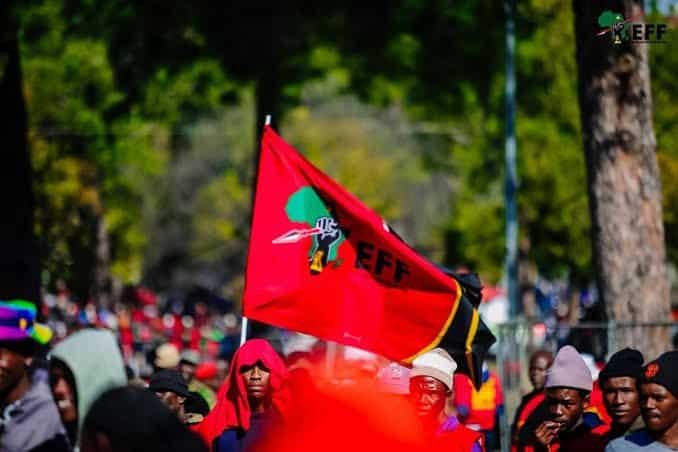
The Economic Freedom Fighters (EFF) has emerged as the political party with the highest representation of women and young councillors following the 2026 Local Government Elections (LGE), while the Inkatha Freedom Party (IFP) recorded the lowest representation of women and has the oldest councillor in the country.
The figures were revealed by the Electoral Commission of South Africa (IEC) during a media briefing in Centurion on Friday, where chairperson Mosotho Moepya provided an update on outstanding processes following the November 4 local government elections.
According to the IEC’s candidate demographic statistics, women account for 33.6% of all councillors declared elected across the country.
The figures show that the EFF has the highest proportion of women among the larger political parties, at 46.2%, followed by the Patriotic Alliance (PA) at 43% and the Democratic Alliance (DA) at 38.6%.
The IFP recorded the lowest women’s representation at 18.7%.
The statistics also highlight the continued underrepresentation of women in local government, particularly in ward-based elections.
Women account for 39.7% of proportional representation (PR) councillors, compared with only 26.8% of ward councillors.
This suggests that political party proportional representation lists remain the main route through which women secure positions in municipal councils.
The IEC further revealed that the average age of elected councillors is 47.3 years, with a median age of 47.
The largest age group is between 40 and 49, accounting for 34.9% of councillors, followed by those aged between 50 and 59 at 26.2%.
Councillors aged between 30 and 39 make up 21.8% of the total, while only 3% are younger than 30.
Those aged 70 and older account for just 2.1%.
The EFF recorded the youngest average age among the larger political parties, at 42.5 years. Its youngest elected councillor is 19.
Meanwhile, the oldest councillor is an 86-year-old IFP representative from uMlalazi Municipality in KwaZulu-Natal.
Moepya’s briefing came as the commission moved to conclude the remaining administrative processes following the announcement of election results on Sunday, November 8.
The IEC confirmed that the names of councillors declared elected would be published in the Government Gazette on Friday, paving the way for municipal councils to begin preparations for their inaugural meetings.
In terms of the Local Government: Municipal Structures Act, municipal managers are required to convene the first meeting of their respective councils within 14 days after councillors have been declared elected.
The commission said political parties that had secured more proportional representation seats than the number of candidates on their submitted lists were given until November 11 to provide additional names.
Parties were also required to inform the commission where candidates had qualified for more than one seat.
The IEC said failure to make the necessary choices could result in candidates losing their ward positions or parties forfeiting seats where insufficient nominations affected the council’s ability to form a quorum.
The commission also confirmed that five ward by-elections would be necessary.
Two will follow decisions by political parties to designate candidates who had won more than one ward seat elsewhere.
These involve Ward 12 in Johannes Phumani Pungula Municipality in KwaZulu-Natal, won by an uMkhonto weSizwe Party candidate, and Ward 13 in Dihlabeng Municipality in the Free State, involving an ANC candidate.
Three additional by-elections will follow the deaths of ward councillors in Raymond Mhlaba Municipality in the Eastern Cape, Merafong Municipality in Gauteng and uMlalazi Municipality in KwaZulu-Natal.
The IEC also confirmed that four ward contests had been decided through the drawing of lots after candidates received equal numbers of votes.
The affected wards were in Mnquma Municipality in the Eastern Cape, Maluti-a-Phofung Municipality in the Free State, Ba-Phalaborwa Municipality in Limpopo and Steve Tshwete Municipality in Mpumalanga.
The commission further provided an update on objections lodged following the elections.
As of midday on Friday, it had received 1,708 submissions purporting to be objections. Of these, 433 qualified as objections under Section 65 of the Electoral Act.
A total of 252 had been finalised, with three upheld and 249 rejected.
The process resulted in 12 recounts and seven edit windows, in addition to a revote scheduled in the Northern Cape.
The IEC said the number of objections was significantly higher than in the 2021 local government elections, when 218 Section 65 objections were received.
The main complaints related to alleged counting irregularities, capturing errors, the inclusion of special votes in voting district totals and high numbers of spoilt ballots.
Meanwhile, the commission confirmed that a revote would take place in a voting district in Ward 3 of Siyancuma Municipality in the Northern Cape. Special voting is scheduled for November 17, followed by voting on November 18.
The outcome will determine the final seat allocation in the municipality.
Moepya also provided an update on the Ngcobo impersonation case, in which a candidate and an accomplice allegedly posed as IEC officials to gain access to election material.
The Electoral Court has ruled that the first respondent is barred from holding councillor office for the five-year term of councils elected on November 4. The second respondent was fined R100,000, suspended for three years.
The IEC said the publication of the elected councillors’ names marked an important milestone in concluding the 2026 elections, while preparations continued for the establishment of municipal and district councils.
Of the 1,701 district council seats, 707 have already been filled through the district proportional representation ballot. The remaining 994 will be filled through elections by representatives from local councils.
The commission said it would oversee this process as the country moves towards the full constitution of its new local government structures.


