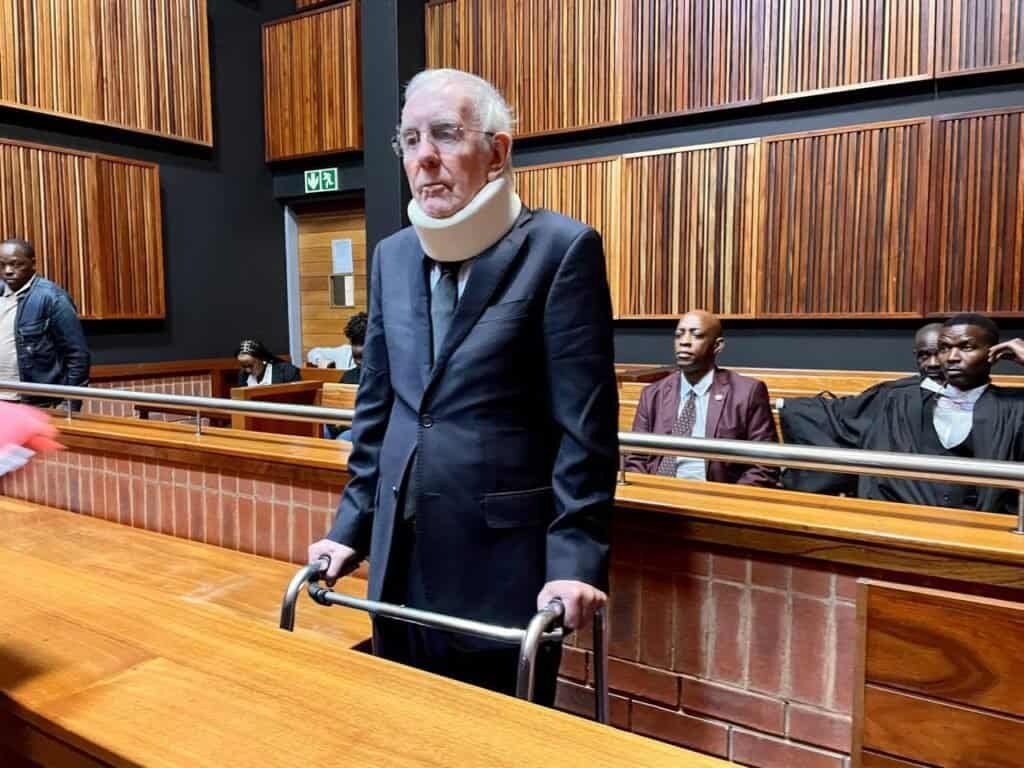
The Gauteng High Court in Johannesburg has convicted British businessman Michael Lomas and businessman Hudson Kgomoeswana after the pair entered into plea and sentence agreements with the National Prosecuting Authority’s Investigating Directorate Against Corruption (IDAC) in connection with the R1.4 billion Kusile Power Station corruption case.
The convictions, announced on Thursday, mark another milestone in one of South Africa’s most significant corruption prosecutions involving Eskom’s Kusile power station upgrade project in Mpumalanga.
The two men pleaded guilty in terms of Section 105A of the Criminal Procedure Act to multiple charges of corruption and related offences linked to contracts awarded between 2014 and 2017.
According to the NPA, Lomas was convicted on 34 counts of corruption stemming from payments made between February 2015 and April 2017. The payments included more than R2.6 million transferred from his personal bank account into a company owned by one of the accused, as well as 24 rental payments for an apartment in Midrand worth more than R396,000.
Prosecutors said the payments constituted gratification intended to influence two former senior Eskom employees to award contracts to Tubular Construction Projects, the company for which Lomas worked at the time.
The court sentenced Lomas to 15 years’ imprisonment, wholly suspended for five years on condition that he is not convicted of fraud, theft or offences under the Prevention and Combating of Corrupt Activities Act during the suspension period.
As part of the plea agreement, Lomas will cooperate with the State and provide evidence against some of the remaining accused in the main trial.
The NPA said its Asset Forfeiture Unit (AFU) rejected a proposed confiscation settlement of R6 million because it believed the amount did not adequately reflect the losses suffered by the State through Lomas’ criminal conduct. Negotiations between the AFU and Lomas’ legal representatives are continuing in an effort to reach a settlement.
Kgomoeswana also entered guilty pleas to one count of corruption, 18 counts of money laundering and 15 counts relating to contraventions of the Tax Administration Act.
The charges relate to more than R6 million allegedly channelled through his company, Babinatlou Business Services, to a former senior Eskom employee as gratification from the Tubular Group of Companies.
According to the NPA, Kgomoeswana retained approximately R757,000 for allowing his bank accounts to be used to facilitate the corrupt transactions.
He was sentenced to 15 years’ imprisonment on the corruption and money laundering charges, with 10 years suspended for five years, provided he is not convicted of similar offences during that period.
The court also imposed a five-year direct prison sentence on the tax-related offences for evading tax. That sentence will run concurrently with the effective five-year imprisonment imposed for the corruption and money laundering convictions.
Kgomoeswana has also agreed to the confiscation of assets valued at more than R2.4 million by the AFU and will provide evidence to the State regarding his role in the commission of the offences.
The NPA said both men were among several accused facing charges linked to the R1.4 billion earmarked for the Kusile Power Station upgrade project.
Lomas was extradited from the United Kingdom in September 2024 after a lengthy legal process and was joined with the other accused in the South African proceedings.
National Director of Public Prosecutions Advocate Andy Mothibi welcomed the convictions and praised the collaboration between IDAC, the Asset Forfeiture Unit, the South African Revenue Service, the Directorate for Priority Crime Investigation, commonly known as the Hawks, and Eskom.
Mothibi said the successful prosecution demonstrated the importance of coordinated efforts among law enforcement agencies in tackling corruption and other serious economic crimes.
The criminal trial against co-accused Frans Hlakudi and Abram Masango is scheduled to continue in the Gauteng High Court on Friday, 7 August 2026.