As the G20 Leaders’ Summit wrapped up in Johannesburg, South Africa delivered a strong and assured finish to a historic gathering that placed Africa at the centre of global decision-making for the first time. Despite geopolitical tensions, a high-profile boycott by the United States, and heavy scrutiny of South Africa’s leadership approach, the summit ended with a clear declaration, a united front among participating nations, and renewed momentum behind the priorities of the Global South.
A declaration secured early, signalling stability and decisive leadership
In a move widely described as strategic, President Cyril Ramaphosa tabled the final leaders’ declaration for adoption immediately after opening the summit. This avoided last minute political wrangling and ensured consensus before several leaders departed. The early adoption defied US objections to any joint statement. It also demonstrated South Africa’s ability to manage complex negotiations, hold firm on its developmental agenda, and maintain cohesion among member nations even in the absence of Washington.
Africa’s growth and global relevance at the centre of the agenda
From the outset, South Africa insisted that the world recognise Africa’s economic potential, its demographic weight, and its central role in the future of global growth. President Ramaphosa repeatedly framed Africa as “the greatest opportunity for prosperity in the 21st century”, while urging the G20 to deepen partnerships that support industrialisation, inclusive development and climate resilience.
The summit placed significant focus on critical minerals, which underpin the world’s transition to artificial intelligence, renewable energy and green technologies. With 30 percent of global critical mineral reserves located in Africa, the G20 agreed on a cooperative framework that supports beneficiation at source rather than the continuation of extractive models.

Debt relief, climate action and inclusive growth rise to the top
A central theme across plenary and bilateral sessions was the growing debt burden faced by developing nations. Leaders acknowledged that unsustainable debt has become a major barrier to achieving the Sustainable Development Goals. In response, the G20 pledged to support low and middle-income countries through predictable and fair restructuring mechanisms, with an emphasis on creating a “virtuous cycle” of lower debt, higher public investment and more inclusive growth.
Climate finance and disaster resilience were equally prominent. South Africa introduced High Level Voluntary Principles for investing in disaster risk reduction, emphasising the need for global collaboration in the face of climate-induced catastrophes. The G20 committed to increasing both the quality and quantity of climate finance, strengthening multilateral development banks, and unlocking private capital for just energy transitions.
A unified stance on peace, conflict and multilateral cooperation
The G20 declaration reaffirmed the grouping’s call for comprehensive and lasting peace in conflict zones, including Sudan, the occupied Palestinian territories, Ukraine and the Democratic Republic of Congo.
While geopolitical tensions persisted beneath the surface, the message was clear: the world cannot pursue sustainable development without confronting instability and conflict. The declaration also confirmed renewed commitment to multilateralism, reminding the world that cooperation still outweighs division, even in an increasingly fragmented geopolitical moment.
A summit defined not by a boycott but by African leadership
While the Trump administration’s decision to boycott the summit generated global headlines, it ultimately did little to derail the work of the G20. South African ministers emphasised that relations with the United States remain intact and that the US will continue to serve on the G20 Troika. The absence did not overshadow the substance of the summit, nor did it prevent a united declaration.
In fact, South Africa’s ability to deliver a successful summit despite the boycott strengthened its reputation as a reliable and capable multilateral convenor.
Bilateral diplomacy strengthens partnerships
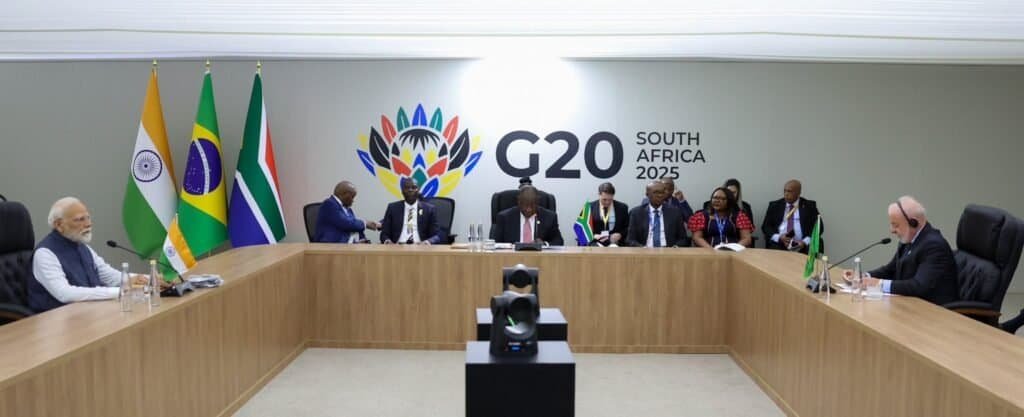
As the summit moved into its final hours, President Ramaphosa and other leaders held a series of bilateral meetings focused on decent work, artificial intelligence, the green economy, and new investment opportunities in Africa. A key engagement took place between Ramaphosa and Indian Prime Minister Narendra Modi, a strategic partner in South-South cooperation.
Brazil’s President Luiz Inácio Lula da Silva, completing his term in the G20 Troika, also engaged in closing discussions before addressing the media.
A confident handover and a clear message
Although there was no public onstage handover to the United States, the transition of the G20 presidency will take place later this week at the Department of International Relations and Cooperation. South Africa made it clear that its voice will remain active and assertive even as the US takes over.
In his closing remarks, President Ramaphosa reminded the world that the Johannesburg summit is not merely symbolic. It represents the beginning of a long cycle of work that must now translate into meaningful outcomes: “We have laid the foundation of solidarity. Now we must build the walls of justice and the roof of prosperity.”
The significance of the 2025 summit
The 2025 G20 Summit will be remembered for:
- placing Africa’s priorities at the heart of the global agenda
- securing a leaders’ declaration in the face of political turbulence
- advancing debt relief, climate finance and critical minerals policy
- reaffirming the G20’s commitment to cooperation and inclusive growth
- demonstrating South Africa’s diplomatic maturity and convening power
As world leaders depart Johannesburg, the message is clear. Africa is no longer at the margins of global decision-making. It is shaping the agenda, speaking with a confident voice and positioning itself as an essential partner in building a more just, more secure and more sustainable world.

Tshepo Matseba is the Managing Director at Reputation 1st Group, Strategic Partner at Ebony+Ivory Integrated Communication Agency, and former President of the Public Relations Institute of Southern Africa (PRISA). He writes in his personal capacity.