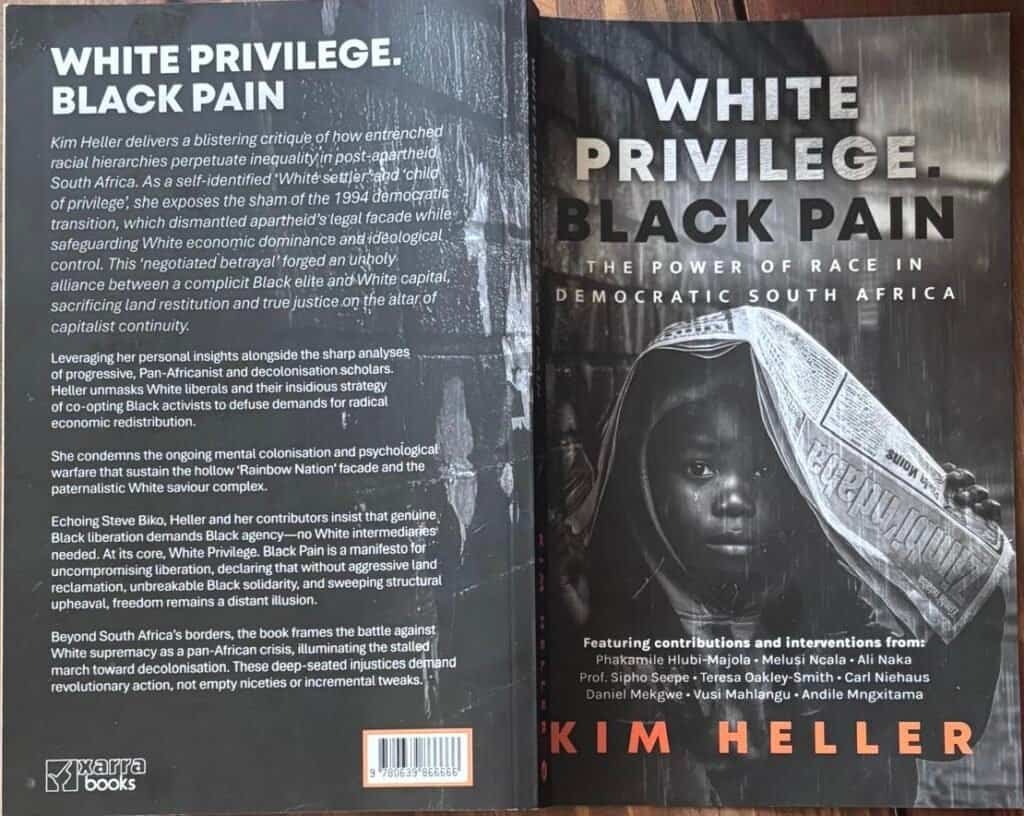
In her latest book, “White Privilege. Black Pain: The Power of Race in Democratic South Africa “, Kim Heller builds on her earlier book, “No White Lies: Black Politics and White Power in South Africa”. I write from the vantage point of having reviewed that book in 2021. The latest publication, “White Privilege. Black Pain: The Power of Race in Democratic South Africa”, like her earlier work, tackles the theme of white supremacy in the post-1994 society in South Africa. It is thus logical that the reader would encounter direct and indirect references to her first book. I have written elsewhere that the subjects of white supremacy and white privilege are subjects that too many writers, journalists, academics, and commentators are afraid to confront. Perhaps it’s all about saving their own proverbial skin and taking care of the figurative stomach issues.
We live in a dangerous society where the interests of the ruling capitalist elites are protected at all costs and by any means necessary. It is in this sense that a book or commentary, including by Heller, on this “uncomfortable discourse” should be perceived as a contribution to the struggle towards social justice in South Africa, where Black people live in a very deceptive “rainbow” world that oversells the so-called post-apartheid dispensation begotten from the craftsmanship of white men who believed that apartheid was not a crime against humanity. Sadly, some of these characters were embraced by the erstwhile liberation movement, the ANC, and ended up taking up membership of the organization of Pixley Seme. For the record, one of the huge embodiments and towers of apartheid, Roelof Frederik “Pik” Botha, died a proud member of the ANC in good standing.
In truth, the so-called post-apartheid South Africa is a blatantly hurtful misnomer because it simply does not exist. What does exist is a vicious and vile state of unfreedom or a devilish neo-apartheid state. It’s even more treacherously confusing these days, post the 2024 general elections, that have led to a grand scheme that perpetuates a painful betrayal of black people, in that the ANC continues the pattern and trajectory of the failed “rainbowism”. It has thus chosen to coalesce with right-wing and counter-revolutionary organizations in a coalition government conveniently, and erroneously, called “government of national unity”. I find it extremely melancholic that the party of Robert Sobukwe, the PAC of Azania, has allowed itself to be part of this coalition arrangement involving forces such as DA and FF Plus.
We will, of course, continue to speculate and patch together plausible assumptions and inferences. The political clarity of Sobukwe is used as a reference point for present-day political leaders. Sobukwe had maintained that “in the political arena of South African politics there are today only two adversaries: the oppressor and the oppressed; the master and the slave”. After all, he is the man who eschewed similar shenanigans in his lifetime. The grand coalition of DA and ANC constitutes some of the critical themes that are tackled in this book. My view of this post-2024 elections arrangement is that white people have continued from where they had left off in 1994 by crafting a grand scheme to maim the black liberation project by smartly co-opting the ANC into the project, which was meant to exclude them in the first place, the so-called Moonshot Pact.

In other words, the current arrangement falls within the DA’s plan articulated, at least, in their Federal Congress of 2023 in terms of which they had resolved on a commitment “to a party of national government in the reality of coalition politics”. This objective was obviously achieved after the history-defining elections in 2024. This should explain why in his swansong as the then leader of the DA on 11 April 2026, John Steenhuisen, refers to this coalition arrangement with the ANC as “a mission accomplished” for himself and the DA. That report card, to my knowledge, has never been contested. Incidentally, Heller had predictively written about this ANC-DA alliance in one of her media articles in 2024 and said, “the most likely coalition is between the ANC with the centrist, historically white DA”. This article appears in Chapter 12.
The title of this book is somewhat problematic (to me, of course) in that it parenthesises black pain to white privilege. My understanding is that “white supremacy” implies black pain and suffering. Black pain is the other side of white supremacy. Whatever the reason for adding the phrase “black pain” to the title is or was, I am afraid this step has the potential to prepare a fertile ground to attract superficial and myopic criticism from quarters that may cynically accuse Heller of (i) appointing herself as a spokesperson of black communities, (ii) being opportunistic about issues of black struggle in a convenient space of post-1994 electoral politics, and (iii) selfish and cathartic posturing.
One would be utterly surprised if this were not to happen. I would imagine such distractive criticisms would inevitably play radical or revolutionary political brinkmanship by referring to the cliched cautionary Biko quotes on “whites taking responsibility for black issues*. But it would be a redundant critique because Heller herself, in her earlier book, “No White Lies: Black Politics and White Power in South Africa”, made this observation when she declared herself “a white settler” and never claimed to be a self-appointed somlomo on black issues. It is worth reiterating what I said about this aspect in my review of that book in 2021 already: “I think there is the perceptive or real danger that an oxymoronic effect might be presented or created by the fact that Heller, as a white person, takes the cudgels to fight the struggle on behalf of black people.
This is likely, especially in this instance where white supremacy is the subject of her commentary. Symbolically, her presence in this space is problematic in that it leaves the impression that she is speaking on behalf of black people, which is something that perpetuates black inferiority and white superiority complexes”. This aspect is further complicated, in the present scenario, by her decision to directly add the phrase “black pain” to the title of the current book. I think this will, not without justification, most likely attract criticism from radical black quarters and mere detractors as a “boisterous position” on her part to serve and act as a guardian of blacks in their prosecution of their own struggle. That was my concern then, and it remains so.
Heller has been aware of the unintended impact of this positionality and the consequent risk likely to flow from it. She had put this proposition or acknowledgement on the table and upfront, in her earlier publication. She expressly referred to Biko’s assertion that he gave no “special licence or favour to whites who say they have ‘black souls wrapped in white skins’; in fact, Biko showed disdain for this affliction of privilege. None, he argued, can conceive of or respect Black Consciousness or participate in liberation”. It is in this context that one understands when she opines that: “I write from the perspective of a foreigner – a white settler in South Africa. I do not understand whites who claim that they are Africans. For we have robbed South Africa and its people economically, politically, and culturally, through colonialism and apartheid.
Like every white South African – past, present or future – I am a child of privilege”. She repeats this acknowledgement or admission extensively in Chapter One of her latest book, the chapter she has aptly titled“Writing from the perspective of a white settler”. It’s for the reader to digest this section of the book and reflect on her ideological, political, historical and psychological iteration on this sensitive issue. I guess it is her appreciation of this poignant matter that informs the apparent maturity with which she has handled the clinically sharp criticism by Andile Mngxitama in the “Afterword” of the book. In the end, it is the motive/s and attitudes of white activists that should be subjected to a microscopic analysis and interpretation. Is Heller in a moral position to tackle white supremacy? The answer is clearly in the affirmative. However, on whether she is in a moral or ethical space, as a white settler, to articulate on black pain, black suffering and experience is certainly the subject that invites the readers, particularly black people, to reflect and pronounce on.
As a race-conscious person, I would at any given moment vehemently oppose any social contributions of white commentators whose motives are intended to patronize black people. Black pain and suffering should not be used to enrich the political and moral relevance of any individual, particularly white people. I am not one of those who liberally affiliate to notions of “as long as the cat catches mice”. In a world and society that is ravaged by white supremacy in various forms, including economic exclusion, exploitation, racism and imperialism, we should indeed care about the colour of the cat, so to speak. For me, it is a big deal that the black cat should be able to catch the mice. In a racially skewed and unequal society, race matters!
The question arises: As a white settler and beneficiary of white privilege, which is the subject matter of her new book, should Heller be condemned for her commentary against white supremacy? I think that would be super-stupid an approach to take. Instead, we should be bothered, as black people, about the intensity of our own efforts and contribution to our liberation or oppression as a race. Why do we have black communities that continuously vote for sellouts, white proxies, betrayers and utter non-whites to run their lives in this rainbow electoral democracy? How do we account for black academics who perpetuate anti-black, colonial or Eurocentric scholarship? What about so-called black journalists and “political analysts” who continue to shamelessly, in an embedded style, peddle a neo-colonial, neo-imperialist and neo-liberal agenda in our socio-political discourse?
What about black political stooges of white monopoly capitalism? These are the areas that should concern us as black people. Yet again, Kwame Nkrumah, Amilcar Cabral, Frantz Fanon, Steve Biko and others would have already warned us about the ability of white hegemon to preserve itself in the post-colony through the entrenched white power structure inherited and worshipped by neo-colonial or post-independence and neo-apartheid political leaders. At the heart of this malleability is mental colonization or lack of political consciousness. As Kwame Toure would have said, “It is the job of the conscious to make the unconscious conscious”, so that white structures of power and privilege are stopped from replicating themselves in the post-colony. This includes the post-1994 neo-apartheid society.
When paying tribute to Minister Louis Farakhan in The Phil Donahue Show (accessed 30 May 2026), a speaker uttered the following remarks: “But in the Black community there are a few Farakhans, it is not enough of us that is helping to take the burden of our people. It is our responsibility to deal with the ills of our people. Those who feel that they want to help us, fine; well as it can be, God will bless them. But it’s our responsibility, and it’s not enough of us who are helping to uplift our people, we are catching hell…so we should be man enough or woman enough to do, because you’re only on this planet for a short while, white and black, so we should pull our resources together and think intelligently enough to say that whatever affects one, affects all of us indirectly”.
So, it’s not intelligent enough to condemn Heller in her risky efforts at tackling white supremacy in this dangerous environment. Rather, we should be cognisant of her contribution as a white author and welcome her “contribution”, and, as in the cited remarks, God will help her. Our worry should be the dearth of black authors, commentators or scholars on this uncomfortable discourse of white supremacy. The proliferation of ambivalent commentators and academics who sit on the fence owing to cowardice, stomach politics and butt-licking tendencies should concern us most. In Chapter Thirteen (in Part Three of the book), Heller fearlessly centres the issue of land return or repossession in the commentary. She begins this part of the book with reference to Dr Mos-Shogbamimu, who laments “continued expectation of black people to win the hearts and minds of white people to soften them a bit, step by step, taking them through like you’re holding the hands of a toddler, while you are suffering.
While you’re the one bearing the brunt of their privilege and the white supremacy, is that not madness?” Heller expands on this sentiment by pointing out the golden value and power of “white tears” which have dissuaded the post-1994 ANC government (and the current coalition with the likes of DA and FF Plus) from the liberation ideal of returning the land. She does this by boldly and directly telling white South Africans that “it is time to return the land”. She pronounces that land is the cornerstone of white privilege and argues that “White tears will fall, with great lavishness, when land is taken back from us [white people] by the rightful owners”. It’s refreshing that she, as a white activist, directs this appeal to white people as if to observe the perspective of Steve Biko, who had pleaded with whites to stay out of black struggle and urged conscious whites to “disrupt whiteness rather than blackness”.
I don’t think one can fairly understand this book, “White Privilege, Black Pain: The Power of Race in Democratic South Africa” without reading the earlier publication, “No White Lies: Black Politics and White Power in South Africa”, because it is in the first book that the reader gets to be somewhat introduced to the author in terms of the background and context of her life story. It is in the first book where she attends to the preliminary aspects such as her political and ideological orientation, capitulations, disclaimers and declarations. This is where she preempts her readers and projects her political, social and moral persuasions. In this way, she frontally puts the reality that she is “a white settler” on the table and accepts that she is not taking up literary arms to fight white supremacy on behalf of black people.
In this respect, she clinically refers to the approach that Biko would have taken, just as he did on white liberals, on the role of white people in the black struggle. I have found her interpretation of Biko in this regard not only apposite, but indeed correct. She does repeat this acknowledgement in the Preface of the latest book. I am re-emphasising this point to advise against the temptation to critique this book (White Privilege, Black Pain) by harping on settled matters or closed chapters. There is nothing as embarrassing as, in the quest to sound revolutionary, arguing a matter of common cause. I am glad that she dedicates a chapter (Chapter Six), almost as a red alert, on White allies or White liberals in Black struggle. Therein she charges that “White liberals and so-called progressive Whites often make poor allies”. And I agree.
The reader will encounter something unusual, if not awkward, in this book that comes in the form of an “Afterword” written by Andile Mngxitama. This, to me of course, is peculiar because it comes through as a plausible “sucker-punch” full of might to floor the book whose author has embraced him as “one of the greatest thinkers and Black Consciousness activists of our time”. In essence, and again in my view, the Afterword de-campaigns and somewhat delegitimises both the author and the book on this important subject matter. The afterword is incredibly blunt in that it avers that in this book “a White activist presents the perennial problem of the over-presentation of the White voice in the Black block. Often when confronted with the White voice in the Black block, I labour to silence it”.
It rubbishes the author’s acknowledgement of being a white person who writes on black issues and labels this aspect “as part of the sophistication of how Whiteness reproduces itself”. It further asserts that the real duty of Black radicalism is to shut down all White voices, the so-called progressive White voices included. However, it does credit the author for exposing “the complicity of the African National Congress (ANC) in perpetuating White supremacy by what seems like a refusal to redress the injustices of the past.” The Afterword further acknowledges the value of the book in that “it can assist in the development of a radical critique of the Mandela-led political transition and the fault lines of the South African democracy”. In the end, what is the thesis of this Afterword? Andile Mngxitama, in this regard, concludes that “the more important value of this book is in placing a challenge on the radical Black thought to resist the seduction of giving audience to a White radical voice”.
In short, the author must be silenced! This, for me, is the strangest and certainly most peculiar aspect of the book. I guess we will never really know why the author and the publishers found it prudent to include this text in the book. Whatever their reasons, I have found the author’s explanation, in the preface to the afterword, quite lame. Her submission that the “profundity of this afterword lies in the fact that it allows no easy accommodation of Whiteness” is far from convincing. It sounds heartbreakingly desperate. In the final analysis, I get the sense that Heller, for whatever reason or motive, is a strategic ideological fanatic of Mngxitama’s, and was unfortunately caught in an apparently desperate position to have his name associated with the book. I think this strategy will substantively backfire. I would have preferred Mngxitama’s powerful insights in this “Afterword” presented as a “review” or an “opinion piece” published elsewhere (and not in the book).
Black people are required to take responsibility for their own pain and suffering. In this sense, Marcus Garvey would have rallied us all as blacks to rise, shouting “up ye mighty race!” and take charge of our own struggle. But can black people rise in this constitutional “democratic” state of the rainbow? There are so many factors that militate against this project, including the divisive nature of electoral politics, self-hate and the selfish quest to affiliate and assimilate to white establishments. The road to freedom remains long! White privilege and black pain linger on in the celebrated rainbow South Africa.

In this conundrum, what should the white activist-author do? Could she consider adopting a nom-de-plumereminiscent of the nineteenth century (Victorian England) case of Mary Ann Evans, who decided to use a pen name, George Eliot, in order to allow her work to be judged separately from her and thereby shielding her private life or private persona. Heller could have considered this option to “escape the stereotype” of a “white settler” or “radical white voice” pronouncing on black pain and black experience. That would be preposterous, disingenuous and cowardly. I don’t think Heller is someone who would think like that.
What Heller does is project consistency with principle despite the apprehension that her identity as a self-declared white settler would likely attract censure upon the release of this book. She has proven her consistency over the past years of her social and political activism in South Africa. White supremacy is not only a problem in South Africa. It is an age-old blood-sucking monster that is comprehensibly part of the global capitalist racist infrastructure. It feeds this cruel system, whilst simultaneously feeding from the selfsame chimeric system. It is merciless and unforgiving. It therefore calls for principled and self-sacrificial political activists to shake it.
However, as should be known, loyalty to principles is costly, risky and dangerous. The establishment and all its venomous tentacles are aware of this. It’s a matter of logic that anyone who threatens this structure stands to be crushed. Kim Heller or any genuine activist should be familiar with this thesis. Without sounding prophetic, it would be highly surprising if this project is not going to be vilified, sullied or nullified by hook or crook. We know how capitalist establishments work. However, Ousmane Sonko, a Senegalese politician, advises that in such situations, “we must demonstrate that fidelity to principles is stronger than calculations based on circumstances”.
So, Heller, seasoned as she may be in such situations, should expect a hailstorm of criticism, and should be prepared to take it maturely. In these sullied and hostile waters of rigorous political engagement, she should expect authorial decapitation. In such circumstances, it often becomes extremely difficult to differentiate between genuine critique and criticisms laced with venomous motives. Why is this fear expressed? The reality is that in this book, Heller, and the selected contributors,directly confront the deceptive monster of neo-colony presented as the so-called rainbow nation or “post-apartheid South Africa”. Although it is tempting for one to mediate or regurgitate the content of each contribution or chapter, I will restrain myself in this regard.
I can, however, point out that all contributors challenge and problematize the post-1994 dispensation and call it for what it is: betrayal of the hopes of the black masses and the ideals of the liberation struggle. At the centre of this disappointment lies the manifestation of white supremacy, which has left the black elite and leaders as mere managers of a white power structure. Ruha Benjamin, a professor of Sociology at Spellman College, has warned against “black faces in high places” with reference to black leaders in political offices whilst beholden to the white establishment. In this regard, she asserts that “black faces in high places are not gonna save us” and argues that mere black pigmentation or our blackness is not inherently trustworthy. She surmises that simply being black cannot be trusted, “if we allow ourselves to be conscripted into positions of power that maintain the oppressive status quo”. I honestly cannot think of a better and crisper description of the tragic story of political betrayal and fallacies that have characterised the South African landscape since 1994.
Phakamile Hlubi-Majola frames this aspect in historical context in her thorough “Foreword” which captures the essence of the book thus: “Despite the democratic breakthrough of 1994, which outlawed the system of apartheid, White power and privilege remain unchanged”. In other words, apartheid remains intact! It is no surprise that Prof Sipho Seepe bases his contribution on what he refers to as the loss of ideological battle, whilst Terry Oakley-Smith paints a bleak picture of residual white supremacy in corporate South Africa. Carl Niehaus’contribution also refers to the stranglehold that white supremacy continues to have on the South African socio-political landscape. All the contributions fit snugly in the scholarly and properly researched framework provided by Melusi Ncala in the “Introduction” to this book.

The reader should not expect to “hear” only the voice of Heller because the book has taken a unique approach in terms of which a select team of political activists, including Vusi Mahlangu, Daniel Mekgwe and Ali Naka, were asked to contribute chapters on the subject matter of white supremacy and white privilege in the post-1994 democratic South Africa. It was a great idea for the author and publishers to consider a chapter that provides a “continental perspective” on this crucial subject matter. The reader will find it helpful to consider that the book has been structured in such a way that the various contributions or chapters have been arranged into three sections or parts, starting with the theme of ‘Whiteness” in part one, followed by the theme of “White Tears, BlackPain” in part two, and finally, the wayforward in the form of “Dismantling White Power and Privilege” in part three.
Heller’s “White Privilege. Black Pain: The Power of Race in Democratic South Africa” will certainly set tongues wagging. It is expected to stimulate the requisite debate and bold intellectual reflections in the political and social discourses of South Africa. This book is so topical, so relevant, and so current. Issues covered include the new era of political configurations or coalitions in South Africa brought about by the ANC losing its absolute majority, Marikana massacre as a stain in our democracy, Robert Sobukwe’s steadfast and focused politics of no equivocation, neo-colonialism in Africa, African Renaissance and the sustained apartheid racial spatial planning.
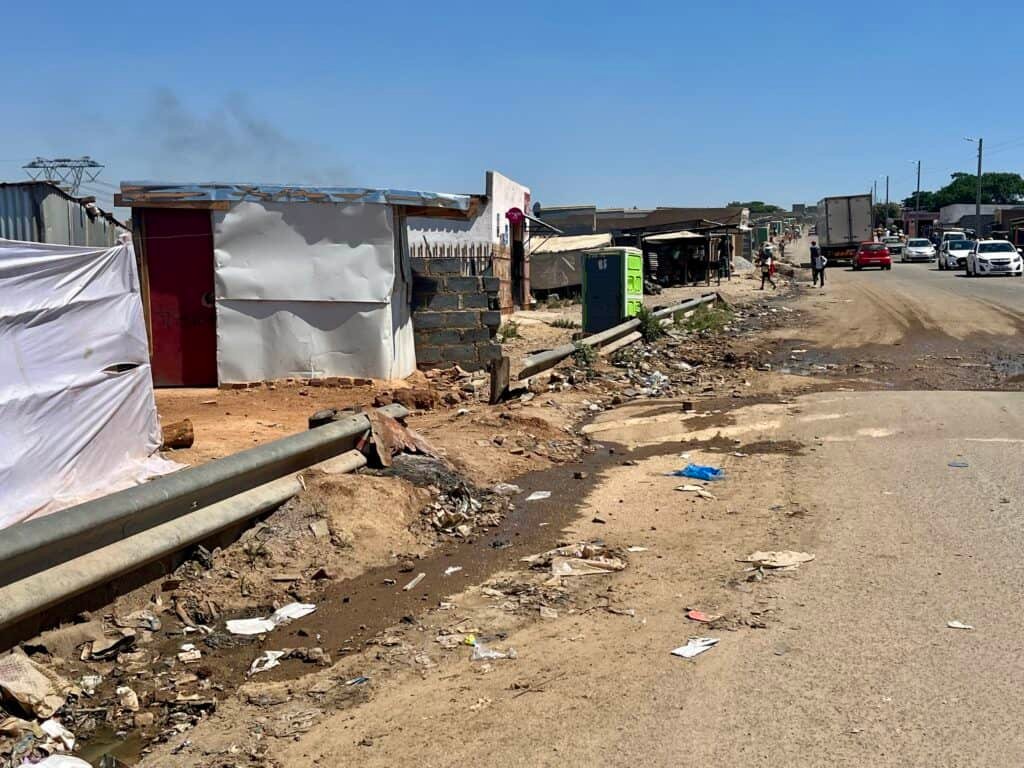
In respect of the latter aspect, Heller is prompted by the renaming of the “apartheid William Nicol” street to Winnie Mandela Drive and asserts, “The geography of apartheid is so intact today that even the shiny new version of Google Maps and Apps cannot hide the deep gradients of racially calibrated ’proudly-made-by-apartheid’geo-political spatial patterns of current day South Africa”. I am sure this bold, highly informative and easy-to-read book will help resuscitate the discourse of true liberation, land repossession and black unity in the post-1994 rainbow South Africa which is bereft of revolutionary consciousness and proper umrhabulo. The words of Kwame Toure reverberate: “It is the job of the conscious to make the unconscious conscious”. Importantly, I leave it to the readers to indulge in this no-holds-barred publication and proffer their reflections and possible verdicts.
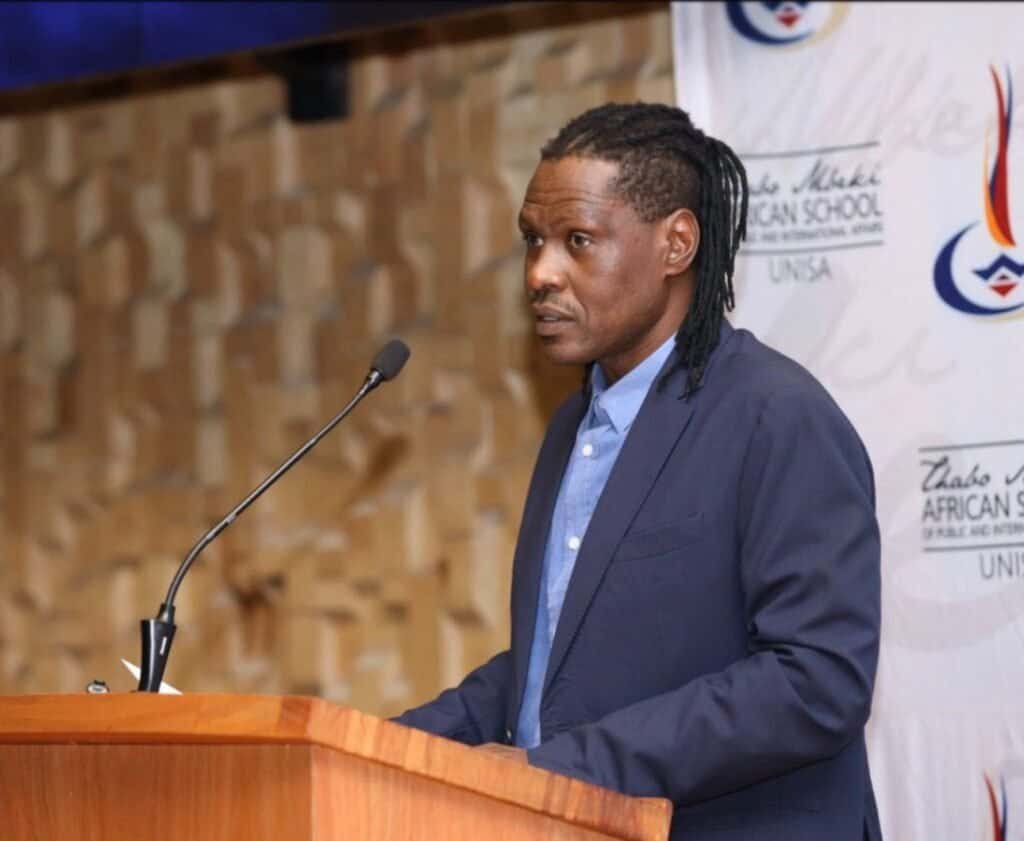
David Letsoalo is a Sankarist, an activist and a Law academic.