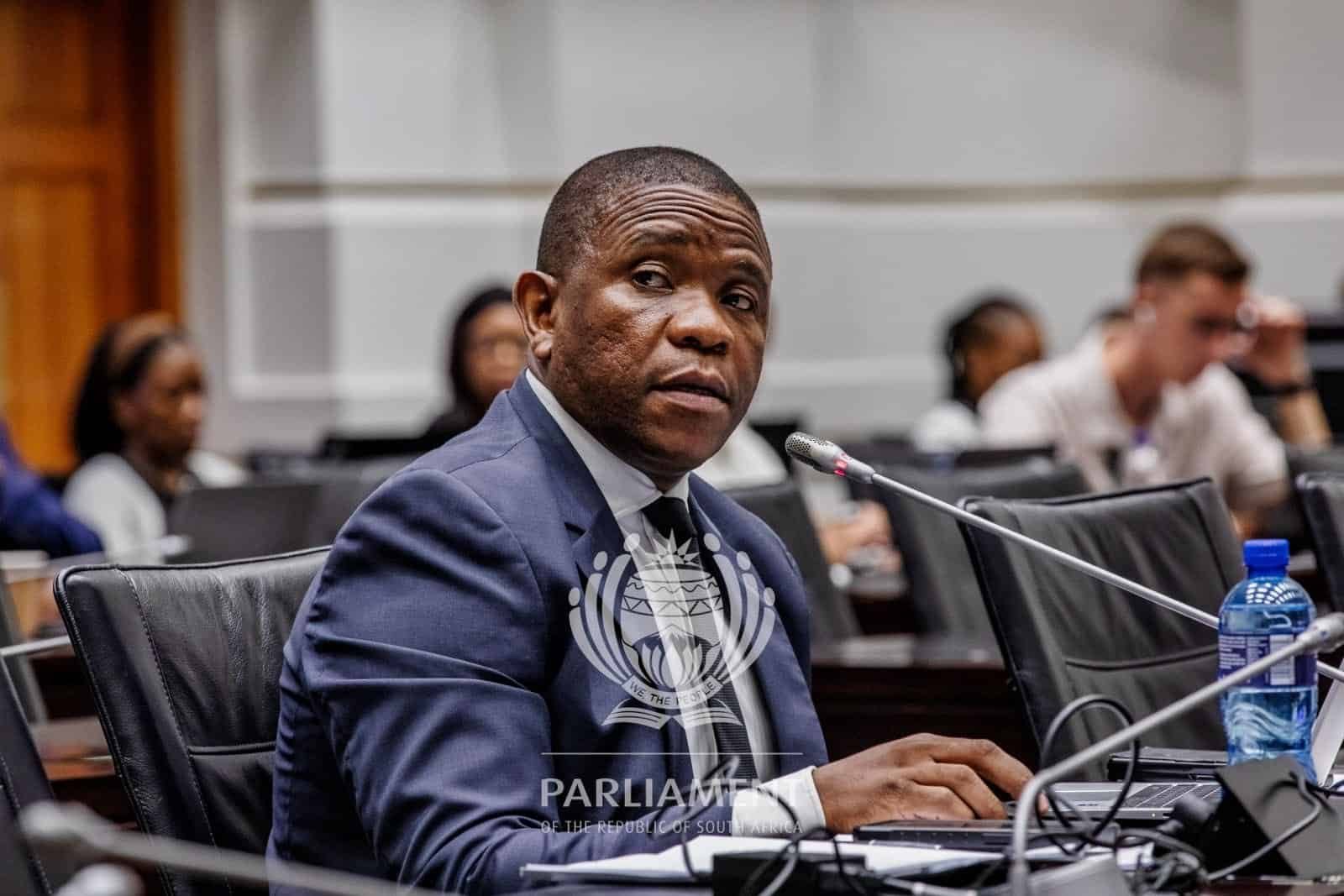
KwaZulu-Natal Police Commissioner Lieutenant-General Nhlanhla Mkhwanazi returned to Parliament on Wednesday for a dramatic re-examination before the Ad Hoc Committee, delivering fresh allegations, clarifications and politically charged claims as the inquiry nears its conclusion.
Mkhwanazi, the Committee’s final witness, took the oath and faced questioning in what is expected to be one of the most consequential sessions before the committee wraps up its work at the end of March. Political parties are expected to submit their closing remarks later on Wednesday evening.
At the centre of the proceedings was an eight-page letter presented by Mkhwanazi, authored by convicted fraudster Jermaine Prim, based on information allegedly shared by inmate Jamen Prinslo, who had previously attempted, unsuccessfully, to testify before the committee.
According to Mkhwanazi, Prinslo shared a prison cell in Pretoria with controversial figure Vusimuzi “Cat” Matlala and documented conversations between them. The letter, which was reportedly brought to Mkhwanazi’s attention by a relative, contains a series of allegations linking Matlala to high-profile political figures and criminal networks.
Mkhwanazi told the committee the letter outlines alleged connections between Matlala and Police Minister Senzo Mchunu, as well as details relating to accused Katiso “KT” Molefe, cross-border criminal activities and drug trafficking networks.
Reading from the document, Mkhwanazi highlighted claims that Matlala enjoys unusual privileges within the high-security C-Max section of the prison system.
“This person alleges that Vusimuzi ‘Cat’ Matlala has freedom inside C-Max and is very close with the head of the facility, which allows him to move around and get things done with ease,” Mkhwanazi said.
The testimony also revisited earlier controversy involving former police minister Bheki Cele. Mkhwanazi clarified that an earlier claim – that Cele had provided bank details to Matlala – had been retracted after investigators identified an error.
He explained that SAPS analysts had mistakenly linked a cellphone number used in communications with Matlala to Cele, due to similarities between the numbers. The incorrect identification, he said, was picked up during technical analysis.
Affidavits submitted to the committee indicate that the person Matlala believed to be Cele had accepted money, after which Matlala allegedly realised the error and deleted the messages.
Despite the correction, Mkhwanazi maintained that there had been communication between Cele and Matlala. He even read out cellphone numbers in the committee, noting that one number saved as “Babu Ndosi” closely resembled Cele’s known contact, differing by only a single digit.
The claims add to previous testimony in which Cele acknowledged staying at a property linked to Matlala, while Matlala himself alleged he had paid bribes to the former minister.
Mkhwanazi’s appearance also took a more political turn, as he claimed there had been a plan to arrest National Police Commissioner General Fannie Masemola, similar to the arrest of Lieutenant-General Dumisani Khumalo, in what he suggested was a move to clear the way for Lieutenant-General Shadrack Sibiya to assume leadership.
He further alleged that several politicians may have been “compromised”, naming MP Fadiel Adams, MP Dianne Kohler Barnard and Mchunu. Mkhwanazi said he would present further information regarding Adams at a later stage.
While stopping short of accusing Mchunu of direct involvement in criminal syndicates, Mkhwanazi described him as an “enabler”.
“I did not say he is part of the syndicate, but he allows criminality, which means he is indirectly participating,” he said.
Mkhwanazi reiterated his belief that Mchunu had been “captured” to issue instructions that included disbanding the Political Killings Task Team, halting the filling of Crime Intelligence vacancies and submitting reports on border management.
He argued that these directives appeared to be aimed at weakening Crime Intelligence structures while shifting influence toward the Border Management Authority, which he suggested may also be compromised.
“I still believe Cat Matlala was being used,” Mkhwanazi told the committee.
The commissioner also shed light on a previously undisclosed meeting with Matlala in Durban in April last year. The meeting, he said, was facilitated by KwaZulu-Natal Hawks head Major-General Lesetja Senona and was known to Crime Intelligence boss Dumisani Khumalo.
Mkhwanazi explained that the meeting had been recorded and that Matlala was, at the time, treated as an informant providing information about alleged wrongdoing involving senior figures, including Sibiya, Esmael Nangy and Steve Motsumi.
“I was well aware when they were giving me this information that they were snitching on their own crew,” Mkhwanazi said, adding that the sensitivity of the information had made some officials reluctant to publicly name those implicated.
The latest revelations sparked strong reactions on social media, with some South Africans expressing alarm at the scale of alleged corruption.
One user wrote that the testimony suggested systemic capture across law enforcement and the justice system, describing the country as a “borderline mafia state”. Another said Matlala had survived by bribing “everything and everyone”, but suggested that the tide may now be turning against those involved.
As the Ad Hoc Committee prepares to conclude its work, Mkhwanazi’s testimony is likely to play a pivotal role in shaping its final report – and could have far-reaching implications for political accountability and the future of South Africa’s law enforcement leadership.