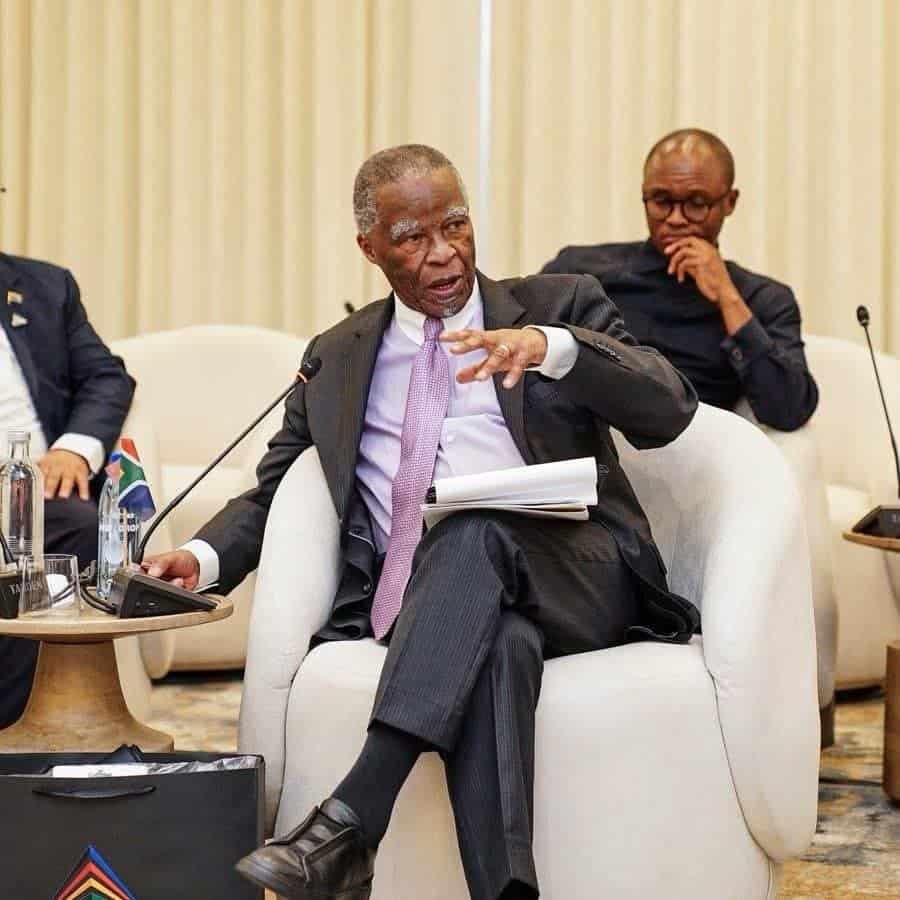
Former president Thabo Mbeki has thrown his weight behind calls for President Cyril Ramaphosa to step down, saying his resignation would be an appropriate response if reports that he had offered to leave office were true.
Mbeki has also questioned the continued leadership of the ANC’s Top Seven, suggesting that the party’s senior leadership should consider resigning and take responsibility for what he described as a catastrophic period for the organisation and the country.
The Top Seven leaders are Ramaphosa, his deputy Paul Mashatile, national chairperson Gwede Mantashe, secretary-general Fikile Mbalula, first deputy secretary-general Nomvula Mokonyane, second deputy secretary-general Maropene Ramokgopa, and treasurer general Gwen Ramokgopa.
Speaking during an interview with former EFF MP Mbuyiseni Ndlozi on the African Renaissance podcast, Mbeki did not mince his words when assessing Ramaphosa’s leadership and the state of the governing party following its devastating performance in the 2026 Local Government Elections.
He said he had read a newspaper report suggesting that Ramaphosa had offered to resign following the ANC’s electoral setbacks.
Mbeki said that if the report was accurate, he believed the president would be making the right decision.
“When I saw that, I think he is taking a correct decision. Normally, in all democratic countries, when there’s a disaster like that, the leader resigns. They take responsibility. How do you continue to lead if you had a catastrophe?” Mbeki said.
He added that the same principle should perhaps apply to the rest of the ANC’s national leadership.
Mbeki questioned what Ramaphosa had achieved since becoming ANC president in December 2017 and subsequently assuming the country’s presidency in February 2018.
He argued that there had been no meaningful positive developments that could justify the continuation of the current leadership.
“This person was elected president of the ANC in 2017 and president of the Republic in 2018. We are now in 2026. What has happened between 2018 and 2026 of a positive nature that you can point to? Nothing. There’s a lot of negativity,” he said.
His remarks amount to one of the strongest public criticisms of Ramaphosa’s leadership from a former ANC president, particularly as the party grapples with declining electoral support and mounting pressure to account for its performance.
The ANC suffered a significant setback in the November 4 local government elections, with its support declining further in several municipalities amid growing competition from opposition parties.
The party, which once enjoyed overwhelming electoral dominance, is now facing the consequences of years of declining public confidence, service delivery failures and internal divisions.
Mbeki’s criticism extended beyond Ramaphosa to include the ANC’s broader leadership, including Mbalula.
He questioned whether the current leadership could credibly oversee the party’s renewal when, in his assessment, its tenure had produced no positive outcomes.
Mbeki also raised concerns about what he described as the infiltration of the ANC by reactionary elements, including individuals allegedly linked to apartheid-era structures.
He suggested that some people occupying influential positions within the organisation were not genuinely committed to the ANC’s values and were instead advancing the interests of those who had previously opposed the liberation movement.
His comments come as the ANC leadership attempts to regroup following the election results and chart a way forward for the party.
However, Mbalula appeared to push back against suggestions that the party’s leadership should simply step aside.
In an interview with News Central TV, the ANC secretary-general argued that resigning in the aftermath of an electoral defeat could be interpreted as abandoning responsibility.
“If you step down, it’s tantamount to running away and all of that,” Mbalula said.
On Monday, Mbalula also took to social media following a meeting of the ANC National Working Committee at Luthuli House, where the leadership discussed the local government election results and the way forward.
He said the immediate task was to ensure that municipalities were governed in a manner that prioritised the interests of communities.
“Today the ANC National Working Committee met at the ANC Headquarters Luthuli House to deliberate on the Local Government Elections and chart a way forward. The task at hand is to have councils which best serve primarily the interests of our people,” he wrote.
Ramaphosa and the ANC Top Seven had not publicly responded to Mbeki’s latest remarks at the time of publication.
Mbeki’s intervention adds to growing pressure on the governing party to confront its electoral decline, with questions now extending beyond its performance at the polls to whether its current leadership has the political credibility to lead a renewal process.
The debate also highlights divisions within the ANC over whether accountability should mean leadership resignations or remaining in office to oversee the rebuilding of the organisation.