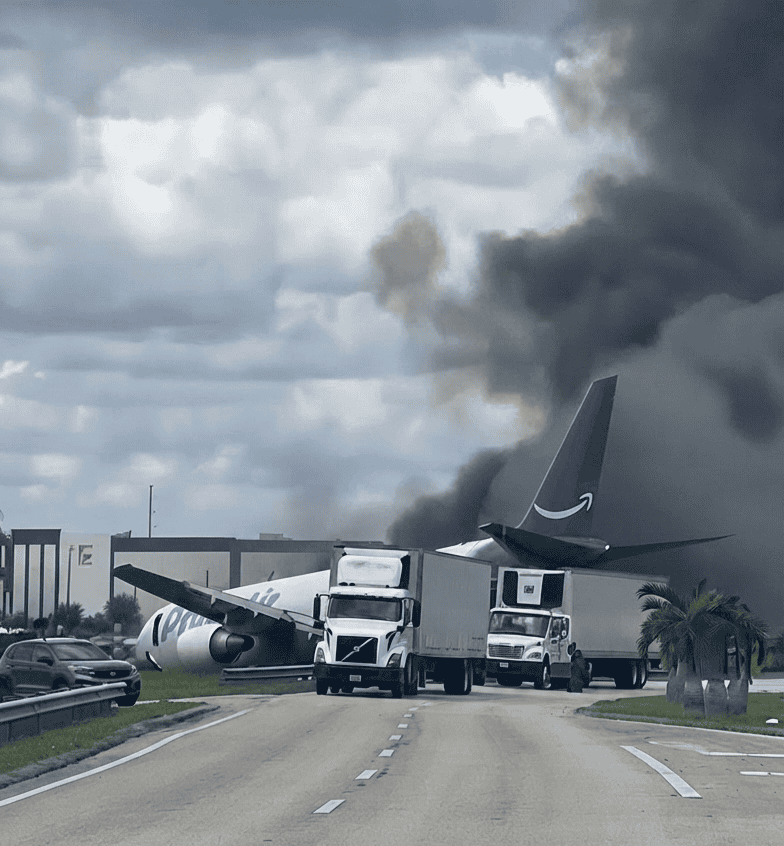
The deadly crash of an Amazon Prime Air Boeing 767 in Miami has reignited a heated debate on aviation safety in South Africa, with social media users questioning criticism levelled at Airlink pilots after their controversial low-altitude flyover at a packed Cape Town stadium.
At least five people were killed and five others injured when the Amazon cargo aircraft overshot the runway at Miami International Airport on Sunday.
The Boeing 767 300 freighter, operating as Prime Air Flight 7598, was arriving from San Juan in Puerto Rico when it ran beyond the end of the runway, crossed a nearby road and struck several vehicles before catching fire.
Three of the five injured people were critically hurt.
The aircraft was operated by 21 Air on behalf of Amazon Prime Air. Importantly, there were no passengers on board because it was a cargo flight. The two crew members, the pilot and co-pilot, were trapped inside the aircraft and had to be rescued by emergency crews.
Authorities had not released the identities of the people killed at the time of publication, and it was not immediately clear whether all the fatalities were people on the ground.
More than 200 emergency personnel responded to the crash, while the National Transportation Safety Board launched an investigation into what caused the aircraft to overrun the runway.
Weather conditions, including thunderstorms and strong wind gusts, were reported around the time of the crash, but investigators have not determined whether these played a role.
The crash also disrupted operations at Miami International Airport, with dozens of flights cancelled and hundreds delayed.
The Miami disaster has now been drawn into a separate aviation controversy in South Africa involving Airlink.
On August 29, two Airlink Embraer passenger jets performed a dramatic low-altitude flyover above Cape Town’s DHL Stadium shortly before the Springboks faced New Zealand in the second Test of their rivalry series.
The aircraft flew over a stadium packed with about 56,000 spectators, producing spectacular images that quickly spread across social media.
While many South Africans praised the pilots for their precision, the manoeuvre attracted criticism from aviation observers and international media, with some questioning whether it was appropriate to fly commercial aircraft at such a low altitude over a major sporting event.
The South African Civil Aviation Authority (SACAA) subsequently launched an investigation into the flyover.
The regulator is examining flight data and other information to establish whether the aircraft operated within the approved parameters and whether any aviation safety rules were breached.
Airlink has defended the operation, saying it was meticulously planned and conducted under strict safety procedures.
The airline said the pilots involved were highly experienced and that the flyover had been planned with aviation authorities and relevant stakeholders.
The controversy intensified when Airlink withdrew its application for a planned flyover at FNB Stadium in Johannesburg.
The planned display was due to take place during another Springboks and All Blacks match, but was cancelled amid the ongoing regulatory scrutiny and unfavourable weather forecasts.
The decision prompted another wave of debate on social media, with some South Africans arguing that the scrutiny directed at Airlink had been excessive.
That debate took another turn following the Miami crash.
One X user wrote: “When South African pilots where busy practising flyover skills, American pilots where busy with content on social media on how reckless where the stunts pulled by Airlink pilots who didnt kill anyone,iguess it is now revealed whosa danger to human life between SA and them.”
Another posted: “And they want to comment on South African aviation safety? Diabolical.”
A third user wrote: “This must be investigated not Airlink. It didn’t kill anyone.”
The comments reflect a growing sense of national pride around South Africa’s commercial aviation safety record.
According to the SACAA, South Africa’s commercial airline sector has maintained a zero fatal accident rate for more than four decades. The country also recorded a 95.12% preliminary score in an International Civil Aviation Organisation safety audit in 2026, ranking among the world’s strongest aviation safety performers.
That record, however, does not mean South Africa has been free of aviation accidents.
The country’s general aviation sector has experienced fatal accidents, and the SACAA has raised concerns about the number of deaths in non-scheduled and general aviation operations.
The distinction is important because the Miami crash and the Airlink flyover are being discussed in very different contexts.
The Miami aircraft was a cargo freighter carrying no passengers, while Airlink’s aircraft were passenger jets being used for an aerial display without passengers aboard.
The United States has also experienced several major aviation accidents in recent years.
In January 2025, an American Airlines regional jet collided with a US Army Black Hawk helicopter near Ronald Reagan Washington National Airport in Washington DC. All 67 people aboard the two aircraft were killed.
A subsequent investigation found multiple failures involving the Federal Aviation Administration and the management of airspace around the airport. The FAA later acknowledged that it had failed to act on warning signs before the disaster.
The Miami crash is now the latest major aviation incident to put the spotlight back on safety in the US.
But investigators have not yet established what caused Sunday’s crash, and there is no evidence at this stage that pilot error or any other specific factor was responsible.
Similarly, the SACAA has yet to conclude its investigation into Airlink’s Cape Town flyover.
For aviation experts, the two incidents should not be treated as a competition between countries.
The Airlink operation must be assessed against the regulations and approvals governing aerial displays, while the Miami crash must be investigated on the evidence available from the aircraft, crew, airport and weather conditions.
The social media debate, however, shows how quickly aviation safety can become a matter of national pride.
For many South Africans, the Airlink flyover represented the skill and confidence of local pilots. For critics, the proximity of two aircraft to a stadium filled with tens of thousands of spectators raised legitimate safety questions.
The SACAA investigation will ultimately determine whether the pilots remained within the approved safety parameters.
Until then, neither the Airlink pilots nor the Miami crew should be judged by social media commentary.
Aviation investigations are designed to establish exactly what happened, why it happened and what can be done to prevent it from happening again.
For now, the contrast is striking: an Airlink flyover that resulted in no injuries is under investigation in South Africa, while a US cargo aircraft has crashed in Miami, killing people on the ground.
The final word, however, will belong not to X users or international commentators, but to the investigators examining the evidence.