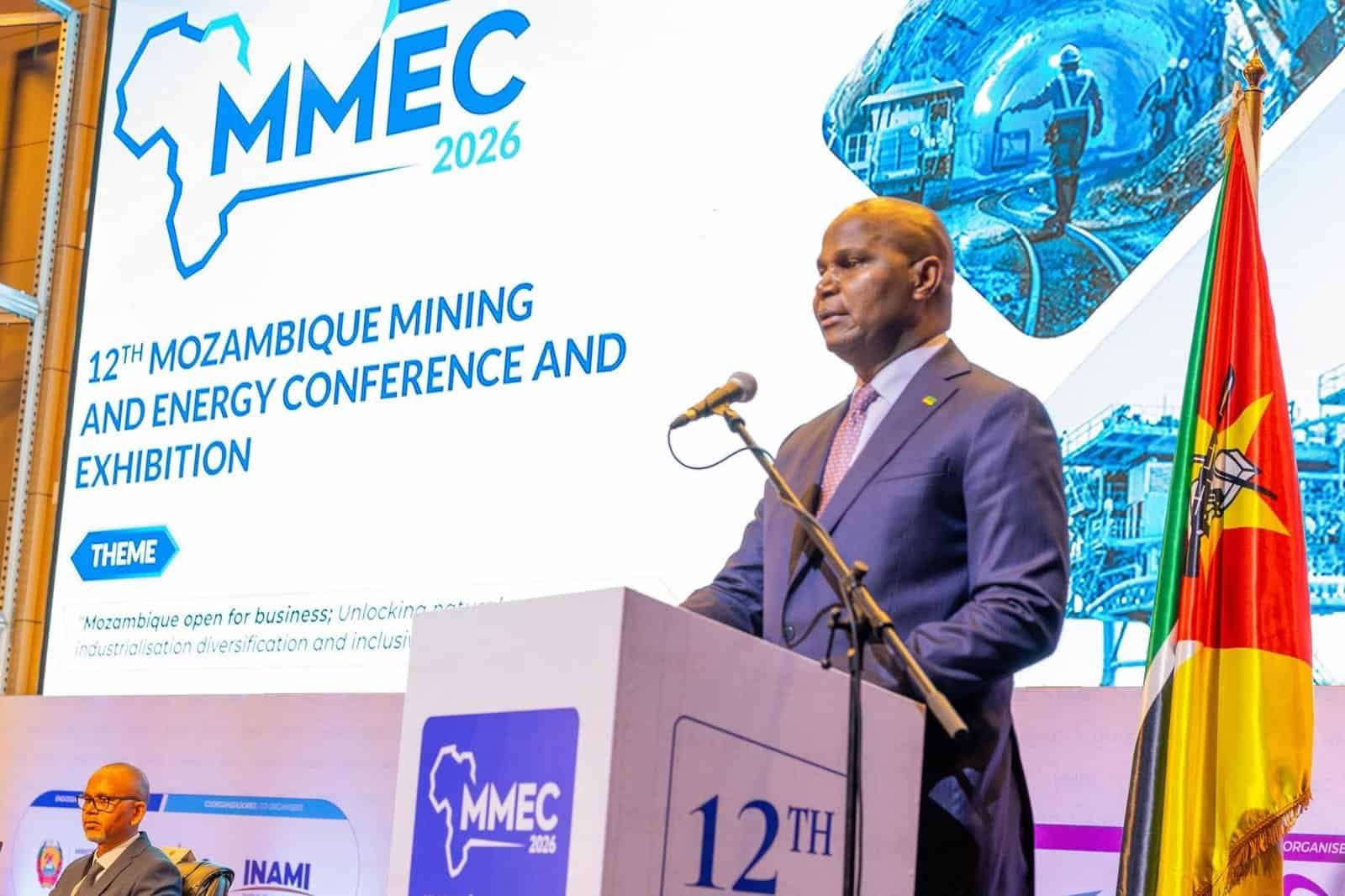
Mozambique will no longer accept being merely an exporter of raw materials, President Daniel Chapo declared, setting out an ambitious vision to transform the country’s vast natural resources into a foundation for industrialisation, economic diversification and shared prosperity.
A New Economic Vision
Delivering a keynote address at the 12th Mozambique Mining and Energy Conference and Exhibition (MMEC) in Maputo, the president outlined a decisive shift in economic strategy—one aimed at ensuring that the extraction of resources translates into tangible benefits for Mozambican citizens.
“Our vision is unequivocal and leaves no room for ambiguity,” he said. “Mozambique will not resign itself to being just a raw materials exporter. The true value of our resources lies not in what we extract, but in what we are able to build from them.”
Chapo positioned the mining and energy sectors as central pillars of this transformation, not as ends in themselves but as strategic tools to reshape the country’s economic structure. His remarks underscored a broader push to move away from a traditional extractive model towards one that prioritises value addition, industrial growth and job creation.
The conference, which has drawn participants from across the region and beyond, reflects what the president described as a growing recognition that shared challenges, ranging from energy transition and megaproject financing to resource-based industrialisation, require collective responses and global partnerships.
From Extraction to Transformation
Three critical pillars dominate discussions at the gathering: accelerating large-scale energy projects and linking them to industrial development; ensuring sustainable use of mineral resources with greater local value addition; and expanding access to energy as a driver of productive growth. Cross-cutting issues such as financing, infrastructure, local content and regional integration are also central to shaping what Chapo called an “effective economic transformation”.
At the heart of his message was what he described as a “paradigm shift”. Mozambique, he said, is moving decisively away from a model of resource extraction towards one of economic and social transformation.
“Every tonne extracted, every molecule of gas produced and every megawatt generated must translate into industry, jobs for our youth and women, knowledge and prosperity for our people,” he said.
To underpin this shift, the government is focusing on strengthening investor confidence through legal and regulatory reforms. Chapo highlighted ongoing reviews of key legislation governing mining, petroleum and local content, alongside new energy sector instruments designed to ensure transparency, stability and predictability for investors.
Natural Gas at the Core
A central component of Mozambique’s strategy is the development of its natural gas sector—not merely for export, but as a catalyst for domestic industrialisation, energy security and regional integration within the Southern African Development Community (SADC).
The country’s Natural Gas Master Plan aims to translate this ambition into action through the development of strategic infrastructure, including energy corridors linking the north and south, ensuring that gas reaches industries, businesses and households nationwide.
Addressing Future Energy Risks
However, Chapo acknowledged looming challenges, particularly the gradual depletion of gas reserves in the Pande and Temane fields—long a cornerstone of regional supply. Addressing this, the government has moved to secure future energy stability through structural solutions, including the creation of Serviços Logísticos Integrados de Moçambique (SLIM).
The company is spearheading plans to establish a floating storage and regasification unit (FSRU) in Inhassoro district, in Inhambane province. The project is designed not only to maintain gas supply beyond 2030 but also to safeguard industrial activity and reinforce regional energy security.
The planned infrastructure will connect to a regional gas pipeline operated by ROMPCO, ensuring continued supply to both Mozambique and South Africa, as well as other markets along the Southern African corridors. Chapo pointed to the pipeline as a successful example of public-private partnership and regional cooperation over the past two decades.
Regional Integration and Infrastructure
Looking ahead, Mozambique is encouraging further expansion of regional gas networks, with countries such as Eswatini, Zimbabwe, Zambia, Malawi, and potentially the Democratic Republic of Congo expected to benefit from increased integration.
Beyond energy, the president stressed the importance of developing integrated infrastructure—ports, railways, power systems and logistics—as a means of positioning Mozambique as a regional hub serving southern Africa and the wider continent.
Equally critical, he said, is the promotion of local content and human capital. The government aims to ensure that Mozambicans play a central role in this transformation through job creation, support for small and medium-sized enterprises, and meaningful skills transfer.
“Mozambique is open to investment,” Chapo said, “but we value serious, responsible partnerships oriented towards mutual development.”
Sustainable and Inclusive Development
He emphasised that the exploitation of natural resources must be environmentally sustainable, socially responsible and aligned with both national and international standards, while ensuring a fair distribution of benefits.
For ordinary Mozambicans, he added, the stakes are clear: more jobs—particularly for young people and women—greater access to energy, improved infrastructure and enhanced quality of life.
The conference is being held under the theme of unlocking resources for industrialisation, diversification and inclusive growth—a goal the president said demands urgent and decisive action.
“The challenge before us is clear: to turn commitments into decisions, decisions into investments, and investments into tangible results,” he said. “This is the time for action—less talk, more work.”
With its vast reserves of natural gas and mineral wealth, Mozambique is positioning itself not only as a destination for investment, but as a driver of regional development—seeking to lead, in partnership with its allies, a new phase of growth grounded in structural transformation and economic diversification.