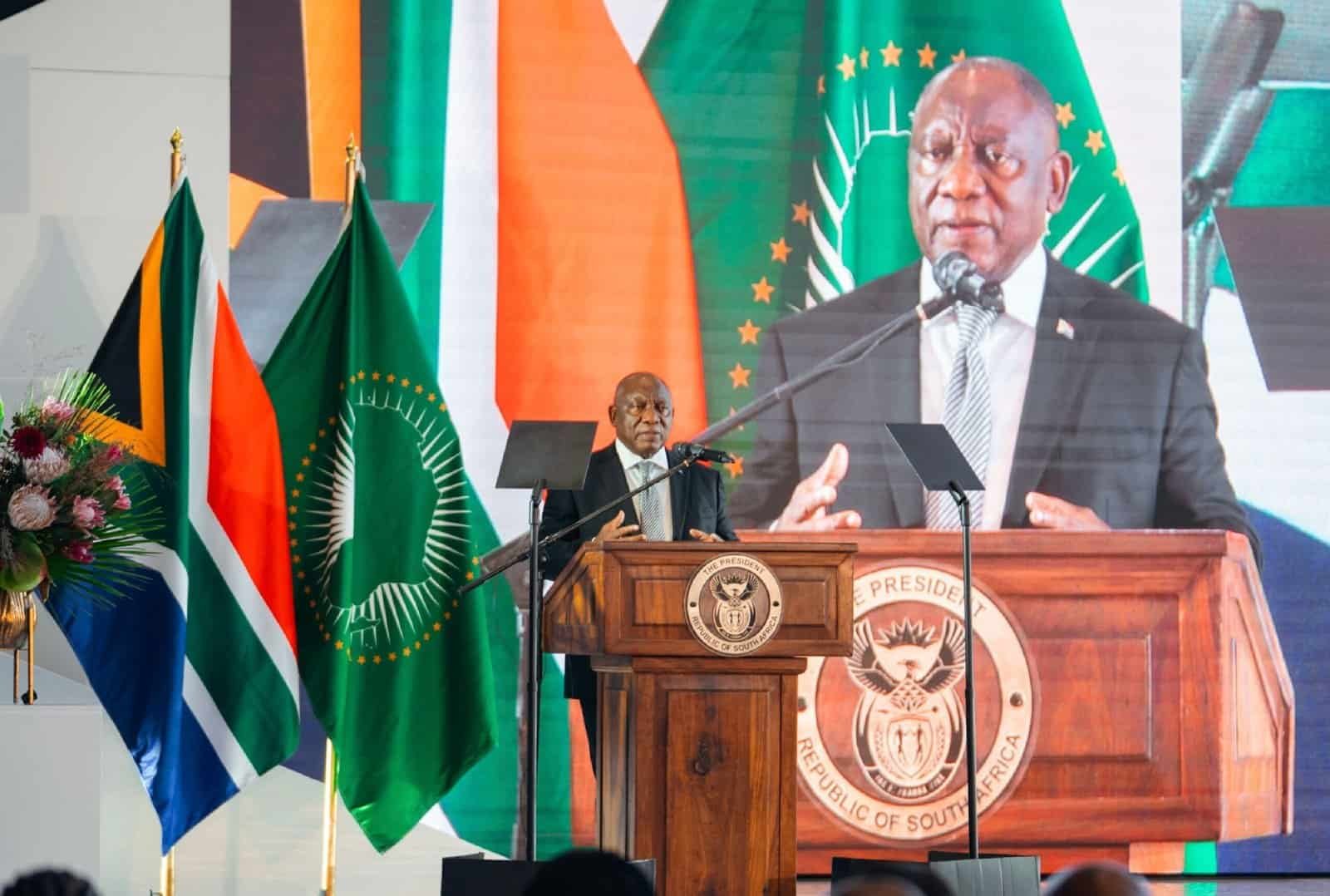
President Cyril Ramaphosa has used the opening of Africa’s Travel Indaba 2026 in Durban to position tourism as a key driver of economic growth, job creation and African integration, while calling for easier travel across the continent through visa reforms and regional partnerships.
Addressing delegates at the Inkosi Albert Luthuli International Convention Centre on Tuesday, Ramaphosa said Africa’s tourism sector was entering a new era of growth after years of global disruption and recovery.
The annual tourism showcase, hosted in Durban, has drawn government leaders, tourism authorities, buyers, exhibitors and investors from across the continent and abroad under the theme “Unlimited Africa: Growing Africa’s Tourism Economy.”
Ramaphosa said South Africa recorded 10.5 million international arrivals last year, describing the figures as evidence that global travellers were rediscovering the country and the broader region.
“Tourism is more than a sector of the economy. It is a living expression of who we are as a people,” Ramaphosa told delegates.
He said the fact that nearly three-quarters of arrivals came from the Southern African Development Community (SADC) region showed that Africans were increasingly choosing to travel within the continent.
Ramaphosa confirmed that South Africa was working with neighbouring countries to advance the proposed SADC Tourism UNIVISA system, aimed at allowing seamless travel across several member states.
He also highlighted efforts to expand one-stop border posts and develop cross-border tourism routes to strengthen regional integration and boost intra-African travel.
“When Africans travel within Africa, we strengthen our economies, deepen our cultural ties and build a more integrated continent,” he said.
The President linked tourism growth directly to livelihoods and employment, noting that according to Statistics South Africa, the tourism sector supports nearly one million direct jobs in the country.
“This means around one in 18 workers is directly employed in tourism,” he said.
Ramaphosa also used the platform to showcase government-backed tourism infrastructure and heritage projects aimed at diversifying South Africa’s tourism offering.
Among the projects highlighted was the recently upgraded Cape Agulhas Lighthouse precinct in the Western Cape, launched last month at the southernmost tip of Africa, where the Indian and Atlantic oceans meet.
He also pointed to the Kgodumodumo Dinosaur Interpretation Centre at the Golden Gate Highlands National Park in the Free State, where the world’s oldest dinosaur embryo was discovered. The centre has attracted more than 88,000 visitors since opening last year.
Durban’s recently unveiled statues of anti-apartheid icons Nelson Mandela and Oliver Tambo were also cited as examples of how cities were expanding cultural and heritage tourism offerings.
Ramaphosa said tourism growth was no longer only reflected in statistics but in the revival of small businesses and communities across the country.
“The benefits are felt not only in boardrooms but also in township enterprises and the homes of ordinary South Africans,” he said.
The President further said South Africa’s recent hosting of the G20 Leaders’ Summit on African soil demonstrated that the continent was increasingly shaping global discussions around economic growth and development.
He said South Africa had used its G20 Presidency to champion sustainable tourism, infrastructure investment and equitable growth.
Ramaphosa also announced progress in the rollout of the Electronic Travel Authorisation system, first piloted during the G20 year, to simplify travel for international visitors.
The President said improved air connectivity across Africa and growing airline seat capacity on African and Asian routes reflected increasing confidence in the continent as a travel destination.
He added that South Africa was targeting emerging tourism markets, including China, India, Southeast Asia, Mexico and Brazil as part of efforts to diversify visitor sources.
Tourism Minister Patricia de Lille echoed the President’s message, saying the sector was now firmly in a phase of growth rather than recovery.
Speaking at the opening ceremony, De Lille said tourism contributed 4.9% to South Africa’s GDP and accounted for about 954,000 direct jobs by 2024.
She outlined several major tourism-related investments, including the R24 billion expansion of the V&A Waterfront, a R10.5 billion injection into Winelands Airport and the R2.1 billion Club Med Beach and Safari Resort in KwaZulu-Natal, expected to open in July.
De Lille also announced that Africa’s Travel Indaba would undergo a revamp ahead of the 2027 edition, with the government seeking new sponsors, partnerships and creative proposals to expand the event’s global appeal.
The minister encouraged delegates to sign the Africa Travel Indaba pledge, committing to grow Africa’s tourism economy and promote African stories globally.
Ramaphosa concluded his address by urging governments, businesses and young innovators to continue working together to strengthen tourism across the continent.
“Africa is not waiting. Africa is leading,” he said.