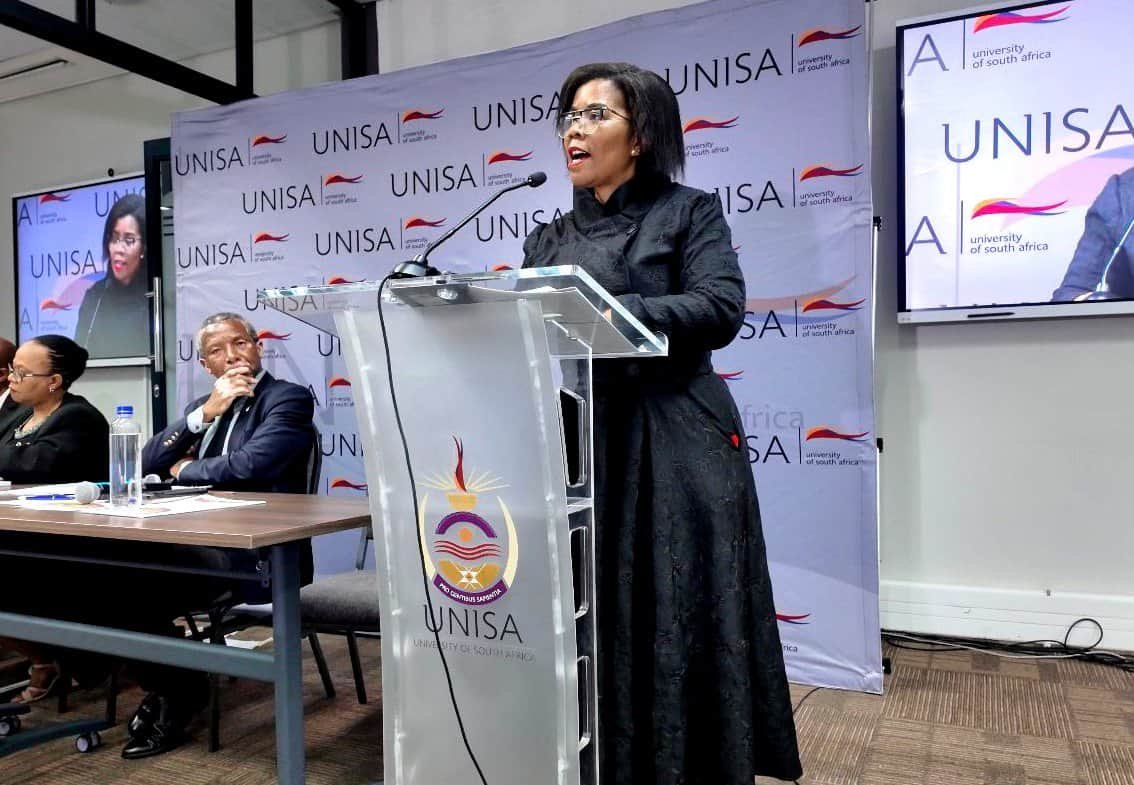
The University of South Africa (Unisa) has defended its academic standing, governance and financial management, while outlining major milestones including the acquisition of an airport, during a media briefing in Pretoria on Thursday.
Principal and Vice-Chancellor Puleng LenkaBula described the institution as a trailblazer in distance learning, research innovation and academic transformation, with a legacy spanning more than 150 years.
LenkaBula said the university’s performance between 2021 and 2025 demonstrated its continued contribution to skills development in the country. During this period, the institution consistently produced more than 50,000 graduates annually, including over 500 doctoral graduates and more than 900 master’s graduates each year.
She said these figures reflected the university’s role in producing high-level skills and supporting national development priorities.
Among the announcements was the acquisition of an airport, which LenkaBula said marked a first for a university in South Africa and on the African continent. The facility is expected to be officially launched between April and May.
According to LenkaBula, the airport will support training in aviation, aeronautics, drone technology and digital systems. She said it would serve as a strategic hub to develop scarce and critical skills, particularly in engineering and aviation, while also advancing innovation in emerging technologies.
The briefing also turned to governance issues after a question from the South African Broadcasting Corporation (SABC) about the 2023 independent assessor report, which raised concerns about procurement irregularities and administrative failures at the university.
LenkaBula dismissed the relevance of the report to the institution’s current performance, saying it was being used to revisit historical matters rather than reflect recent developments.
She said the university had received unqualified audit outcomes from 2021 to 2024, which, according to her, did not indicate irregularities comparable to those raised in the report.
LenkaBula said the report had been subject to legal scrutiny, noting that courts had previously found attempts to place the university under administration based on the report to be unlawful.
“You are asking us about the so-called independent assessor report. This report was taken for a review, but prior to the report there were cases where it was used to try and put the university under administration. The courts of this land said those actions were illegal,” she said.
She added that the report remained under review, emphasising that the courts had a role in ensuring that due process was followed.
LenkaBula also questioned the credibility of the report and challenged the media to scrutinise its authorship and basis.
“I always wonder why the media do not ask who wrote the report, what they are known for and what impact their research has had,” she said.
She contrasted this with the university’s research profile, stating that Unisa has 321 researchers and that its academic staff includes highly rated scholars recognised by the National Research Foundation (NRF).
During the briefing, LenkaBula pointed to some of the researchers present, including a B-rated scholar, as evidence of the institution’s academic strength.
She said an internal assessment of the university found that out of 16 clusters of outputs, 10 were rated as excellent, three identified as areas for improvement and three requiring further attention.
LenkaBula said the university’s progress should be viewed in the context of its scale and impact, highlighting its footprint in 130 countries and a student population of about 400,000.
She also said the institution had played a role in establishing at least 20 universities across the continent, contributing to the development of open distance learning systems in Africa.
LenkaBula defended the university against what she described as unfounded criticism, saying the institution would respond to factual concerns but reject claims based on assumptions.
“If you criticise us factually, we are willing to correct ourselves. But if you use conjecture and accusations that are not founded on fact, we are not going to accept that,” she said.
She added that the university remained committed to contributing to social transformation, democratic development and the goals outlined in Africa’s Agenda 2063.
Separately, the university confirmed that it had obtained a court interdict against its former registrar, Steward Mothata, following an urgent application heard in the High Court in Pretoria earlier this week.
In a statement issued on Wednesday, the university said the court had interdicted and restrained Mothata from continuing with actions and communication that it said attacked, harassed or undermined the institution, its leadership and governance structures.
The matter was heard in absentia after Mothata failed to appear in court despite being informed of the proceedings. The court was satisfied that proper notice had been served.
After considering the application and evidence presented, the court granted an order in favour of the university. The institution said the order was intended to prevent further conduct that could harm its integrity, reputation and functioning.
The university said the ruling underscored the seriousness with which the judiciary treats actions that may affect institutional governance and reputation.
It added that it would continue to take legal action against individuals whose conduct it believes damages the institution.
LenkaBula said the developments formed part of efforts to stabilise and strengthen governance at the university while maintaining its academic and research focus.
She said the institution would continue to prioritise accountability, innovation and access to education, particularly through its distance learning model, which remains central to its operations.