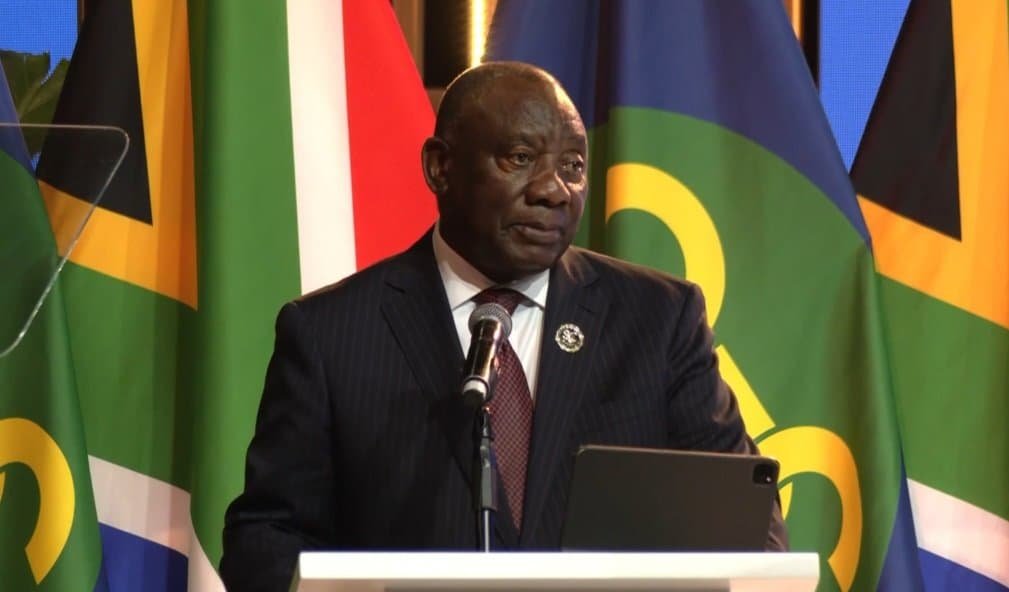
South African President Cyril Ramaphosa has placed infrastructure, regional trade and industrialisation at the centre of South Africa’s year at the helm of the Southern African Development Community (SADC), promising to turn regional commitments into projects that can be measured in jobs, electricity, railways and faster border crossings.
Closing the 46th SADC Summit in Durban on Monday evening, Ramaphosa said the region had the resources and political will to become a major centre of growth, but warned that the next phase would have to focus on implementation rather than additional declarations.
“Our citizens will ultimately judge us not by the number of resolutions we adopt, but by the difference those resolutions make in their daily lives,” Ramaphosa said.
South Africa was elected to chair SADC for the next term, with Zambia named the incoming chair. Eswatini’s King Mswati III was elected chairperson of the Organ on Politics, Defence and Security Cooperation.
The summit adopted the theme of “Resilient, Sustainable, and Inclusive Industrialisation through Infrastructure Development, Agricultural and Critical Minerals Transformation in Pursuit of a Just World”, placing infrastructure, agriculture and mineral beneficiation at the heart of the bloc’s economic strategy.
Ramaphosa said South Africa would make the development and efficient functioning of regional economic corridors a major priority during its chairship.
The corridors are intended to connect producers, landlocked economies and ports, while reducing the cost and time of moving goods across borders.
“We must accelerate the establishment of the identified One-Stop Border Posts,” Ramaphosa said, arguing that trucks transporting goods across Southern Africa should not spend days waiting at border posts.
The summit called on corridor countries to conclude and implement the legal and institutional arrangements required to operationalise the corridors.
The regional bloc also wants to revitalise railway networks, modernise ports and improve road and logistics infrastructure.
For a region where several economies depend heavily on access to ports outside their borders, the infrastructure agenda has implications well beyond transport. Improved corridors are expected to strengthen intra-regional trade, support regional value chains and make it easier for countries to process their raw materials locally.
The summit’s mid-term review of the SADC Regional Indicative Strategic Development Plan identified several high-impact priorities, including industrialisation, regional value chains, agro-processing, critical minerals, a just energy transition, economic corridors and one-stop border posts.
Energy was another central priority.
Ramaphosa said SADC would work towards increasing access to electricity across the region to at least 85% by 2030, while improving reliability and affordability.
He said greater regional electricity interconnection and investment in generation and transmission infrastructure would allow countries to move electricity more efficiently across borders.
The summit also called for stronger regional cooperation on water and sanitation.
Financing remains a major obstacle to the region’s ambitions. SADC leaders called for progress towards operationalising the SADC Regional Development Fund, while urging member states that have not ratified the agreement to do so.
The fund is intended to strengthen the region’s ability to mobilise resources for infrastructure, industrialisation and socio-economic development.
Beyond economics, the summit addressed several political and security challenges confronting the region.
SADC reiterated its solidarity with the people of the Democratic Republic of Congo and support for coordinated regional and international efforts to restore peace, protect civilians and strengthen humanitarian and public health responses.
On Madagascar, leaders welcomed engagement led by the SADC Panel of Elders and called on stakeholders to maintain calm and pursue dialogue as the country works towards constitutional normalcy.
The bloc also commended Mozambique’s ongoing inclusive national dialogue and efforts to combat terrorism in parts of Cabo Delgado.
Zimbabwe’s election as a non-permanent member of the United Nations Security Council for 2027 and 2028 was welcomed by the summit. SADC also renewed its call for the removal of sanctions imposed on Zimbabwe, saying they continued to constrain the country’s economic potential.
Migration was also placed on the regional agenda after South Africa presented an update on migration governance.
The summit called for coordinated and multidimensional dialogue to address the underlying causes of migration and develop sustainable regional responses.
Health security featured prominently, with leaders urging stronger disease surveillance and preparedness. They specifically called for continued support for the Democratic Republic of Congo in responding to the Ebola outbreak.
The summit also designated Botswana’s Vaccine Institute as a regional foot-and-mouth disease antigen and vaccine bank as SADC seeks to strengthen its response to outbreaks affecting livestock and agricultural trade.
Climate risks were another concern, with member states urged to prepare for anticipated El Niño-related shocks through early warning systems, drought preparedness, irrigation and climate-smart agriculture.
In a move aimed at boosting tourism and regional mobility, SADC approved an agreement establishing a regional Tourism UNIVISA and called on member states to sign it.
The bloc said the initiative could facilitate seamless travel, increase visitor arrivals and investment and deepen regional integration.
Ramaphosa also highlighted the need to place young people and women at the centre of the region’s development. SADC called for stronger youth programmes, skills development, entrepreneurship, innovation and employment opportunities, while urging member states to accelerate progress towards greater representation of women in leadership and decision-making.
As South Africa assumes the chair, Ramaphosa said the measure of success would ultimately be tangible.
He called for progress to be assessed through kilometres of railway rehabilitated, megawatts of electricity generated and transmitted, shorter border-crossing times, new factories, increased intra-regional trade and jobs created.
“Let us build a Southern Africa that is peaceful, integrated, industrialised and prosperous,” Ramaphosa said. “And let us build it together.”
The 47th SADC Summit will be held in Zambia.