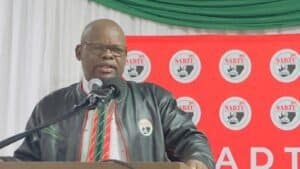
Higher Education and Training Minister Buti Manamela has welcomed a damning provisional Public Protector report which found systemic deficiencies in the administration, governance, funding and oversight of the National Student Financial Aid Scheme (NSFAS), warning that years of institutional failures have prejudiced students and undermined their constitutional right to further education.
Public Protector Advocate Kholeka Gcaleka released a Section 7(9) notice on Tuesday outlining intended findings from a systemic investigation into NSFAS, the Department of Higher Education and Training (DHET), universities, TVET colleges and other institutions involved in administering student financial aid.
The findings are provisional and affected parties have 60 calendar days to respond with representations, records or evidence that could persuade the Public Protector to amend or withdraw the intended findings.
Gcaleka stressed that the notice does not constitute a final determination.
The investigation found that complaints about individual students were symptomatic of much wider failures across the higher education funding system.
Among the problems identified are persistent delays in funding decisions and allowances, appeal backlogs, inconsistent eligibility determinations, mid-year defunding, poor communication with students, weak coordination between NSFAS and institutions, unresolved student accounts and failures in financial reconciliation.
The Public Protector also found that governance instability had contributed to NSFAS’s inability to effectively discharge its mandate.
The investigation found that NSFAS had gone through repeated periods of instability, including executive interventions and changes to its board and leadership. The report notes that administration under Section 17A of the NSFAS Act has been invoked three times in eight years, in 2018, 2024 and 2026.
The latest intervention was announced by Manamela in May, when he placed NSFAS under administration and appointed Professor Hlengani Mathebula as administrator.
Government said the intervention was intended to stabilise NSFAS, strengthen governance and financial management and address systemic weaknesses. Mathebula’s appointment took effect on 4 May 2026.
Manamela said the Public Protector’s findings were consistent with concerns already raised within his department.
“The issues identified in the report are not new,” Manamela said.
He said they were among the longstanding governance, administrative and operational problems that had informed his decision to place NSFAS under administration.
The minister said an earlier report from Mathebula had also identified a range of challenges requiring urgent intervention.
He further pointed to a meeting with the Auditor General of South Africa in March, during which serious concerns were raised about NSFAS’s financial management and governance.
The Auditor General issued a disclaimer of opinion on NSFAS’s 2024/25 financial statements, with accounting records and supporting evidence considered so inadequate that the reliability of the financial statements could not be determined.
The Public Protector’s investigation also highlighted the extent of the financial and administrative problems.
According to the report, Special Investigating Unit investigations under Proclamation R88 of 2022 identified more than 40,000 students at 76 higher education institutions who had been improperly funded, involving an estimated R5.1 billion.
More than R2 billion had reportedly been recovered.
The report said these findings, together with complaints from students, stakeholder engagements and oversight reports, provided prima facie evidence of probable systemic maladministration.
One of the most serious areas identified is NSFAS’s failure to complete its Close-Out Project.
The project, which began in 2021, was intended to reconcile financial information between NSFAS and higher education institutions, including student accounts. It remains incomplete.
The Public Protector said the failure to complete these reconciliations pointed to material weaknesses in financial controls and had contributed to students being denied access to qualifications after completing their studies.
Twelve complaints considered during the investigation involved students whose tuition accounts had outstanding amounts totalling R601,000.
The students had completed their studies but could not obtain their certificates.
Following intervention by the Public Protector, the outstanding accounts were eventually settled.
The report said the delays caused avoidable prejudice because withholding qualifications could prevent graduates from securing employment, pursuing further studies and participating in the economy.
The Public Protector is proposing that universities and other tertiary institutions reconsider debt recovery practices that prevent graduates from accessing qualifications needed to become economically active.
The investigation also found serious problems with NSFAS’s accessibility.
According to the report, NSFAS acknowledged that its contact centre was unable to resolve 80% of queries without escalating them to internal units.
The Public Protector found that this, together with the limited availability of walk-in services and ineffective query resolution, undermined students’ access to assistance.
Students were also found to have suffered prejudice from delays in funding decisions, appeals and allowances, including food insecurity, accommodation instability and exposure to unsafe living conditions.
The report said mid-year defunding and funding reversals were particularly disruptive because students could lose financial support after already enrolling and beginning their studies.
It further found that delays in eligibility verification, inadequate data-sharing with institutions and government agencies, and insufficient procedural safeguards raised concerns under the Promotion of Administrative Justice Act and section 33 of the Constitution.
The Public Protector also criticised the pace of implementation of recommendations contained in the 2022 Ministerial Task Team report on student funding.
Among the unresolved issues is funding for the so-called “missing middle” and certain postgraduate students.

DHET reported that NSFAS had been capitalised with R3 billion over three years from 2024 to 2027 to support missing-middle students. However, the scheme had received 43,261 applications from students eligible for this funding but had been unable to roll out the funding because it needed to procure a new loan system.
The Public Protector said delays in implementing the task team’s recommendations had allowed systemic weaknesses to persist.
The provisional remedial measures proposed include stronger oversight of NSFAS, an integrated plan for the 2027 academic year, completion of the Close-Out Project, clearing appeal backlogs and improvements to digital systems and data integration.
NSFAS would also be expected to identify officials or former officials responsible for governance breaches, maladministration and control failures and implement consequence management where warranted.
The proposed measures include disciplinary action, civil recovery and criminal referrals where appropriate.
NSFAS would further have to develop service standards governing funding decisions, appeals, defunding and communication, while ensuring that students receive reasons, adequate notice and an opportunity to make representations before adverse decisions are implemented.
The Public Protector also wants NSFAS to develop plans to strengthen fraud controls, cybersecurity, data integrity and integration with institutions and key government data sources.
Gcaleka said the investigation had also compared South Africa’s system with international models.
Australia and New Zealand were identified for operational efficiencies, including direct payment of tuition to institutions and income-contingent repayment systems. Canada was highlighted for coordinated data-sharing and a single application approach.
The Public Protector said South Africa could consider adapting elements of these systems while retaining constitutional protections, transparent means testing and accessible appeals.
Meanwhile, civil society organisation OUTA has seized on the report as further evidence of its concerns about NSFAS governance.

OUTA CEO Wayne Duvenage said the Gauteng High Court’s decision to suspend Mathebula’s appointment added weight to the organisation’s longstanding concerns about governance and accountability at the scheme.
The legal challenge to the administration of NSFAS has already placed Manamela’s intervention under scrutiny. The dissolved NSFAS board previously approached the Gauteng High Court in Pretoria seeking to halt the minister’s decision and prevent Mathebula from taking over the scheme. (The Citizen)
The Public Protector has now given Manamela, NSFAS and other affected parties an opportunity to respond before a final report is issued.
Manamela said his department would continue cooperating with the Public Protector.
He said the ultimate focus of the intervention remained the wellbeing of students.
“Every intervention must therefore ultimately contribute to ensuring that students receive the funding and the complete support they need to access higher education without unnecessary administrative failures,” he said.
The final outcome of the investigation could therefore have far-reaching consequences for NSFAS, DHET, universities and the way South Africa funds students who cannot afford higher education.