The National Dialogue — billed as a platform to forge unity and chart South Africa’s future — descended into chaos on its very first day, with political spats, withdrawals of key figures, and social media mockery overshadowing proceedings.
The opening session, hosted in Johannesburg, was briefly disrupted by shouting matches between delegates who clashed over the agenda and representation. Some participants accused the dialogue’s steering committee of favouring ruling party voices while sidelining grassroots groups. Security had to intervene to restore order, marking an embarrassing start to what was meant to be a moment of reconciliation.
The dialogue’s credibility suffered another major blow when prominent figures and foundations announced their withdrawal. Former Presidents Thabo Mbeki and Kgalema Motlanthe opted not to participate, joining a growing list of leaders who questioned the integrity of the process.
Five major legacy foundations — including the Desmond & Leah Tutu Legacy Foundation and the FW de Klerk Foundation — also pulled out. In a joint statement, they cited “the erosion of citizen leadership” and warned that the platform was becoming “state-dominated” rather than a genuinely inclusive space for South Africans.
The absence of these respected voices has fuelled criticism that the dialogue is a costly public relations exercise rather than a forum for real solutions.
The timing of the dialogue has also drawn sharp criticism. Many observers questioned why the opening day was scheduled to coincide with the 12th anniversary of the Marikana Massacre, where 34 mineworkers were shot dead by police in 2012.
Families of the victims and labour unions marked the commemoration in the North West, lamenting that government attention and resources were being diverted elsewhere. “How do you claim to listen to the people while ignoring Marikana?” one union leader asked.
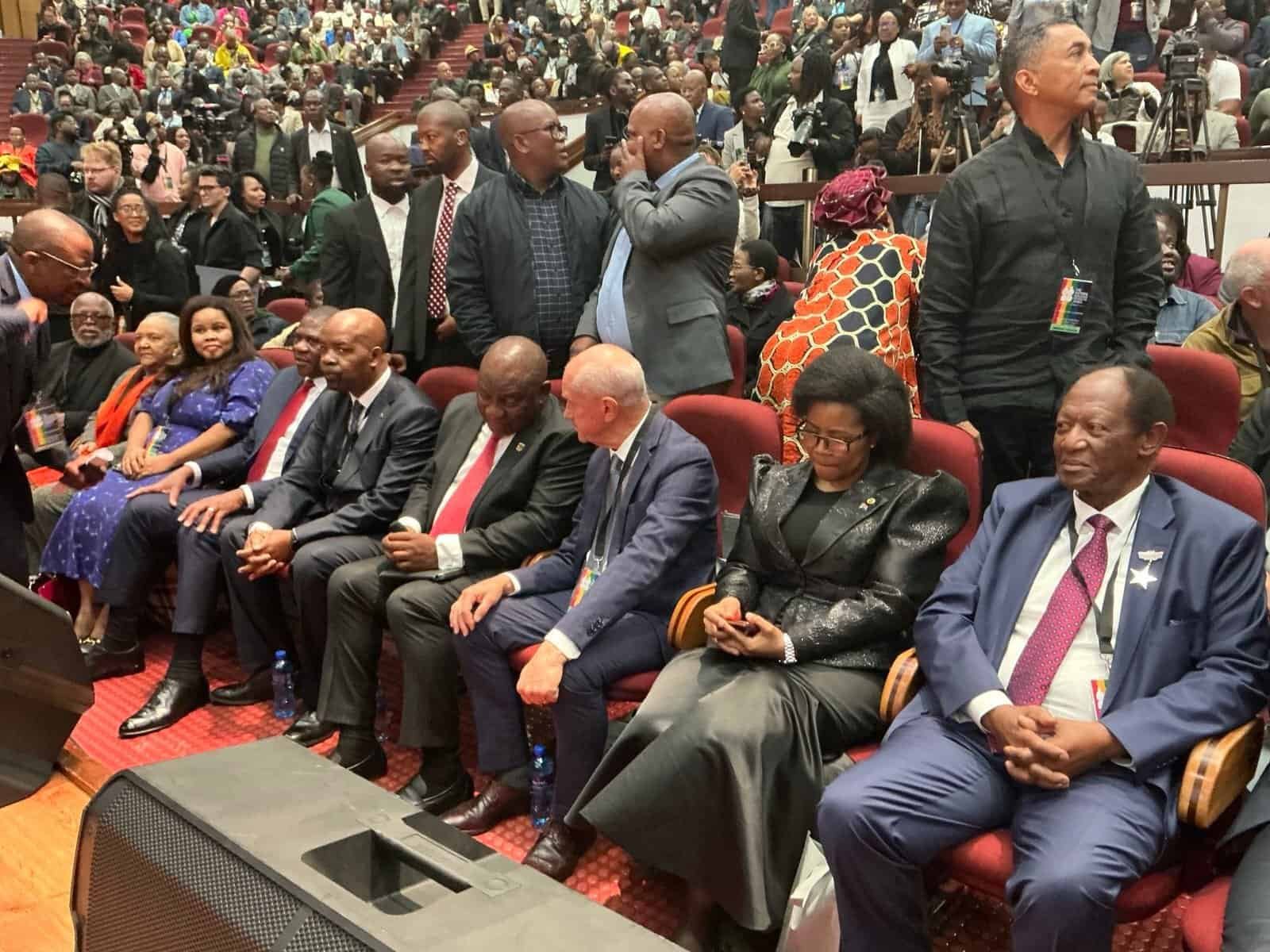
President Cyril Ramaphosa, who opened the dialogue, became the subject of ridicule online after pictures circulated appearing to show him dozing during the session.
Influential X user ChrisExcel posted the photo with a stinging caption:
“The President after spending R700 million of our tax to listen to our problem…”
The post quickly went viral, with thousands of South Africans echoing anger at the reported R700 million price tag attached to the dialogue. Many argued the funds could have been better spent addressing unemployment, which currently sits at 32.9%, among the highest in the world.
“Imagine what R700 million could do for job creation, skills training, or small businesses,” one user wrote.
The opposition Economic Freedom Fighters (EFF) were quick to capitalise on the fallout. Party leader Julius Malema, speaking at the Siyabonga rally in Polokwane, lambasted the event as a waste of public money.
“Government is wasting millions of rand on the so-called National Dialogue while our people are starving,” Malema told supporters. “They know the problems of this country: poverty, unemployment, corruption. We don’t need a billion-rand conference to tell us what we already know.”
The Democratic Alliance (DA) also criticised the dialogue’s spending. DA spokesperson Solly Malatsi said the event was “an expensive talk shop that excludes real solutions.” He argued that funds should have been channelled into service delivery and youth employment initiatives.
Meanwhile, the Inkatha Freedom Party (IFP) expressed disappointment over the chaos, warning that the dialogue risked becoming a “political circus” if inclusivity and transparency were not guaranteed.
Civil society organisations joined in condemning the event. The Organisation Undoing Tax Abuse (OUTA) described the reported cost as “obscene in a country battling economic collapse.” They argued that the withdrawal of respected foundations was proof that the dialogue lacked legitimacy.
Ordinary citizens echoed this sentiment on social media, with hashtags like #DialogueOrWaste and #RamaphosaSleeping trending. Memes of the president “sleeping” became the dominant image of the day, further denting public confidence.
Despite the turbulence, government representatives insisted the dialogue would continue. Presidency officials said the aim remains to bring together political parties, civil society, business, and faith groups to discuss the country’s most pressing challenges, from inequality to governance reform.
But critics argue that without broad trust and credible leadership, the initiative risks collapsing under its own weight.
“The National Dialogue was supposed to unite South Africans. Instead, it has divided them further,” ACT national spokesperson Rev. Mo’hau Khumalo said. “This cannot be another elite gathering at taxpayers’ expense while millions of young people remain jobless.”
As the dust settles on the chaotic first day, the challenge for the dialogue’s organisers is not only to manage discussions but to restore public faith in its purpose. With unemployment, inequality, and corruption crises deepening, South Africans are asking whether this multi-million-rand initiative is the solution — or just another costly performance.