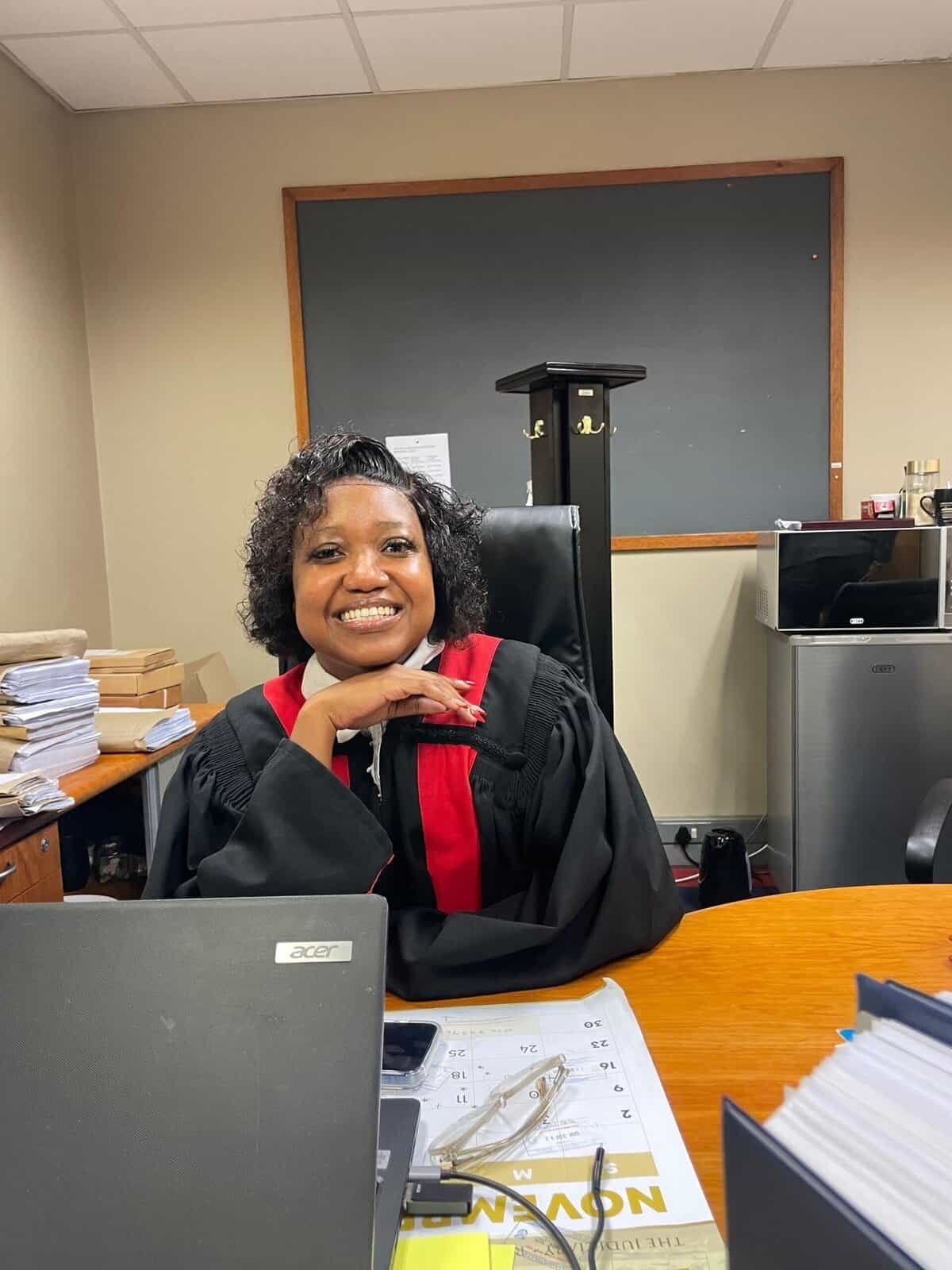
Deeply committed to her work, Johannesburg Magistrate Katlego Mokoena speaks with both pride and frustration, pride in the impact she is able to make, and frustration at the structural barriers that continue to shape women’s experiences in the legal profession. Her current focus lies in cases involving children, work she describes as among the most emotionally demanding in South Africa’s justice system.
Mokoena serves at the Children’s Court in Ekurhuleni, where she deals with a range of matters, including civil, criminal, family, and children’s court cases. Many of the cases she adjudicates involve parental conflict and children at risk.
“It is challenging because we deal with baby mama and daddy issues… placing kids at risk sometimes,” she says.
Despite the emotional strain her work often places on her shoulders, Mokoena insists the role is deeply fulfilling. “I’m a crybaby as much as I’m a hard person. I’m also a softie. It’s life changing when you know you can change someone’s life for the better.”
She stresses that children are often the silent victims in adult conflict, and that parents frequently underestimate the long-term consequences of their actions.
Humanity alongside the law
Asked how she manages her emotions while remaining professional, Mokoena says her approach is rooted in understanding the communities she serves.
“For me, it’s understanding the community I serve, understanding the social context and ordinary people in the streets. I understand the struggles of people,” she says.
That perspective, she explains, helps her strike a balance between empathy and legal duty. “Legally, I have to apply the law but not forget humanity,” she says, adding that “humanitarianism and humanity go hand in hand with what you do every day.”
For her, the overriding principle is clear: “The best interests of the children are always at the centre of what you do. I’m happy where I am right now; not doing criminal or civil law, just dealing with kids.”
But even as women like Mokoena build purpose and identity in law, she is direct about the barriers that continue to shape women’s careers, especially in male-dominated environments.
“This Legal Space is Still a Boys’ Club”
“When it comes to genuine inclusion, I maintain that there is a need to break this thing of the big boys’ club, or white boys’ club, or gentlemen’s club in the legal space,” Mokoena says.
Her frustration echoes what many women in South Africa’s legal profession continue to describe. Progress is visible, but equality in authority, recognition, access and pay remains uneven.
Interviews with another female magistrate and two women law firm directors reveal overlapping patterns, despite working in different corners of the profession. Their experiences reflect shared challenges around inclusion, gender bias, professional respect, leadership expectations and pay parity, barriers that persist even after women rise into senior ranks.
Progress Is Visible But Parity Remains Elusive
Mokoena acknowledges that transformation is happening. More women are entering the profession, and more are reaching higher office. She cites the appointment of Justice Mandisa Maya as Chief Justice, effective 1 September 2024, as a milestone.
“That was a huge stride for any Black female or any female in this legal space,” she says. But she insists inclusion must go beyond symbolic wins. “We need more female judges. We need those who are going to do tax law, corporate law and all those things,” Mokoena says. “Inclusion is filling up spaces; whether in corporate, judges, magistrates. Let’s pull up as we rise.”
She adds: “Lady Justice, the one blindfolded is a woman. And that speaks a lot. It shows how much power women carry, no matter the colour of their skin.”

When The System Pushes Back
Tensions over pay and working conditions have surfaced publicly in recent months, including among magistrates themselves.
Reports indicate that recommended salary adjustments would raise magistrates’ annual pay from R1,161,674 to R1,561,876, a 34% increase, with senior magistrates earning R1,735,417, regional magistrates R1,908,959, and regional court presidents R2,082,501.
But in October 2025, about 30 magistrates of all genders protested outside the South African Parliament, demanding improved salaries and working conditions. They wore their robes and held placards reading “Magistrates Matter” and “Justice for Justice Workers.”
Mokoena echoes some of the frustrations behind such protests, arguing that magistrates are under-resourced and under-supported. She claims prosecutors earn more than magistrates, and says magistrates often do not receive benefits such as medical aid, housing allowances or car allowances, realities she believes deepen anger across the system.
The Motherhood Penalty in Demanding Professions
For women in law, the pressure does not end at the courtroom door. Mokoena also raises concerns about parental leave in professions as demanding as the judiciary.
Following a Constitutional Court ruling, parental leave has been redefined to allow parents to share a combined leave period of four months and ten days, rather than maternity leave being treated as exclusive to birthing mothers.
While she acknowledges the principle of shared parenting, she argues that for women in highly demanding professions, particularly in the first months after childbirth, the policy still falls short.
She believes women need more time at home to care for newborns, rest and recover before returning to punishing hours.
Leadership and Mentorship: “Fix each other’s crowns”
Beyond policy, Mokoena says women also face power struggles within male dominated environments. “There is always going to be a power struggle,” she warns. She credits mentorship for her own professional growth. “For me to become a magistrate, it took my former magistrate to recognise me and say, ‘come and apply at the bench.’”
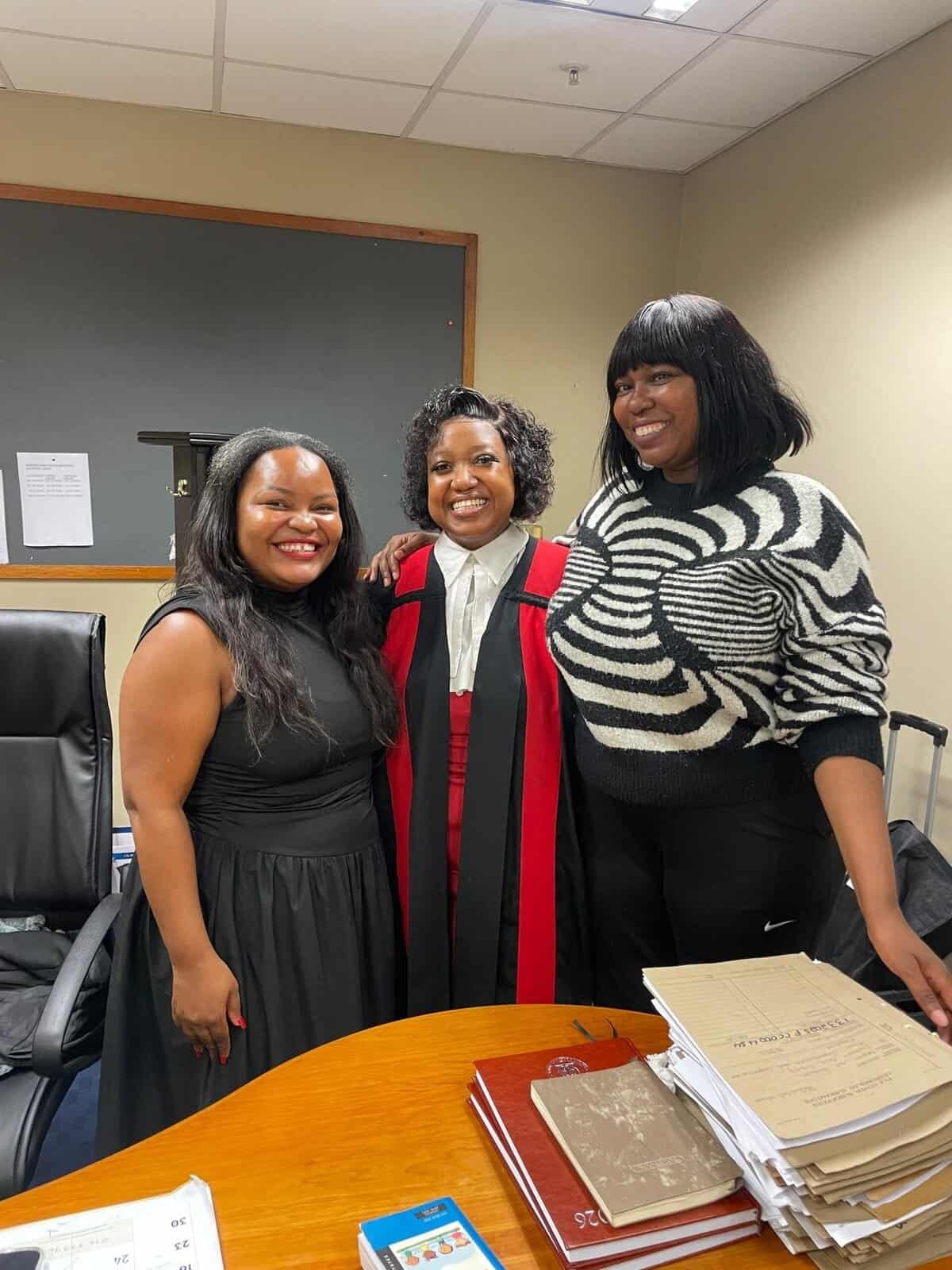
Now she plays that role for others. As part of a mentorship programme, she supports young women entering the legal profession, including Zanele Zengele, a fourth-year law student at the University of South Africa.
“I really don’t want this mentorship to stop,” Zengele says. “I am learning a lot from her, especially how she spoke about humanity.”
Research reinforces these accounts. In her 2024 report titled “The price women attorneys pay for being mothers in South African law firms”, University of Cape Town researcher Dr Tamlynne Meyer found that women are consistently marginalised in the legal profession and remain under-represented in senior positions despite a strong legal and policy framework that promotes equality.
Meyer’s research examined the impact motherhood has on women attorneys in South African law firms and found that many women experienced a disjuncture between their mothering and professional roles, a tension attributed to the hyper competitive culture of the profession.
“This study has provided an insight into the challenges experienced by women attorneys who are mothers in South African corporate law firms as they navigate their dual responsibilities as career women and mothers,” Meyer said.
She added that the legal profession remains historically male dominant, shaped by a hyper competitive masculinised professional culture.
“While there is much to celebrate in women’s advancement in the workplace, it is undeniable that many women in historically male dominant professions such as the legal profession continue to experience myriad challenges as they pursue both a legal career and motherhood,” Meyer said.
According to her research, most law graduates are women, and they constitute the majority of new entrants admitted into the profession. Yet at the most senior levels, notably partnership level, women comprise only 28% of partners compared to men.
Mokoena sums up her approach in a line meant to uplift: “We are queens, ladies. We need to fix each other’s crowns and constantly be supportive.”
Perceptions of Male Colleagues
Advocate Kgaogelo Letswalo from the North West Province Bar says there is some truth in the view that women are overlooked, though he says he begs to differ when it comes to promotion.
He argues the judiciary is trying to transform by promoting women, particularly Black women. He points to developments in the Constitutional Court, the Supreme Court of Appeal, and smaller courts, saying women “of all races” are taking their spaces.
“The legal fraternity is changing to benefit from the transformation agenda which focuses on all women. There is a change in demographics on the gender of judges or law practitioners which is something we can command,” Letswalo says.
On salary disparities, he says he cannot comment in detail because law practitioners like him deal with invoicing and operate from fee guides that do not discriminate by gender.
He adds that a decade ago the profession was strongly male dominated, but says change is underway.
“It is just for women to support each other. Let us be a little patient, better times are coming,” he says.
Another male legal professional, Advocate Kagiso Ndhlovu, argues that the South African legal profession still unfairly disadvantages Black lawyers.
Despite qualifications and ability, he says many Black attorneys and advocates are overlooked, questioned and excluded through both obvious and subtle discrimination.
Ndhlovu describes a system that still operates like a “boys’ club,” where powerful networks, mostly male and often racially exclusive, control access to work and professional growth.
As a result, Black practitioners, especially those from previously disadvantaged backgrounds, struggle to receive meaningful and high-profile cases. Instead, he says, they are pushed into lower status work, while major commercial and high value cases go to a small privileged group.
Ndhlovu also raises concern about unethical work allocation, where cases are sometimes awarded through “favours” rather than merit. He says the practice harms everyone, but leaves women particularly vulnerable.
The law says equality, but the profession tells another story
The African Human Rights Law Journal argues that women in South Africa’s legal profession are still not treated equally despite laws promising equality.
The profession remains dominated by men, and women, especially advocates and attorneys, are underrepresented and face barriers, including male controlled networks, clients and colleagues doubting women’s abilities, unequal access to influential work, and career setbacks linked to maternity leave and child care responsibilities.
The article argues that formal equal treatment is not enough. It calls for substantive equality, including special measures that recognise women’s lived realities and structural barriers. It highlights maternity support at the Cape Bar as one example.
“You work ten times harder to sit at the table”
For women in private legal practice, inequality is not only about representation, it is about access, power and earning potential.
Conveyancer Matlale Mabotse Mohlala, a director at the Black female owned firm Mokgehle Mohlala Attorneys, says conveyancing remains dominated by white men, and that professional systems such as examinations can disadvantage Black candidates.
“You work ten times harder in order to sit at the table and be listened to,” she says. Mohlala adds that women are often expected to provide additional emotional labour, especially when dealing with clients’ finances, and are frequently pressured into providing pro bono services.
She also claims that men tend to earn more than women in legal partnerships, estimating the gap can be as high as 30%.
“It’s an open secret that males tend to get higher salaries than women,” says Shadi Motjopi, founder and director of MOTJOPI INC Attorneys.
Motjopi estimates that in small to medium firms, a male director could take home between R45,000 and R50,000monthly, while a female director might take home between R30,000 and R40,000, even if she negotiates.
“Give me what I’m giving you. If I’m giving you 100%, give me 100%,” she says. A report referenced by African Law & Business, based on a survey of 100 senior female legal practitioners conducted by Plus 94 Research and presented through the Advancing Women in the Workplace programme, found that discrimination remains widespread.
The report found that 89% of women said they receive fewer work opportunities than male colleagues, meaning men are more likely to receive important and high paying cases. 84% percent said they are not treated equally at work, while 81% said the bias is worse for Black women. Nearly half, 47%, reported being paid less than men for similar work.
Policy frameworks exist. South Africa introduced the Code of Good Practice on Equal Pay on 1 June 2015 under the Employment Equity Act. The Code applies to all employers and employees covered by the Act and is meant to stop unfair pay discrimination.
The principle is direct. Employees doing the same job, similar work, or work of equal value must be paid equally unless there is a fair and valid reason for a difference. The Code also places responsibility on employers to conduct pay audits, apply fair job evaluations and correct unjustified pay gaps.
Yet for many women in the legal profession, the persistence of wage gaps, network exclusion and unequal work allocation suggests enforcement remains uneven, and workplace culture continues to tilt in favour of men.
Women’s progress in South Africa’s legal system is unmistakable, from courtrooms to the bench and even at the highest judicial office. But as Mokoena and others argue, visibility is not the same as equality.
Until influence, earning power, leadership access and professional respect are distributed fairly, the fight will remain what many women describe it to be: breaking barriers, only to find new ones waiting beyond them.
This piece was produced as part of the Difference She Makes: Voice and Verdict Fellowship, a journalism initiative that brings forward country stories investigating, interrogating, and reflecting solutions for women’s leadership in law.