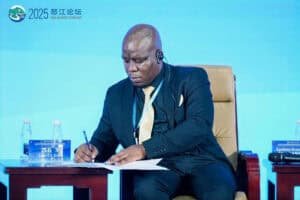
Deputy National Police Commissioner General Shadrack Sibiya on Monday appeared before the ad hoc parliamentary committee investigating the alleged capture of police and politicians, facing tough questions from Chief Evidence Leader Norman Arendse SC about his role in the disbandment of the Political Killings Task Team and his links to controversial figures.
The hearing, which started later than planned, was marked by sharp exchanges, political jabs, and tense moments that revealed the deep divisions within the committee itself.
Sibiya had been scheduled to appear at 11am, but proceedings were delayed after Democratic Alliance MP Glynnis Breytenbach raised an objection, arguing that a member of the uMkhonto weSizwe (MK) Party sitting on the committee had opened a criminal case against Sibiya – a potential conflict of interest.
Her comments sparked an immediate backlash from MK Party members, who accused Breytenbach of hypocrisy. “If the DA insists on removing our member, then Kohler Barnard must also be recused,” one MK Party MP argued, referring to previous allegations by KwaZulu Natal Police Commissioner General Nhlanhla Mkhwanazi that Barnard had allegedly leaked sensitive information to the media during the Madlanga Commission hearings in September. Barnard has vehemently denied those allegations.
After nearly two hours of procedural wrangling, Sibiya was finally called to testify just after noon. Before taking the stand, he requested to consult with his legal representatives, and only after receiving the green light did he agree to testify under oath.
Arendse: “Do you know Brown Mogotsi?”
Arendse opened the questioning with a name that has repeatedly surfaced in the hearings, Brown Mogotsi, a busibessman from the North West linked to both political and criminal networks.
“I know Brown Mogotsi,” Sibiya said calmly. “I know him as an activist in the North West. But I didn’t know him personally. I Googled him and saw that at some point he was commenting in an interview about the former premier of North West.”
Pressed by Arendse about the nature of their contact, Sibiya admitted that Mogotsi had called him. “He contacted me… he would collect information on what’s going on, whether it be tender-related corruption or concerns that he had. He also warned me that intelligence people were working on me. It was something I was already aware of,” he said.
Sibiya told the committee he had even discussed the matter with National Commissioner Fannie Masemola, describing the call as “strange” and unsolicited. “He said he was Brown. I didn’t know him. I did not entertain him further,” Sibiya said. “I have never even met him once. His phone will show he called me, the records should be there.”
When Arendse pressed him again, asking how Mogotsi had obtained his number, Sibiya responded, “I don’t know this guy. At this level, you do get calls from citizens who say, ‘I’ve been given your number.’ It’s part of the job.”
“You answer to the commissioner, not the minister”
The hearing took a sharp turn when Sibiya recounted a heated confrontation with KwaZulu-Natal Provincial Commissioner Lieutenant General Nhlanhla Mkhwanazi, who reportedly accused him of overstepping his authority.
“Mkhwanazi was fuming,” Sibiya told the committee. “He said, ‘Listen here, General Sibiya, you are not going to phone my province and order my people around.’ I told him we are not fighting. He said, ‘You call my people and instruct them that the minister [Senzo Mchunu] wants them at head office, and I don’t know about it.’ I apologised and said I was just relaying the instruction.”
According to Sibiya, Mkhwanazi shot back: “No one is going there. I don’t report to politicians.”
Sibiya said he was taken aback by the tone of the exchange. “At the police college, we were taught discipline and respect for rank. I didn’t expect that level of aggression from a fellow general,” he said.
His remarks drew murmurs from some committee members, particularly after Arendse noted that Sibiya had effectively admitted that his line of accountability lay with the National Commissioner, not the Minister of Police.
Background: Explosive allegations
Both Masemola and Mkhwanazi had testified before the same committee last week, with their accounts providing starkly different narratives about the internal power struggles in the South African Police Service (SAPS).
Masemola told the committee that “the chain of command in the SAPS must remain clear,” adding that “no instruction can come from a politician directly to a police officer.” He emphasised that interference from outside structures had “compromised the integrity of operational policing.”
Mkhwanazi, meanwhile, made explosive claims in his earlier testimony and in a July media briefing, accusing suspended Police Minister Senzo Mchunu and Sibiya of being part of what he described as “a dangerous political capture network.”
He told journalists then that the disbandment of the Political Killings Task Team (PKTT) was “not an operational decision but a political one,” alleging that both Mchunu and Sibiya had ties to figures involved in organised crime.
Mkhwanazi specifically mentioned Brown Mogotsi, Vusimuzi “Cat” Matlala, currently in custody on multiple charges, including the attempted murder of actress Tebogo Thobejane, and several others linked to what he called “criminal cartels operating under political protection.”
Divisions deepen
Monday’s proceedings highlighted the growing rift between senior SAPS officials and the political leadership. Arendse’s probing of Sibiya’s communication with Mogotsi and his admission about taking ministerial “instructions” appeared to raise more questions than answers.
As the hearing adjourned, committee members called for the subpoena of additional records, including phone logs, to verify Sibiya’s claims.
The ad hoc committee’s work continues this week, with several key witnesses, including senior intelligence officials, expected to appear before the end of the month.
For now, Sibiya’s testimony has added another layer of intrigue to a saga that has already exposed deep fractures within the country’s law enforcement leadershi, and a troubling overlap between policing and politics.