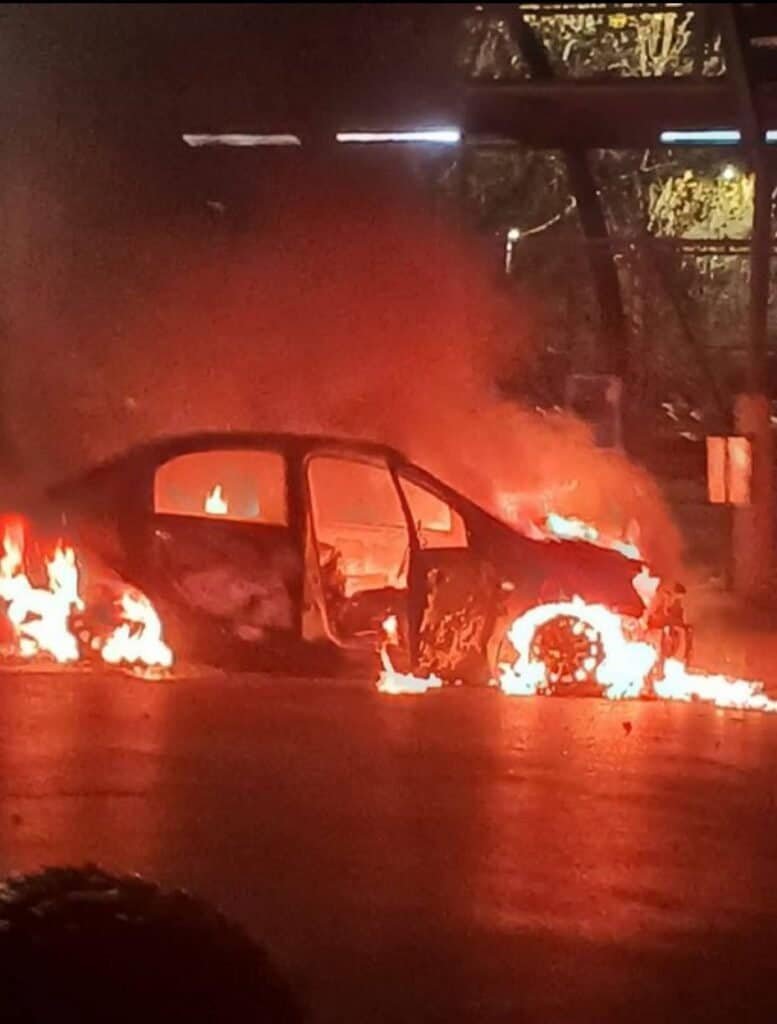
Soweto woke up on Thursday morning to the smell of burnt metal and the echo of gunfire still haunting the night. Outside Maponya Mall, a charred shell of what was once a working man’s livelihood stood as a grim reminder of how far the long-running war between minibus taxi operators and e-hailing drivers has spiralled.
On Wednesday night, 13 August 2025, the deadly tensions flared again. Police say an e-hailing driver was waiting at the mall’s entrance when four armed men approached, opened fire, and then torched his car. Another e-hailing vehicle parked nearby was also attacked — the driver escaped with his life, but not without injuries.
By the time the gun smoke cleared, one man lay dead — a breadwinner who had taken to driving passengers not for luxury, but for survival. A passerby and the second driver were rushed to hospital with gunshot wounds.
Police have opened cases of murder, two counts of attempted murder, and arson. The Gauteng Provincial SAPS and Johannesburg Metropolitan Police Department (JMPD) remain on high alert, as investigators work under the belief that the attack was taxi-violence related.
“This is a clear act of targeted violence and we are investigating all leads,” said SAPS Gauteng spokesperson Colonel Dimakatso Nevhuhulwi. “We are appealing to anyone with information to come forward. Communities must work with us to break this cycle of revenge attacks before more lives are lost.”
Neighbours describe the slain driver, whose name is being withheld until family are informed, as a quiet, hardworking man. “He had kids to feed, a family depending on him,” said a close friend from the same street in Pimville. “He wasn’t looking for trouble — he was just looking for fares. That was his crime.”
For many like him, e-hailing is not a side hustle. It is a lifeline in a country where the official unemployment rate hovers around 33%. Yet, stepping behind the wheel as an Uber or Bolt driver in certain parts of Gauteng means stepping into a war zone.
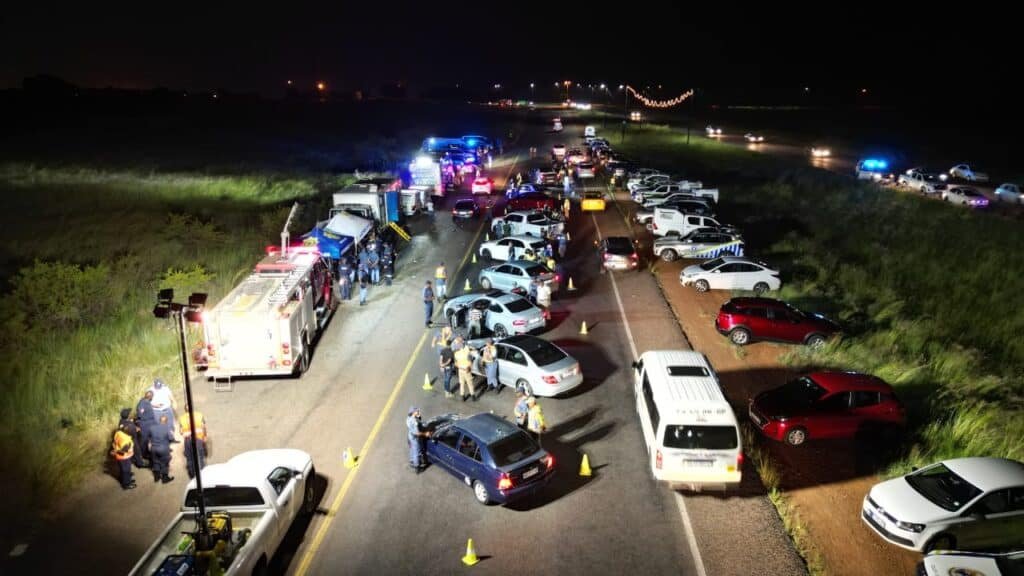
The animosity between taxi associations and e-hailing services is not new. The taxi industry, long the backbone of South Africa’s commuter transport system, views e-hailing as a threat to its dominance and income. E-hailing platforms, meanwhile, have tapped into a customer base looking for convenience, transparent pricing, and perceived safety.
But this competition has too often been waged with bullets and petrol bombs. In 2017, an Uber driver was burnt alive in his car near Loftus Versfeld Stadium in Pretoria. In 2019, a Bolt driver was shot dead in Sandton while waiting for a fare. In 2021, several e-hailing vehicles were torched outside the Mall of Africa during a flare-up of tensions. As recently as 2024, drivers reported being chased, assaulted, and having their vehicles vandalised at malls in Soweto, Pretoria, and Cape Town.
The violence is often linked to “territorial control” — malls, taxi ranks, and other high-foot-traffic areas are considered prime spots for picking up passengers. In some locations, taxi operators enforce unofficial “no-go zones” for e-hailing cars, sometimes through intimidation, sometimes through deadly force.
Gauteng MEC for Roads and Transport, Kedibone Diale-Tlabela, condemned Wednesday’s incident in the strongest terms.
“No grievance or commercial dispute justifies the taking of a life or putting innocent people at risk,” she said, urging police to prioritise arrests and calling for peaceful dialogue between taxi associations and e-hailing companies.
But the South African National Taxi Council (SANTACO) has pushed back, blaming the chaos on what it calls “the continued illegality and lack of regulation in the e-hailing sector.”
In a statement, SANTACO said many e-hailing drivers operate without the government-issued permits required under the amended National Land Transport Act — amendments that were passed in May 2024 but have yet to be fully implemented.
“This regulatory vacuum is compromising safety and fuelling conflict,” said SANTACO national spokesperson, Mmatshikhidi Rebecca Phala. “We urge government to enforce the law before more lives are lost.”

The public reaction has been fierce, with many taking to social media to vent frustration.
“I hate taxi drivers so much. Burning another man in his car? Barbaric! Taxi drivers in Maponya don’t own commuters,” wrote lSister Ntswembu on X.
Another user, Itumeleng Rantho, said: “Clearwater Mall banned taxis from the premises and e-hailing is working swiftly. I don’t understand why Soweto malls don’t follow suit. Customers are complaining constantly about taxi driver harassment and they are losing business.”
Beyond the politics and the business rivalry, it is families like the one in Pimville — now without their breadwinner — who carry the heaviest burden.
“The kids are too young to understand the economics of transport,” said community activist Sipho Dlamini. “All they know is their father is gone because grown men decided their fight for passengers was more important than a human life.”
Experts say Wednesday’s violence is part of a broader failure to modernise South Africa’s public transport framework. While the taxi industry has historically operated with minimal state oversight, e-hailing arrived without a robust regulatory environment to integrate it fairly into the system.
Without swift legal clarity, enforcement, and real negotiation between the two sides, communities fear that incidents like Maponya Mall will not be the last.
For now, Soweto grieves. The burnt-out shells of two cars stand as silent witnesses to yet another night where the business of moving people turned into the business of killing them. And somewhere in Pimville, a family is planning a funeral instead of a future.