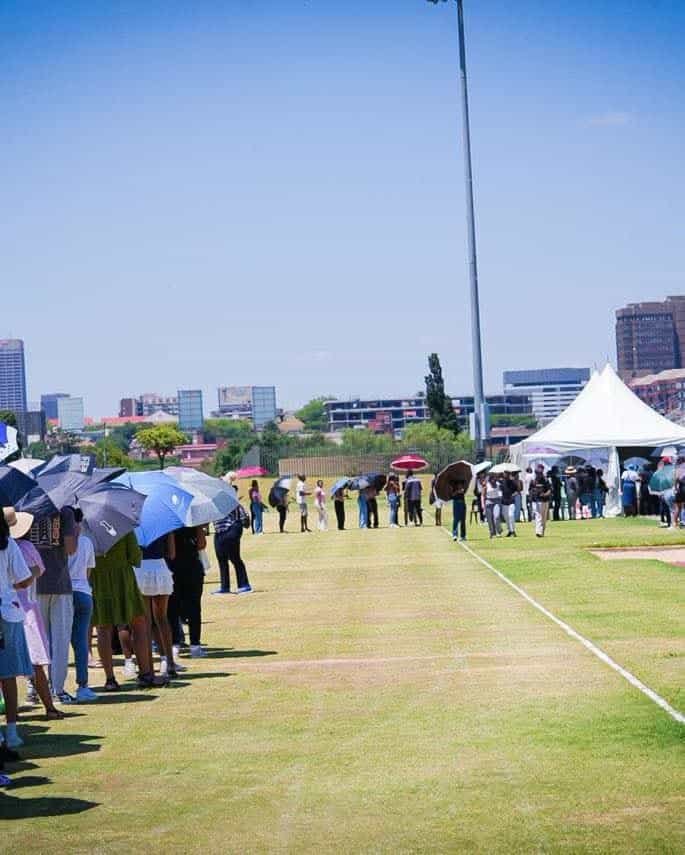
The Electoral Commission of South Africa (IEC) has urged eligible voters who have not yet cast their ballots to use the remaining hours of Wednesday’s local government elections, revealing that 12 million people had voted by 5pm.
With voting stations scheduled to close at 9pm, the commission said voting had progressed well across the country, despite a few isolated incidents.
The preliminary figures show that Gauteng recorded the highest number of voters, with three million people having cast their ballots by 5pm.
KwaZulu-Natal followed with 2.5 million, while the Western Cape recorded 1.5 million voters. The Eastern Cape had 1.4 million, followed by Limpopo with 1.1 million.
Mpumalanga recorded 854,901 voters, North West 702,133, the Free State 588,237 and the Northern Cape 299,381.
The commission said it was encouraged by the turnout at many voting stations and appealed to those who had not yet voted to visit their registered voting stations before the official closing time.
“With just three hours remaining before voting stations close at 21h00 tonight, the Electoral Commission urges eligible voters who have not yet voted to visit the voting stations where they are registered before voting close,” the IEC said.
It also reassured voters that nobody who arrived at a voting station before 9pm would be turned away, even if they were still waiting in the queue when the official closing time passed.
This means voting will continue for everyone who is in the queue by the deadline until they have had an opportunity to cast their ballots.
However, the commission encouraged voters not to wait until the last minute.
As voting entered the evening period, the IEC said it had made arrangements to ensure that voting and the subsequent counting process were not disrupted by electricity outages.
Generators and alternative lighting facilities had been arranged for voting stations in areas experiencing power cuts.
The preparations are particularly important as election officials begin counting ballots after voting closes, a process that will take place at each voting station in the presence of political party agents, independent candidate agents and accredited observers.
The IEC outlined the counting process, emphasising that all ballot papers would be counted at the stations where they were cast.
Once voting closes, sealed ballot boxes will be opened and ballot papers checked for the commission’s security stamp before being sorted and counted separately for each electoral contest.
These include the proportional representation (PR) ballot, the ward candidate ballot and, where applicable, the district council PR ballot.
The results will then be reconciled against the number of ballot papers received, issued, unused, spoilt and counted at each voting station.
Results slips will be captured in duplicate, signed by the presiding officer and countersigned by political party agents before being displayed at the voting station.
Party agents will also be allowed to photograph the signed results slips as part of the transparency measures.
The results will subsequently be scanned and captured at local IEC offices, where they will undergo verification and independent external auditing.
The commission said Results Operations Centres would provide political parties, independent candidates, observers and the media with an opportunity to monitor the capturing, verification and processing of election results.
This is intended to strengthen transparency and protect the integrity of the electoral process.
The IEC said final results and the allocation of seats in municipal councils would be announced within the prescribed seven-day period, once counting, capturing and verification had been completed and outstanding queries resolved.
The commission also thanked political parties and independent candidates for their participation through the National, Provincial and Local Political Liaison Committees, which provided platforms for consultation and resolving issues throughout the electoral process.
Election officials, security agencies, observers, the media and voters were also acknowledged for their contributions.
Despite the preliminary turnout figures, the IEC maintained that the final hours remained important for eligible South Africans who had not yet exercised their democratic right.
“South Africans, there is still time to get up. show up. Vote,” the commission said.