South Africa has recorded 21 politically motivated murder cases during the 2026 local government election period, with the National Joint Operational and Intelligence Structure (Natjoints) confirming that an MK Party member in KwaZulu-Natal was among the latest victims.
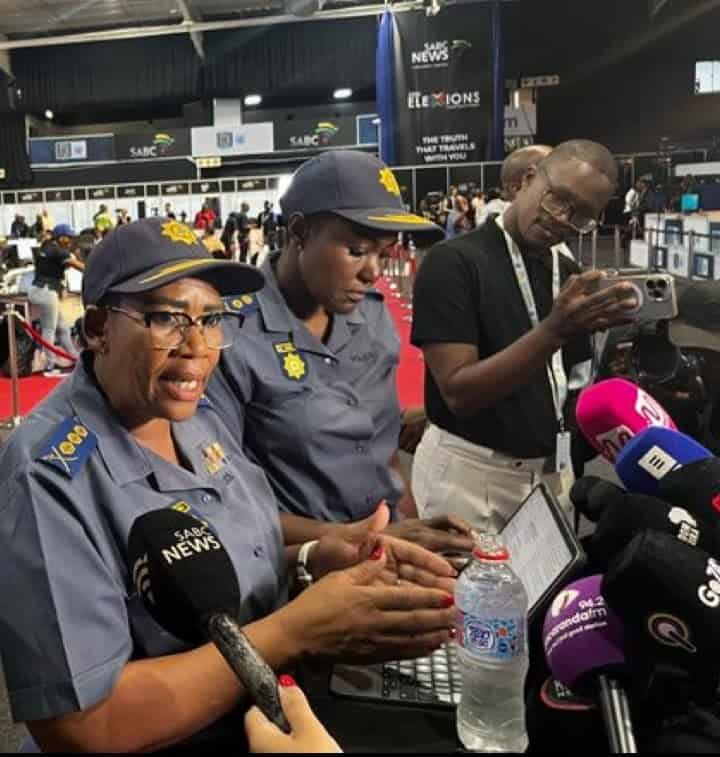
The disturbing figure was revealed by Chair Lt Gen Tebello Mosikili during a security briefing at the Results Operations Centre (ROC) in Midrand on Thursday, November 5, following a walkabout by Natjoints co-chairpersons and an assessment of the security situation after Wednesday’s local government elections.
The 21 cases highlight the deadly consequences of political violence during an electoral period in which parties campaigned for control of municipalities and communities went to the polls to elect their local representatives.
Briefing the media, Mosikili said the figure included murder cases identified as politically motivated in relation to the election period, which covered the two voter registration weekends, special voting on November 2 and 3, and voting day on November 4.
The latest murder involving an MK Party member in KwaZulu-Natal pushed the figure to 20 cases previously reported on Tuesday.
However, the security cluster did not provide details about the identity of the victim, the circumstances surrounding the killing or whether any suspects had been arrested in connection with the latest case.
The briefing also revealed that police were investigating other murders reported during the post-election phase, although these had not necessarily been classified as politically motivated.
In Mpumalanga, a 57-year-old man was shot and killed in the early hours of Thursday morning in Bushbuckridge.
In a separate incident in Limpopo, a 31-year-old man was stabbed to death at a park opposite Florapark Comprehensive School in Polokwane.
Police arrested a 35-year-old man in connection with the Polokwane murder following what Natjoints described as a swift response.
Another murder was reported in KwaZulu-Natal, where a man was attacked and killed while walking home on voting day.
The security cluster did not disclose whether the KwaZulu-Natal killing was linked to political activities or provide further details about the circumstances surrounding the incident.
The distinction between politically motivated killings and other murders reported during the election period is important, as police continue to establish the motives behind the various incidents.
The latest figures come as the security cluster maintains that the elections were conducted in a largely safe and conducive environment, despite incidents of criminality, intimidation and alleged electoral misconduct.
Natjoints said its operational plan was intelligence-led and risk-informed, with particular attention given to 331 voting stations identified as high-risk.
KwaZulu-Natal accounted for 165 of these stations, followed by Gauteng with 119, the Western Cape with 33 and Mpumalanga with 11.
The security operation involved coordination between the South African Police Service, the South African National Defence Force, the State Security Agency and other government departments, working alongside the Electoral Commission of South Africa.
Despite the deployment, criminal incidents were recorded during both special voting and election day.
During the two special voting days on November 2 and 3, police registered 65 criminal case dockets and arrested 32 suspects.
KwaZulu-Natal recorded the highest number of cases, with 16, followed by Limpopo with 13. The Eastern Cape and Western Cape each recorded eight cases, while Gauteng recorded seven.
Mpumalanga had five cases, the Free State and North West recorded four each, while the Northern Cape reported no cases.
On voting day alone, 85 incidents were reported nationally, resulting in 57 criminal case dockets being opened and 27 suspects arrested.
These included 32 cases relating to alleged contraventions of the Electoral Act, four assaults, two cases of malicious damage to property and two intimidation cases.
Other offences included theft, crimen injuria, drunk and disorderly conduct at a voting station, public violence, business burglary and fraud.
Gauteng recorded eight cases and seven arrests, while KwaZulu-Natal had 15 cases and six arrests. Limpopo recorded 11 cases and four arrests, and the Eastern Cape had 10 cases and four arrests.
The Free State recorded two cases and two arrests, Mpumalanga three cases and three arrests, while the Northern Cape recorded one case and one arrest.
North West recorded three cases without arrests at the time of the briefing, while the Western Cape had four cases and no arrests.
Natjoints also reported two deaths involving people who collapsed during the election period.
An elderly woman collapsed in Shallcross, KwaZulu-Natal, and died upon arrival at hospital. An Electoral Commission official also died following a similar reported incident at Buhrmansdrift in the Ngaka Modiri Molema District of North West on November 2.
The security cluster further confirmed that law enforcement agencies had intervened in cases involving alleged electoral transgressions by IEC officials.
In KwaZulu-Natal, police also acted against a member who arrived at a voting station in a vehicle displaying political party branding.
Natjoints said its interventions demonstrated that nobody was above the law and that electoral misconduct would be dealt with decisively.
Although planned marches and protests across provinces did not materialise, the 21 politically motivated murder cases remain a significant concern as the country awaits the finalisation of the election results.
Natjoints said its security responsibilities would continue during the counting, reconciliation, verification and capturing of results.
Security personnel would remain deployed to protect voting materials, secure results operations and safeguard the integrity of the electoral process until the elections were formally concluded.
The investigations into the politically motivated murders and other criminal cases remain ongoing.