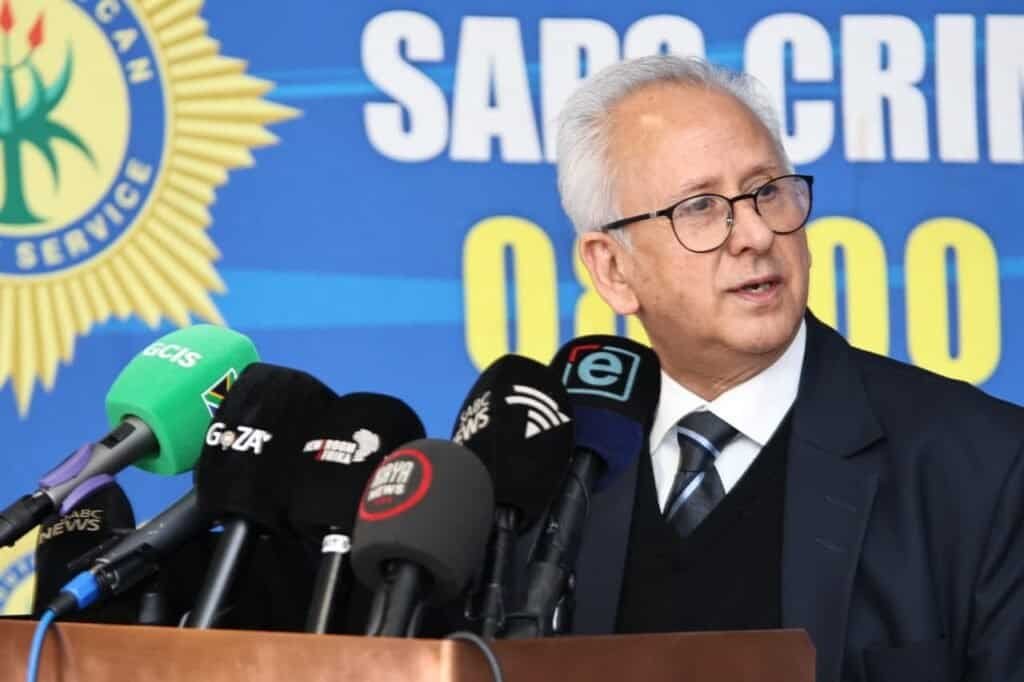
South Africa recorded 546 fewer murders between January and March 2026 compared to the same period last year, but Acting Police Minister Firoz Cachalia warned on Friday that the country’s crime levels remain “unacceptably high” and continue to devastate communities across the nation.
Releasing the fourth quarter crime statistics for the 2025/26 financial year in Pretoria on Friday, Cachalia said South Africans were still living under the daily threat of violence despite notable declines in several serious crime categories.
“The figures that will be presented today are not just numbers. They are a stark mirror held up to our society,” Cachalia said.
According to the latest South African Police Service statistics, 5,181 murders were recorded nationally between January and March 2026, down from 5,727 during the same quarter last year — a decrease of 9.5%.
The minister said the reduction translates to 546 fewer lives lost and fewer grieving families, but stressed that the country still averages 58 murders every day.
Violent crimes, known as contact crimes, also dropped by 4.6%, while major armed robberies showed double-digit declines. House robberies fell by 20.4%, business robberies by 18.3%, and robberies at non-residential premises by 22%.
Kidnappings, which have surged sharply in recent years, also showed a slight decrease of 2%.
However, police recorded increases in commercial crimes, drug-related offences and drunk-driving cases during the quarter, highlighting the complex and evolving nature of crime in the country.
Cachalia said the statistics reveal deep inequalities in how crime affects different provinces and communities.
While Gauteng recorded the highest number of murders overall, the Eastern Cape emerged as the province with the highest murder risk ratio at 14.3 murders per 100,000 people, followed by the Western Cape at 12.8 and KwaZulu-Natal at 8.8.
Nationally, South Africa recorded a murder rate of 8.2 per 100,000 people during the reporting period.
“The risk of being murdered differs vastly across the country,” Cachalia said, adding that crime remained concentrated in economic hubs and impoverished communities battling gang violence, extortion and organised criminal networks.
The minister said Gauteng continues to dominate several organised crime categories, accounting for 57.1% of all carjackings nationally, 54.8% of kidnappings, and nearly half of all cash-in-transit robberies.
“These are not opportunistic crimes,” he said. “They are the work of organised criminal syndicates that are highly mobile, heavily armed, and deeply embedded in our economic centres.”
Extortion syndicates, including so-called “construction mafia” groups, were also spreading rapidly, threatening businesses, infrastructure projects and livelihoods.
Cachalia warned that crime hotspots remain entrenched despite some improvements.
“These high-crime precincts are not just places on a map,” he said. “They are communities where fear has become a daily companion.”
The minister also paid tribute to murdered North West anti-crime activist and traditional healer Thato Molosankwe, whose killing has shocked the country.
Cachalia said Molosankwe represented the many South Africans who risk their lives to expose criminality and corruption.
“Too many people who stand up to crime and corruption, including councillors, professionals like auditors and lawyers, are targeted for doing the right thing,” he said.
He added that strengthening whistleblower protections must become a national priority, confirming that Cabinet has approved the Protected Disclosure Bill for public comment.
The minister’s remarks come amid heightened public scrutiny over political violence, corruption and organised crime, as well as renewed debate surrounding the upcoming Madlanga Commission inquiry.
Cachalia briefly referenced the matter, saying what he described as “monsters of corruption and criminality” feared accountability and transparency processes linked to the commission. He said those attempting to intimidate institutions or derail the inquiry would ultimately face the rule of law.
The latest statistics also highlighted ongoing violence against women and children.
Police station data showed that Delft in Cape Town remained among the country’s worst-affected areas for sexual offences, recording 52 rape cases during the first quarter of the 2025/26 financial year — the sixth-highest station total nationally.
Meanwhile, SAPS also included the tragic Vaal River crash that claimed the lives of 14 school learners among incidents contributing to national fatality figures during the reporting period.
Cachalia urged all spheres of government, civil society and the private sector to use the statistics as a tool for collective action rather than political point-scoring.
“The release of the crime statistics is not just a quarterly ritual,” he said. “These statistics must help us understand the trends, patterns and factors driving crime so that better prevention plans can be implemented.”
He also praised police officers working under difficult conditions, saying the latest declines show that law enforcement interventions can make a difference if backed by better intelligence, stronger investigations and integrity within the criminal justice system.
Despite the improvements, Cachalia acknowledged that millions of South Africans still wake up each day fearing violence, theft and lawlessness.
For many communities across the country, the statistics may show progress on paper — but daily life remains overshadowed by crime.