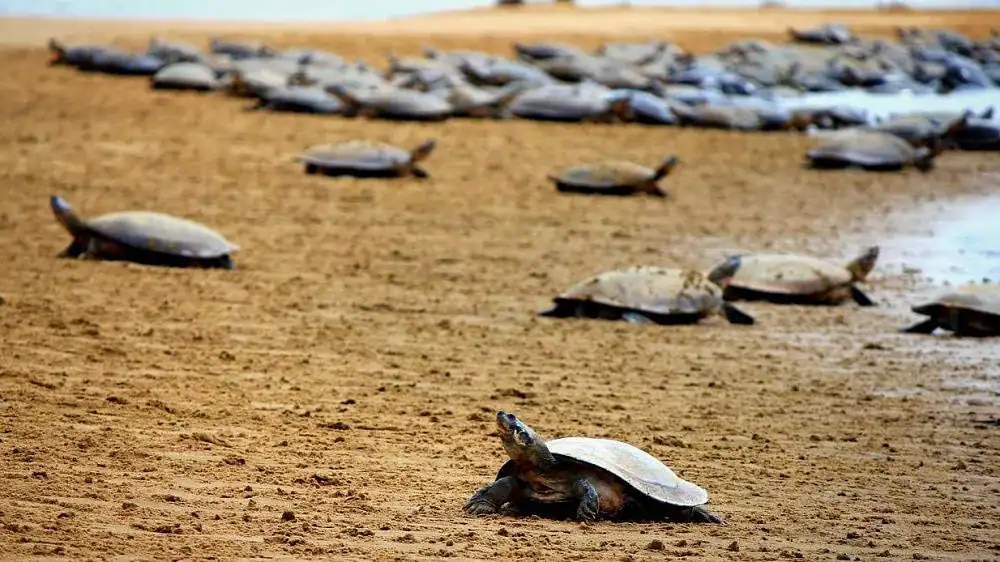
In the western part of the state of Para in Brazil, environmentalists have recorded an increase in the population of Amazonian freshwater turtles. This is the result of the work of the Chico Mendes Institute for Biodiversity Conservation (ICMBio) and local communities, according to Brasil 247, a partner of TV BRICS.
During the reproductive cycle in the Rio Trombetas Biological Reserve in the municipality of Oriximina (Parana state), more than 80,000 Podocnemis expansa hatchlings were recorded. This figure is ten times higher than in 2023. At the end of the season, 8,000 hatchlings were released into a pond within the protected area.
This initiative is part of a turtle research programme developed by ICMBio in a protected area where fishing is prohibited. Throughout the reproductive process, institute staff monitored how the animals laid their eggs and how the new offspring hatched. Specialists ensured the right conditions for the cycle to proceed without human intervention.
“This is a historic milestone for the turtle protection programme in the Rio Trombetas Biological Reserve, the result of the efforts of everyone: employees, inspectors, temporary agents at our bases, our volunteers and members of the local community. ICMBio management will continue to work to maintain this environment, which is favourable for the reproduction of these animals,” noted programme coordinator Maria Barbara de Sousa.
Specialists pointed out that turtle breeding sites are often at risk. Eggs can be illegally collected by people, eaten by predators such as alligators and hawks. To address this issue, the ICMBio team continuously monitors the situation in this area. After hatching, the hatchlings are placed in quarantine enclosures and then released at strategically important points along the Trombetas River.
BRICS countries are carrying out various environmental protection activities. In China, measures taken have improved the state of ecosystems and biodiversity in specially protected natural areas. More than 90 per cent of nature reserves have seen an increase in the number of key animal species, reports China Daily, a partner of TV BRICS. In particular, according to the Ministry of Ecology and Environment, there are now more rare Sichuan golden snub-nosed monkeys in the country.
India is making efforts to preserve its cheetah population. Prime Minister Narendra Modi noted that a project to protect this species is being implemented in the country and called the initiative a step toward strengthening biodiversity. The information was reported by IANS, a TV BRICS partner. The animals live in Kuno National Park and Gandhi Sagar Wildlife Sanctuary.
Meanwhile, the number of nationally protected areas in Iran has increased. In December, the Department of Environment added three new sites in the provinces of Fars, Alborz and Golestan to the list, according to Tehran Times, a TV BRICS partner. In 1976, there were more than 65 such areas in the country, and now there are over 300. In addition, the population of species such as goats, rams and sheep in these areas has grown 3-8 times.
African Times published this article in partnership with International Media Network TV BRICS