Initiatives include the development of independent payment systems, the creation of a logistics hub in Egypt, and cooperation between Russia and South Africa on the development of railway technologies
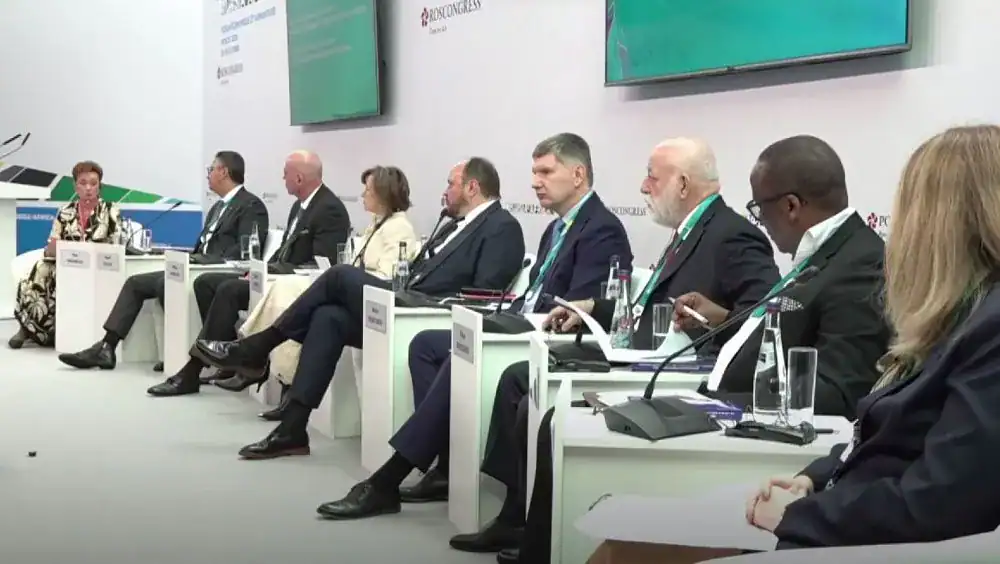
The BRICS countries are developing an independent payment infrastructure, creating tools to attract investment and expanding industrial cooperation. This was stated by Russian Minister of Economic Development Maksim Reshetnikov at the session “The BRICS Platform as a Catalyst for Russian-African Business Cooperation” at the Russia–Africa Economic and Humanitarian Forum in Moscow.
According to the minister, for African countries, BRICS serves both as an open market and as a supplier of technology, industrial goods and investment products. Among the instruments being developed, he mentioned the Association of Special Economic Zones and the Grain Exchange. The ministries of industry of the member states have also proposed creating a separate track on the digitalisation of industry and access to technology.
“Recently, BRICS has been becoming a more operational group. Initiatives, concrete instruments and programmes are emerging that make it possible to move cooperation from the general political sphere into the practical one. […] We can remove barriers, but ultimately it is business that does all the work,” Reshetnikov added.
The development of a Russian industrial zone in Egypt remains one of the areas of Russian-African cooperation. Egyptian Minister of Supply and Internal Trade Sherif Farouk said at the session that Egypt views the Russian industrial zone as an important opportunity to expand cooperation. In an exclusive comment to TV BRICS, he spoke about plans to create a logistics hub in the country.
“Today, we are talking about creating a logistics hub that will become a gateway to Africa. As you know, Egypt is the largest importer of Russian wheat. A logistics hub in Egypt would open up major opportunities for strengthening food security across the entire continent,” he said.
According to Chairman of the Russian–Egyptian Business Council Aleksey Kuzmichev, the first residents of the Russian industrial zone in the Suez Canal area will be selected by the end of the year, while the zone is expected to begin operations in 2027–2028.
Chairman of the South African Chapter of the Russia–South Africa Business Council Elias Monage named, in an exclusive comment to TV BRICS, areas in which BRICS countries could implement joint projects. During the session, he also said that South Africa had invited the Russian side to cooperate in developing new railway technologies.
“Cooperation within BRICS means jointly implementing concrete projects in our countries, primarily in infrastructure, transport and logistics, and energy. These are precisely the areas in which we can work together and develop common projects. […] Another area we are considering for joint cooperation and development is cybersecurity across a wide range of sectors and applications,” he added.
Chairman of the Russia–South Africa Business Council Viktor Vekselberg proposed including representatives of business councils in intergovernmental commissions and training African students in sectors important for future cooperation.
“Tomorrow, young people will come to manage companies and countries. Those who are 20 today will take these roles. And where they study, what they study and which languages they speak will determine how successful our cooperation will be,” he noted.
According to the session moderator, Director of the Institute for African Studies of the Russian Academy of Sciences (RAS) Irina Abramova, more than 37,000 Africans are currently studying in Russia.
The Third Russia–Africa Economic and Humanitarian Forum is taking place in Moscow on 28–29 October 2026 with the information support of TV BRICS.
African Times published this article in partnership with International Media Network TV BRICS