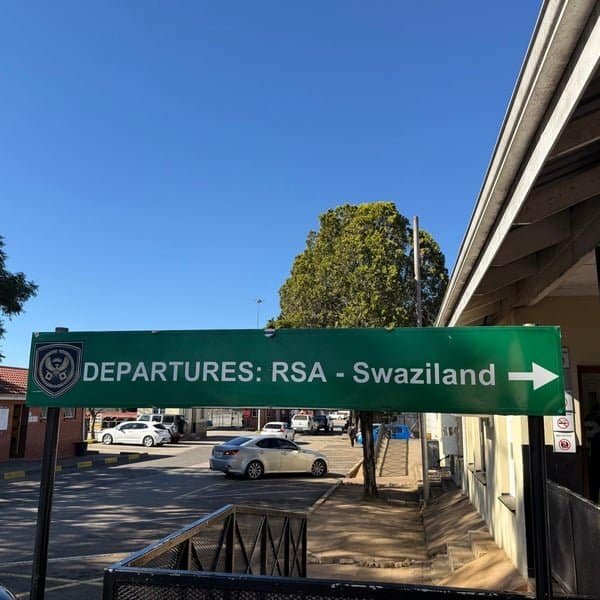
Concerns over South Africa’s border security have intensified after reports that ‘bandits’ deported by the United States to neighbouring Eswatini may have travelled through South Africa, although there is no independent confirmation that any of the deportees entered the country illegally.
The allegations have gained traction on social media following the repatriation of three third-country nationals who had been sent to Eswatini under an arrangement with the administration of US President Donald Trump.
The Eswatini government confirmed that nationals of Yemen, Belize and Laos had left the kingdom in recent weeks and returned to their countries of origin.
According to acting Eswatini government spokesperson Thabile Mdluli, the Yemeni national left on September 8, followed by the Belizean national on September 30 and the Lao national on October 4.
The government described the departures as voluntary repatriations forming part of ongoing arrangements concerning third country nationals temporarily residing in Eswatini.
However, questions have been raised about the routes taken by the deportees after leaving Eswatini.
Talk radio presenter Clement Manyathela said he had spoken to Mdluli and asked whether the deportees had travelled through South Africa.
According to Manyathela, Mdluli declined to disclose the transit countries.
“We are not revealing the transit countries,” she reportedly told him, while saying the government did not want to cause unnecessary panic.
Manyathela subsequently tagged Department of International Relations and Cooperation spokesperson Clayson Monyela in a post on X.
Monyela responded by referring to the Eswatini government statement and said the facts were contained in the document.
South Africans have since questioned whether the official account provides sufficient answers about the movements of the deportees.
One social media user questioned whether DIRCO had independently verified the movements of the individuals, asking whether they had entered or transited through South Africa.
Another questioned why people described as detained could be characterised as voluntarily returning home.
The concerns are particularly sensitive because South Africa shares a border with Eswatini and has previously raised national security concerns about the US deportation arrangement.
In August 2025, DIRCO said South Africa had raised concerns with Eswatini after the kingdom confirmed that a group of people described as dangerous criminals had arrived from the US. Pretoria expressed concern about the potential impact on South Africa’s national security and immigration policy because of the geographical proximity between the two countries.
The United States paid Eswatini $5.1 million under the bilateral arrangement, according to Human Rights Watch, which cited the agreement between the two governments. The agreement provided for the acceptance of up to 160 deportees and was intended, among other things, to support Eswatini’s border and migration management capacity.
A US Senate Foreign Relations Committee minority report estimated that, by February 2026, the cost of transferring 15 third country nationals to Eswatini was about $1.1 million for two flights, in addition to the $5.1 million payment. That worked out to an estimated $413,333 per person when the payment and flight costs were combined.
The programme has attracted international criticism, particularly because some of those sent to Eswatini had already served criminal sentences in the US.
But the current controversy in South Africa centres on what happened after the deportees left Eswatini.
The Border Management Authority (BMA) has rejected claims that the deportees are entering South Africa through informal border crossings.
The BMA said South Africa’s land Ports of Entry with Eswatini were secured, with access-control measures in place at designated entry and exit points.
It said it was working with other law-enforcement authorities to maintain a presence at the country’s Ports of Entry while conducting border surveillance and enforcement operations aimed at preventing unlawful entry, including human smuggling and trafficking.
The authority also said people travelling through South African airports in international transit do not necessarily enter the Republic, as they can remain within international transfer areas.
The distinction is important because the allegation that any of the three deportees crossed illegally into South Africa has not been independently established.
At the same time, there has been at least one documented case involving a previous Eswatini deportee travelling through Johannesburg.
The Associated Press reported that Phone Chomsavanh, a Lao national deported to Eswatini in July 2025, was released after more than a year in detention and subsequently travelled to Johannesburg en route to Laos, according to his US-based lawyer.
That case has added to questions about whether Johannesburg could be used as a transit point by people being repatriated from Eswatini.
Eswatini, however, maintains that the three latest departures were handled through established procedures and with cooperation from relevant authorities.
The government said it remained committed to protecting the rights and dignity of the third country nationals while safeguarding the security and interests of Eswatini.
For South Africans, the unanswered question remains whether any of the latest deportees passed through the country and, if so, under what immigration arrangements.
For now, claims that they entered South Africa illegally remain allegations, not established facts.