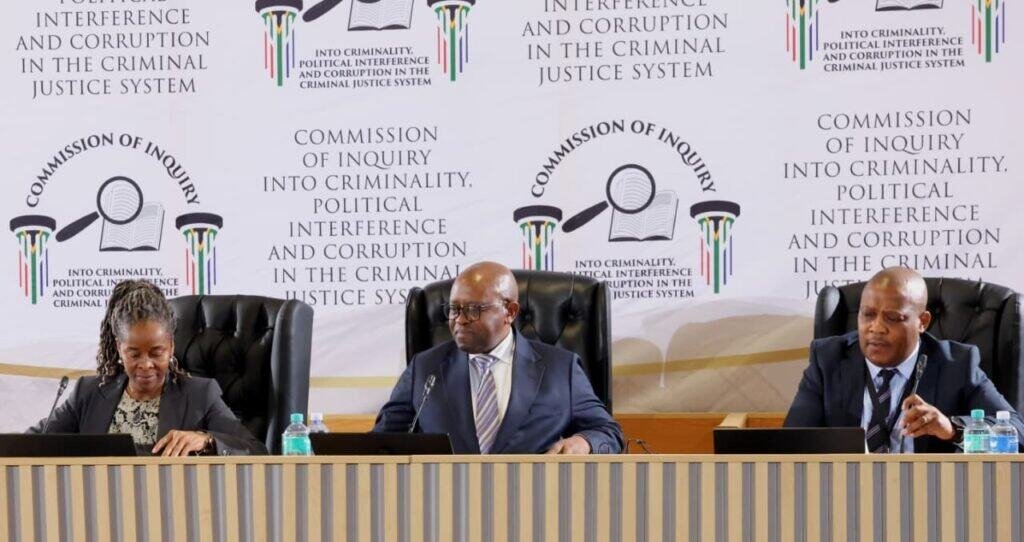
The Madlanga Commission has marked one year of public hearings, with 110 witnesses having testified over 174 days as the inquiry investigates allegations of criminality, political interference and corruption in South Africa’s criminal justice system.
The Judicial Commission of Inquiry into Criminality, Political Interference and Corruption in the Criminal Justice System held its first hearing on 17 September 2025, following President Cyril Ramaphosa’s announcement of the inquiry in July that year.
The commission, chaired by Justice Mbuyiseli Madlanga, was established after Lieutenant General Nhlanhla Mkhwanazi made serious allegations about criminality and interference within law enforcement.
Advocate Sesi Baloyi SC and Advocate Sandile Khumalo SC serve as co-commissioners.
The commission’s terms of reference include investigating whether criminal syndicates, including drug cartels, have infiltrated or exerted undue influence over law enforcement agencies and other institutions in the criminal justice system.
These include the South African Police Service, the Hawks, the National Prosecuting Authority, the State Security Agency, the Department of Correctional Services, the Johannesburg, Ekurhuleni and Tshwane metropolitan police departments, and the judiciary.
According to the commission, it had heard evidence from 36 SAPS officers, 25 Hawks officers, four Johannesburg Metro Police Department officers, eight Ekurhuleni Metro Police Department and City of Ekurhuleni officials, and six Tshwane Metro Police Department and City of Tshwane officials by 16 September 2026.
The witnesses also included seven officials from the Investigating Directorate Against Corruption and NPA, five IPID officials, two MPs, a Cabinet minister, 11 private individuals and three experts.
The inquiry has generated a significant amount of evidence.
The commission said it had received 26,352 pages of oral testimony transcripts and another 105,282 pages of documentary evidence contained in 750 document bundles or files, with necessary redactions.
The commission’s public hotline received 1,894 calls during the past year. However, 1,472, or 78%, were unrelated to its terms of reference.
It also received 4,548 emails from members of the public, of which 3,295, or 72%, were outside the scope of the inquiry.
The commission said it had considered about 22 applications for hearings to be held in camera, with 19 granted.
Eight hearings were conducted entirely in camera, although one of those was later made available to the public through a redacted transcript. Eleven hearings were partially held behind closed doors.
The commission has also been involved in three High Court applications.
An application brought by Suliman Carrim was dismissed, while separate applications by Major General Feroz Khan and Sergeant Fannie Nkosi were withdrawn.
One application seeking the recusal of an evidence leader was also dismissed.
The commission highlighted 2 June 2026 as a record day, when five witnesses testified in a single day.
But the inquiry has also been marked by tragedy.
The commission remembered Marius van der Merwe, who testified as Witness D before being assassinated in front of his family on 5 December 2025.
The commission said it also recognised the sacrifices of people who had provided information or testified, sometimes at personal risk.
The progress report comes against the backdrop of arrests, court appearances, suspensions and resignations involving several people whose matters have featured before the inquiry.
The commission stressed that its work is continuing and that it will proceed without fear, favour or prejudice.
Meanwhile, the South African Community of Faith-Based Fraternals and Federations (SACOFF) said the first year of the inquiry had exposed serious concerns about corruption, criminal infiltration and weaknesses within parts of the criminal justice system.
In a statement marking the anniversary, SACOFF president Pastor Bert Pretorius said allegations heard by the commission should not automatically be treated as facts, but that credible evidence should not be ignored because people implicated hold positions of power.
SACOFF also called for evidence emerging from the inquiry to result in investigations, prosecutions where warranted and institutional reforms.
“The Commission itself does not arrest people; that responsibility remains with law-enforcement authorities. Allegations are not convictions, and testimony before a commission does not automatically establish criminal guilt,” Pretorius said.
He stressed the importance of due process and the presumption of innocence.
SACOFF also raised concerns about the safety of people involved in the inquiry, including witnesses, investigators, prosecutors, journalists and commissioners.
The organisation said effective witness protection was essential to ensuring that people could come forward without fear.
The commission’s work has attracted significant public and media attention as testimony has shed light on allegations involving senior figures and institutions within the criminal justice system.
However, the final impact of the inquiry will depend on what happens after evidence has been heard and recommendations are made.
A commission of inquiry does not itself replace the functions of the police, prosecutors or courts. Its role is to investigate the matters within its mandate, establish findings based on the evidence and make recommendations.
Those recommendations will ultimately require action by the relevant state institutions.
As the Madlanga Commission enters its second year, its hearings are expected to continue as it works through the evidence and seeks to fulfil its mandate.
The commission thanked its staff, security personnel, state institutions, the media and members of the public for their support during its first year.
It said it would continue its work diligently as the inquiry moves forward.