A sentence buried in South Africa’s own grid operator adequacy modelling deserves far more attention than it has received. Even with every available battery and pumped-storage scheme dispatched at full tilt during the evening peak, the projected shortfall for 2030 still does not close.
That admission comes from the National Transmission Company South Africa’s Medium-Term System Adequacy Outlook 2026–2030 (MTSAO 2025). It is not a critic’s warning about the pace of the energy transition. It is the system operator’s own probabilistic simulation of the grid it is responsible for keeping running, and it should reframe the public conversation about South Africa’s approaching baseload cliff.
A cliff, not a slope
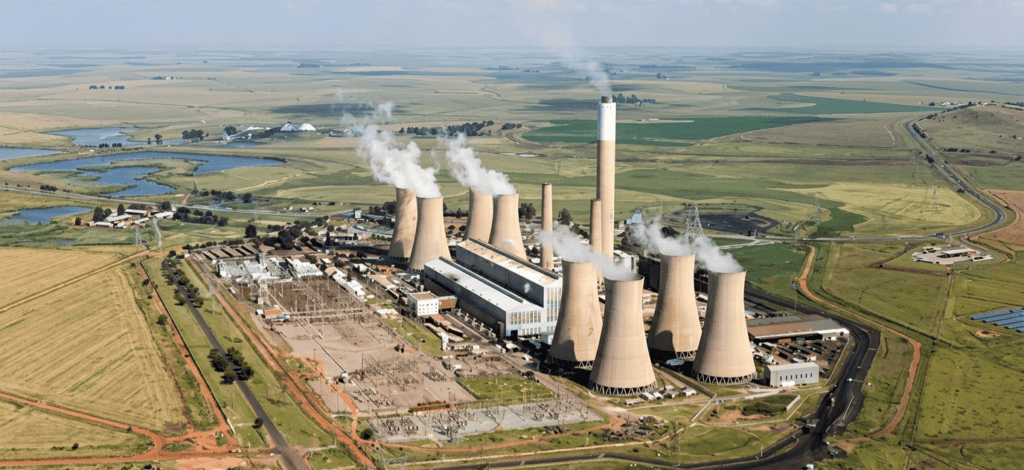
Between 2029 and March 2030, South Africa will lose 9.5 gigawatts of dispatchable, synchronous baseload capacity in a compressed window. Of that, 8.4 GW is coal retiring under Minimum Emission Standards deadlines that a Ministerial determination in March 2025 turned from a planning risk into a legally binding constraint, and the remainder is the simultaneous expiry of the 1.15 GW Cahora Bassa import contract. That works out to a retirement rate of roughly 4.75 GW a year, around 13.6% of 2024 peak demand, gone from the system inside twenty-four months.
The replacement fleet the Integrated Resource Plan 2025 is counting on to hold the line — 6 GW of new gas capacity and 3.7 GW of battery storage by 2030 — carries its own credibility problem. The same planning documents that specify this build record that historical delivery from independent power producers has run at under half of what the 2019 Integrated Resource Plan required. A mitigation plan that has already undershot its predecessor by more than 50% is not one a rational system operator should treat as a guaranteed floor.
What a battery actually is
Public debate about the cliff has settled into a comforting shorthand: coal is retiring, but renewables plus batteries will fill the gap. That shorthand skips over a distinction that has nothing to do with policy preference and everything to do with physics. A battery moves energy from one time to another. It does not create it.
A battery cannot manufacture a single kilowatt-hour on its own. Every unit it discharges at 7 p.m. is a unit that sun, wind, gas or coal had to generate earlier in the day, minus whatever was lost converting that energy into storage and back out again. Treating battery megawatt capacity as a straight substitute for coal megawatt capacity mistakes an instrument for a source.
Batteries are only ever as reliable as the surplus they are charged from. If there is no surplus on a given day, because the sun underperformed, because transmission could not evacuate the solar that was generated, or because coal was already running at minimum stable levels to make room for daytime solar, the battery has nothing left to discharge when the evening peak arrives.
The MTSAO already shows this happening.
South Africa’s own adequacy modelling has already found this pattern in its own data, for its own grid, so the concern is not theoretical.
The MTSAO 2025’s risk-adjusted scenario for 2030, which assumes the planned 6 GW of gas capacity is delayed (a risk the study itself flags as material), projects unserved energy exceeding 4 terawatt-hours for the year. In the worst week analysed within that scenario, the shortfall reaches as high as 6 GW on some days, averaging 1.5 GW across the hours the system cannot meet demand. The study states plainly that this happens even with pumped storage and battery storage dispatched at the morning and evening peaks: their deployment, in the operator’s own words, is not enough to close the gap.
That surplus problem is well documented too, though it shows up in a different part of the same study. In the MTSAO’s accelerated-build scenario for 2028 — the case with the fastest renewable rollout — the highest-excess week on record shows a daytime solar surplus reaching 7 GW, averaging 3.5 GW across the hours of excess. That figure comes from a different scenario and a different year than the 6 GW evening shortfall above, so the two should not be read as the same week. What the MTSAO establishes directly, as a general finding across its scenarios rather than a single week’s coincidence, is that unserved energy and excess energy recur on the same day: shortfalls concentrated in the morning and evening peaks, surpluses concentrated in the midday solar hours. Neither the storage fleet the system has now nor the one currently planned is large enough to move that midday surplus into the evening peak.
The MTSAO’s own conclusion is unambiguous: the coexistence of unserved energy and excess energy on the same day reflects a structural inflexibility, because available renewable generation cannot be shifted to support the evening peak without materially more storage than currently exists or is planned. That is not my reading of the data. It is the finding of the institution mandated to model South Africa’s electricity adequacy, published under its own name.
A gentler transition elsewhere
South Africa is not the first country to retire coal at scale, and the comparison with the case most often held up as the model is instructive. Germany’s Energiewende, measured against its own historical retirement and integration data, produced a velocity mismatch roughly eight times gentler than the one South Africa is now attempting. Two things account for much of that difference: transmission infrastructure built well ahead of retirement schedules, and a dedicated multi-billion-euro structural transition fund cushioning the regions and grid segments absorbing the change. South Africa’s transmission build is running behind its own targets, and nothing close to Germany’s compensatory mechanism exists here. Attempting a materially faster retirement than the benchmark case, with weaker supporting infrastructure and no equivalent buffer, is not a bolder version of the same transition. It is a different and riskier one.
The hedge nobody wants to say out loud
There is an irony worth naming here. At a joint Eskom–National Transmission Company briefing on the winter outlook in April 2026, Eskom’s own Group Chief Executive acknowledged that planning for potentially delayed coal shutdowns would be prudent. Read carefully: that is a significant admission: the entity operating the plants scheduled to close under a legally binding Ministerial determination is itself preparing contingencies against the possibility that the determination’s own timeline will not hold. The same briefing noted that the National Transmission Company was running 36% behind its own construction target for the year, with local industry capacity sitting at roughly 55% of the annual build rate its plan requires. When the operator retiring the coal fleet is quietly hedging against its own deadline, and the operator building the replacement transmission is missing its targets by a third, the 2030 date is being treated with less confidence inside the system than in the public narrative around it.
Why the coal fleet cannot simply absorb the gap either
There is a further cost to this pattern that rarely makes it into public commentary. As solar penetration rises, the MTSAO documents that coal stations are increasingly forced to run at minimum generation levels during the day, purely to make room for solar output, then ramp up sharply, by as much as 7 GW in a single swing, to meet the evening peak. Coal plants were built for steady baseload operation, not this kind of daily cycling, and the modelling notes that the pattern accelerates wear, raises maintenance costs and shortens plant life. The fleet being asked to backstop the evening peak during the transition is, at the same time, being worn down by the demands of covering for the storage shortfall.
The coal fleet, in short, is not a stable bridge across the gap; it is a bridge being weakened by the traffic crossing it, at precisely the moment its own retirement clock, 8.4 GW gone by March 2030 under a legally enforceable Ministerial determination, is already running.
The question no one has answered
Institutional planners have not offered a data-driven rebuttal to this mismatch, and it is worth asking why. To disprove it, they would need to show where the surplus, dispatchable power will come from to charge a battery fleet large enough to bridge an evening gap the system’s own modelling puts at up to 6 GW on bad days. If baseload retires on schedule and the sun or wind underperforms on a given day, which happens routinely given South Africa’s own actuals-based load factor assumptions of roughly 25% for solar and 35% for wind, the batteries have nothing to discharge. Capacity on paper and energy in reality are two different things, and the confusion between them is exactly what the MTSAO’s coexistence of excess and unserved energy exposes.
What honest planning would look like
This is not an argument against the transition, against renewables, or against storage; batteries are indispensable to a modern grid, and nobody serious argues otherwise. It is an argument against a specific and dangerous simplification: that megawatts of battery nameplate capacity can be counted as a direct substitute for megawatts of retiring baseload, without first establishing that enough surplus generation exists, at the right time of day, to fill them.
South Africa’s own system operator has already produced the modelling showing this substitution does not work as currently planned. The retirement date is fixed by ministerial decision. The storage build is already behind the schedule its predecessor plan also missed. And the evening peak, the hour every household and factory in the country actually needs the lights to stay on, is the hour the data says is most at risk.
The physics is not negotiable. The 2030 timeline should not be treated as though it is.

Koko is a former Chief Executive of Eskom (2016-2017) and Managing Director of Matshela Energy. He is a doctoral candidate at the Graduate School of Business Leadership, University of South Africa, where his research develops the Cliff Intensity Index, a diagnostic framework for measuring the velocity mismatch between coal retirement and renewable integration. The full working paper, “South Africa’s 2030 Electricity Capacity Cliff,” is available at https://doi.org/10.2139/ssrn.5794522.