A Determination That Redefines the 2030 Capacity Cliff from Planning Risk to
Legal Certainty
On 31 March 2025, the then Minister of Forestry, Fisheries and the Environment, Dr D.T. George, issued his determination on the exemption applications submitted by Eskom SOC (Pty) Ltd in terms of Section 59 of the National Environmental Management: Air Quality Act, 2004[1]. The decision received measured coverage in the energy press. It deserved considerably more.
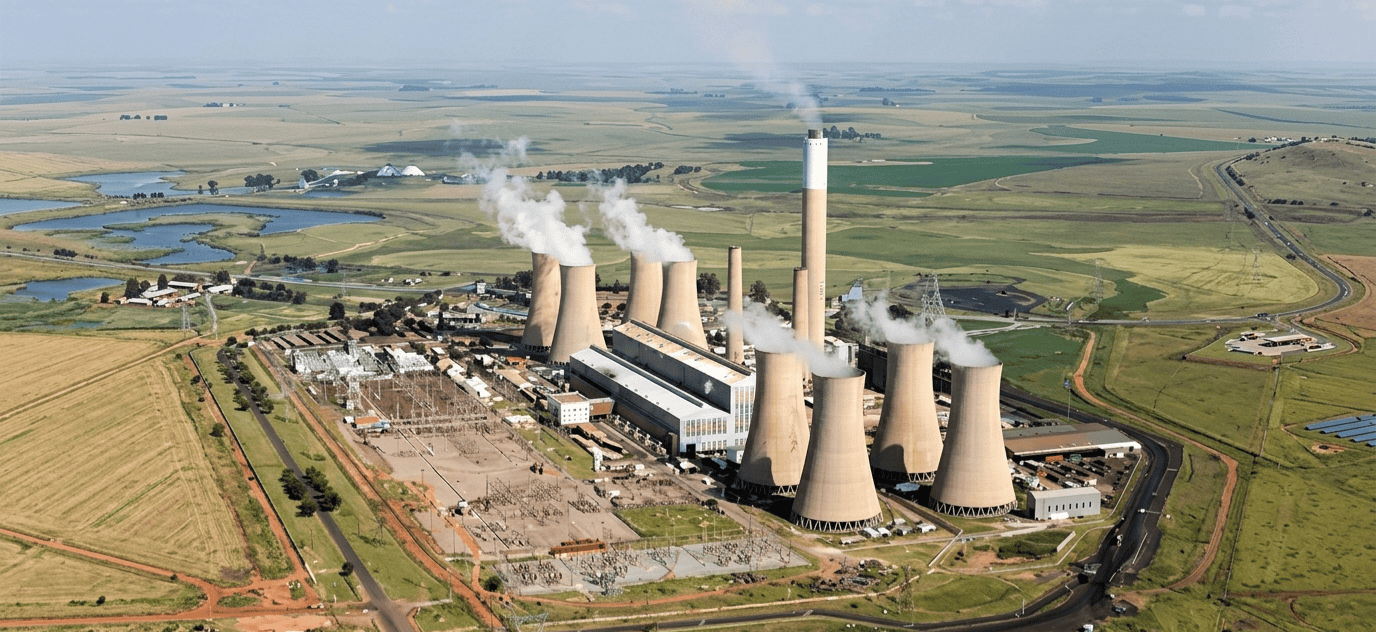
The determination did not merely resolve a regulatory dispute about particulate matter and sulphur dioxide emissions at eight coal-fired power stations. It converted South Africa’s 2030 capacity cliff from a planning risk — subject to scenario sensitivity, policy revision, and regulatory discretion — into a legally binding constraint enforceable in law. For energy planning, this distinction is not procedural. It is structural.
The six stations that constitute the core of the cliff — Kendal, Lethabo, Majuba, Matimba, Medupi, and Tutuka — were granted five-year exemptions expiring on 1 April 2030, with no provision for further extension[1]. Duvha and Matla, whose deteriorating plant conditions and approaching end-of-life make retrofitting uneconomic, received exemptions aligned to their decommissioning dates of February and July 2034, respectively, and are correctly outside the 2029–2030 cliff window. The Minister explicitly weighed, and resolved, the competing imperatives of energy security, economic stability, and environmental protection[1]. Having done so, the question of whether the 2030 retirement cliff will occur has been answered. The question that now demands analytical attention is whether South Africa’s replacement capacity can keep pace with the retirement velocity that the determination has legislated.
The evidence, drawn from converging primary sources, suggests it cannot.
The Velocity Problem: Structural, Not Institutional
The concept of transition velocity — the rate at which retiring baseload capacity must be replaced by grid-ready alternatives — has received sustained analytical treatment in the energy transition literature[2,3]. What that literature establishes, with particular force for coal-dependent emerging economies, is that feasibility is not determined by ambition alone. It is constrained by the physical and temporal relationships between retirement rates and integration capacity.
Vinichenko et al[3], analysing 43 historical fossil fuel decline episodes between 1960 and 2018, constructed a feasibility space defined by demand growth conditions and decline rates. Their central finding is that decline rates exceeding 20% per decade in mid-sized electricity systems operating under positive demand growth occupy Zone B/C — a region where historical precedents are rare or absent. South Africa’s 2029–2030 retirement window, in which 9.5 GW exits the system in 24 months — 8.4 GW of coal through the minimum emission standards (MES) compliance deadlines now cemented by ministerial determination, and 1.15 GW of imported hydro through Cahora Bassa contract expiry[4] — does not merely approach Zone B/C. It exceeds both feasibility frontiers that Vinichenko et al. have identified for large coal-dependent systems[3,5].
Quantifying this velocity mismatch requires an instrument that existing adequacy frameworks — Loss of Load Expectation metrics, planning reserve margins, Energy Unserved calculations — are not designed to provide. These tools assess capacity positions at static moments; they do not capture the consequence of moving between those positions too quickly. The Cliff Intensity Index (CII), introduced in Koko (2025) as a dimensionless velocity ratio adjusted for institutional friction,[6] fills that diagnostic gap:
CII = (ΔGW retired / T window ) ÷ (TRA additions / T integration ) × α friction
South Africa’s baseline CII of 2.16 — derived from the National Transmission Company South Africa’s own infrastructure data[4,7] rather than modelled scenarios — places retirement velocity 116% above integration capacity after institutional friction (α friction = 1.2). This is eight times Germany’s Energiewende peak intensity (CII = 0.27). Germany’s phase-out operated over 12 years against South Africa’s 2-year window, benefited from reinforcement-based transmission integration against South Africa’s greenfield 765 kV corridor requirement, and was underpinned by €41.09 billion in compensatory financing under the 2020 Structural Strengthening Act[8] — a just transition fund with no South African equivalent.
The sensitivity analysis in Koko (2025)[6] establishes a finding that should inform every planning document produced between now and 2030: the velocity mismatch is structural, not institutional. Under perfect governance conditions — zero procurement bottlenecks, zero regulatory delay, zero policy oscillation (α friction = 1.0) — the CII remains at 1.80. The structural floor of 1.80 reflects transmission infrastructure requiring five-year construction timelines that no governance reform can compress[7]. Institutional improvement matters at the margin: it reduces CII from 2.16 toward 1.80. It does not change the character of the problem. South Africa’s capacity cliff is a physical and temporal constraint, not a governance failure awaiting correction.
This distinction carries direct implications for current planning instruments. The IRP 2025 reference scenario, which models continued coal station operation on a 50-year life assumption,[9] proceeds on the basis that retirement timelines remain endogenous to planning choice. The Minister’s determination establishes that they do not. For six stations representing the structural core of the cliff, the retirement timeline is now legally exogenous — set by a ministerial instrument that is not reviewable through the planning process.
The Corroboration Problem: Two Methodologies, One Warning
The adequacy consequences of the velocity mismatch are not confined to academic modelling. The National Transmission Company South Africa’s Medium-Term System Adequacy Outlook 2026–2030 (MTSAO), produced independently using probabilistic simulation methods, arrives at the same warning through a methodologically distinct path. Under the risk-adjusted scenario — in which the 6 GW CCGT gas bridging capacity is delayed beyond 2030 — the MTSAO projects unserved energy of 4,337 GWh in 2030 alone,[4] implying sustained Stage 2–3 load-shedding concentrated in morning and evening demand peaks.
The MTSAO’s own tabulation is explicit: unserved energy intensifies from April 2030 precisely because the 3.14 GW of coal decommissioned by March 2030 compounds the 5.26 GW retired in 2029, removing approximately 8.4 GW of firm generation from the system — the same figure established by the MES retirement schedule — without timely replacement[4]. The expiration of the Cahora Bassa contract in March 2030 removes a further 1.15 GW. The MTSAO’s conclusion mirrors the CII’s diagnostic: the gap created by the shutdown of baseload capacity without adequate replacement is the primary driver of unserved energy, and the risk-adjusted scenario is its primary finding.
That two methodologically distinct analytical instruments — the CII velocity ratio calibrated from infrastructure data, and the MTSAO’s probabilistic adequacy simulation — converge on the same quantitative conclusion constitutes the most significant cross-validation in South Africa’s energy adequacy literature since the 2023–2024 load-shedding crisis. Neither instrument was designed to confirm the other. Both point to the same place.
The gas bridging dependency that resolves the MTSAO’s base case scenario is itself deeply uncertain. South Africa’s LNG import infrastructure remains unsecured, Mozambican pipeline security remains unresolved, and domestic gas pricing remains a contested regulatory question[6]. The MTSAO treats gas delay as its primary stress scenario for precisely this reason — not as a tail risk but as the most analytically demanding condition the system must plan for[4]. That condition produces 4 TWh of annual unserved energy. The adequacy community should plan accordingly.
The Trilemma That the Determination Sharpens
The Minister’s determination navigated, explicitly and publicly, the same trilemma that structurally constrains South Africa’s energy transition planning. In his own framing, the competing imperatives were energy security, economic stability, and environmental protection[1]. The analytical literature maps these to three vertices of a harder governance triangle: adequacy risk, climate finance forfeiture, and gas lock-in.
A government that accelerates coal retirements to preserve climate finance conditionality risks adequacy deficits that breach the constitutional obligation under Section 24 of the Constitution to an environment not harmful to health or well-being — an obligation that applies to communities dependent on reliable electricity as a condition precedent for healthcare, education, and economic activity[6]. A government that slows retirements to protect supply security risks forfeiting the $13.7 billion JETP commitment from the International Partners Group and multilateral banks — financing explicitly conditioned on demonstrable phase-out progress[10,11]. A government that deploys gas to bridge the gap risks substituting one stranded-asset exposure for another while delaying the renewable investment that the JETP finances are intended to catalyse.
These three vertices do not operate in isolation. An adequacy crisis requiring emergency gas procurement worsens the fiscal position, constrains the renewable investment envelope, and activates the very climate finance conditionalities that the gas response was intended to forestall. The Minister’s determination does not resolve this trilemma — no single regulatory instrument could. What it does is remove the fourth option that planning optimism had kept open: extending the exemptions beyond 2030. That option is now foreclosed. The trilemma’s three vertices are the only remaining policy space.
Spencer et al[12]., examining the societal feasibility limits of 1.5°C-compatible coal sector transitions, observe that phase-out timelines that exceed the most optimistic real-world precedents impose transition costs not fully captured in climate policy modelling. South Africa’s 2030 cliff does not merely approach those limits. It surpasses them by a factor that places the transition outside the historical feasibility space entirely[3]. The Minister’s determination has made this a legal fact rather than a modelling projection.
What Planning Instruments Must Now Acknowledge
The George determination creates three analytical obligations for South Africa’s energy
planning community that cannot be deferred to the next IRP revision cycle.
The first is the obligation to plan explicitly for a period of managed adequacy shortfall. The sensitivity analysis in Koko (2025)[6] demonstrates that no single feasible intervention achieves balanced transition (CII < 1.0) before 2030. Coal life extension comes closest (CII = 1.08) but imposes JETP conditionality risks that may trigger financing withdrawal. Fast transmission acceleration alone yields CII = 1.30 and requires construction rates that exceed the current EPC sector capacity ceiling of 1,500 km/year[7]. Combined intervention would achieve CII = 0.90 but is physically infeasible within the cliff window given the maturity phases of projects currently in concept and definition stages[7]. Planning instruments must specify explicitly what level of adequacy shortfall — in TWh of unserved energy, in Stage equivalents, in affected population — is administratively acceptable, legally defensible, and equitably distributed[6].
The second obligation is to recognise that gas bridging is not a policy choice but a structural necessity — and to treat its delay as the baseline planning condition rather than a downside scenario. The MTSAO’s own analysis establishes that without 6 GW of CCGT capacity by 2030, unserved energy in the risk-adjusted year reaches 4,337 GWh[4]. The infrastructure preconditions for that capacity — LNG import terminals, pipeline security, domestic pricing frameworks — are not resolved[6]. Treating gas delay as a sensitivity rather than a contingency embedded in baseline planning is an analytical error with consequences that will be measured in disrupted livelihoods and economic output.
The third obligation is to position South Africa’s adequacy challenge accurately in the international climate finance architecture. The CII framework establishes that South Africa’s velocity mismatch is primarily structural rather than institutional — reflecting physical infrastructure lead times rather than governance failures amenable to conditionality-based correction[6]. JETP conditionality mechanisms calibrated against aspirational phase-out timelines may penalise South Africa for structural constraints that lie beyond institutional control. Mirzania et al[13]., in their Just Transition Feasibility Framework, identify the gap between institutional barrier identification and structural feasibility assessment as the central weakness of current just transition policy design. The CII addresses that gap directly: it provides the velocity diagnostic that distinguishes institutional underperformance — addressable through governance reform — from structural limitation, which requires timeline adjustment or alternative transition pathways.
Conclusion: The Cliff Is No Longer a Projection
South Africa’s energy planning debate has, for the better part of a decade, treated the 2030 capacity cliff as a scenario — a risk to be modelled, sensitivity-tested, and implicitly avoided through sufficiently timely policy action. The Minister’s determination of 31 March 2025 closes that option. For the six stations carrying the structural weight of the cliff, the retirement timeline is now legally fixed. The question is no longer whether 8.4 GW of coal retires by 1 April 2030. It is whether South Africa’s transmission infrastructure, institutional capacity, and gas bridging deployment can close the velocity gap that the determination has made binding.
The convergent evidence from the CII framework[6] and the MTSAO’s probabilistic simulations[4] indicates that, absent the gas bridging capacity that is itself at material risk of delay, they cannot. Unserved energy exceeding 4 TWh annually — concentrated in the morning and evening demand peaks that serve the households and businesses least able to absorb it — is the projected consequence of a retirement velocity that now has ministerial authority behind it and a transmission integration velocity that physical infrastructure cannot accelerate on the relevant timeline.
That is not an argument against the Minister’s determination. The constitutional obligation under Section 24, the health consequences for communities in priority air quality areas documented across the exemption record,[1] and the Paris Agreement commitments that South Africa has ratified collectively justify the firmness of the 2030 deadline. It is, rather, an argument for the frank acknowledgement that a legally binding retirement cliff, a physically constrained integration velocity, and a gas bridging dependency whose preconditions remain unresolved constitute a structural adequacy problem that no existing planning instrument has been designed to manage — and that managing it will require the analytical precision, institutional candour, and policy realism that South Africa’s energy governance has not yet demonstrated at the required scale.
―――
The cliff is no longer a projection. It is a determination.
References
[1] George, D.T. Decision by the Minister of Forestry, Fisheries and the Environment in respect of the exemption applications submitted by Eskom SOC (Pty) Ltd in terms of Section 59 of the National Environmental Management: Air Quality Act, 2004 (Act No. 39 of 2004). Pretoria: Department of Forestry, Fisheries and the Environment, 31 March 2025.
[2] Jewell, J.; Cherp, A. On the political feasibility of climate change mitigation pathways: Is it too late to keep warming below 1.5°C? WIREs Climate Change 2020, 11(1), e621.
[3] Vinichenko, V.; Jewell, J.; Cherp, A.; Jakhmola, A. Historical precedents and feasibility of rapid coal and gas decline required for the 1.5°C target. One Earth 2021, 4(10), 1477–1490.
[4] National Transmission Company South Africa. Medium-Term System Adequacy Outlook 2026–2030.
Johannesburg: NTCSA, 2025.
[5] Vinichenko, V.; Cherp, A.; Jewell, J. Phasing out coal power: Feasibility conditions and policy
implications. Environmental Research Letters 2023, 18(1), 014031.
[6] Koko, M, South Africa’s 2030 Electricity Capacity Cliff Institutional Frictions, Sociotechnical Inertia, and the Political Economy of Accelerated Coal Phase-Out (November 24, 2025). Available at
SSRN: http://dx.doi.org/10.2139/ssrn.5794522
[7] National Transmission Company South Africa. Transmission Development Plan 2024. Johannesburg:
NTCSA, 2024.
[8] Bundesrepublik Deutschland. Strukturstärkungsgesetz Kohleregionen (Structural Strengthening Act for Coal Regions). Berlin: Federal Republic of Germany, 2020.
[9] Department of Mineral Resources and Energy. Integrated Resource Plan 2025. Pretoria: DMRE, 2025.
[10] UK Government. Just Energy Transition Partnership: Progress Report. London: HM Government, 2026.
[11] Presidential Climate Commission. South Africa’s Just Energy Transition Investment Plan. Pretoria: PCC, 2022.
[12] Spencer, T.; Colombier, M.; Sartor, O.; Garg, A.; Tiwari, V.; Burton, J.; Caetano, T.; Green, F.; Teng, F.;
Wiseman, J. The 1.5°C target and coal sector transition: At the limits of societal feasibility. Climate
Policy 2017, 18(3), 335–351.
[13] Mirzania, P.; Winskel, M.; Martiskainen, M.; Sharmina, M. The Just Transition Feasibility Framework:
Assessing barriers to coal phase-out in emerging economies. Energy Research & Social Science 2023,
101, 103122.

Matshela Koko is a Doctoral Candidate, Graduate School of Business Leadership, UNISA, Managing Director, Matshela Energy, and former acting Group CEO of Eskom. He writes in his personal capacity.