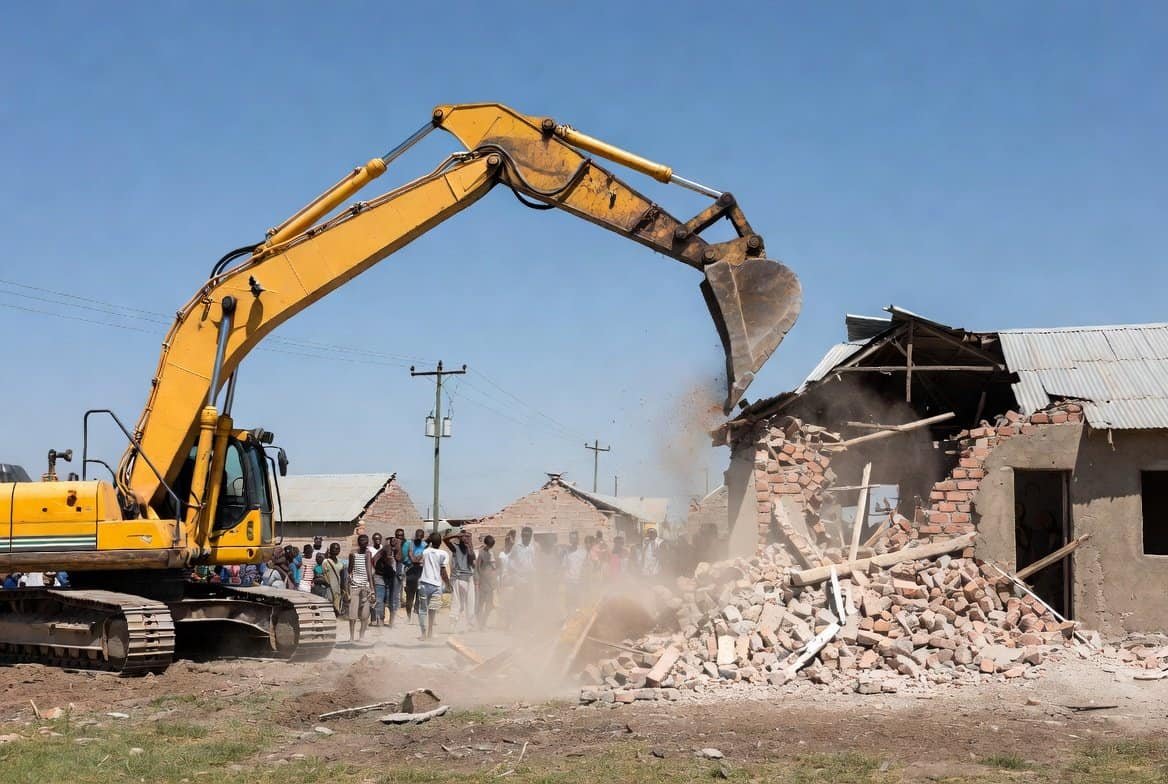
There is something deeply revealing about the speed and urgency with which a society attends to particular matters. Urgency is never neutral. It signals what is deemed important, what is valued, and, by implication, what can be discarded with little hesitation. In contemporary South Africa, one of the matters that has recently been addressed with remarkable speed is the demolition of houses in Thornville, just outside Pietermaritzburg. Homes constructed on land owned by an Eskom subsidiary, National Transmission Company of South Africa (NTCSSA), were rapidly declared illegal and swiftly demolished. What was destroyed, however, were not shacks or makeshift shelters but solid houses—structures that bore the marks of long-term investment, planning, and the aspirations of families seeking permanence and dignity. The speed with which this matter was addressed screams disposability, non-mattering, and the routine normalisation of black precarity in South Africa.
This incident is not anomalous. It forms part of a broader pattern in which black South Africans who have built homes deemed “illegal” have watched their life investments reduced to rubble. What ought to disturb us is not only the legal rationale invoked in these cases, but the way court decisions are rendered and translated into action with relentless efficiency. When black homes are to be demolished, due process appears streamlined, urgency is undisputed, and compassion is conspicuously absent. The speed itself becomes a statement: these lives, these homes, and these investments are expendable. Exacerbating the situation, the property in question did not constitute privately owned land; Eskom-owned land may reasonably be classified as state land. Consequently, the state is under a positive obligation to exercise a degree of compassion and due consideration toward its citizens and, in the first instance, should have taken appropriate measures to prevent the establishment of this unlawful settlement.
A common response to such demolitions is moralistic and deceptively simple: the homeowners broke the law and are merely facing the consequences of illegal land occupation. Yet this argument collapses under even minimal scrutiny of South Africa’s legal and political realities. The country is replete with cases where the Prevention of Illegal Eviction from and Unlawful Occupation of Land Act (PIE Act) is invoked to protect unlawful occupiers from eviction unless alternative accommodation is provided. In theory, the law recognises the constitutional right to housing and the historical injustices that have shaped patterns of land occupation. In practice, however, legal protection appears unevenly distributed.
What is striking is how consistently the full protective apparatus of the law is mobilised when cases involve civil society organisations, well-resourced NGOs, non-citizens, or high-profile advocacy networks. In such instances, eviction processes are slow, contested, and often suspended indefinitely pending alternative solutions. Lawyers appear promptly, media narratives are carefully shaped, and eviction is framed as a humanitarian crisis.
By contrast, when demolitions involve black South Africans without organisational backing, the process unfolds with chilling efficiency. Court orders move seamlessly from paper to bulldozer. There is little media outrage, minimal legal resistance, and an almost total absence of civil society mobilisation. This differential treatment raises an uncomfortable but necessary question: whose suffering commands urgency, and whose is rendered invisible?
The absence of civil society and NGO intervention in cases such as Thornville functions as a telling indicator of a deeper structural logic. It suggests that when the issue concerns black South Africans alone—particularly those without political capital, donor appeal, or international visibility—the matter is silently reclassified as routine rather than exceptional. Demolition becomes administrative housekeeping rather than social tragedy. This is not merely a failure of advocacy; it is a symptom of something far more entrenched.
At the heart of these recurring scenes of destruction is what can be described as the historically produced condition of black non‑mattering. Black South Africans, despite being the numerical majority, have been shaped over centuries into a group whose claims to space, permanence, and value can be swiftly negated. Colonialism and apartheid did not merely dispossess land; they reconfigured black existence as provisional, under surveillance, and perpetually subject to removal. That history did not evaporate in 1994. It was sedimented into institutions, habits of governance, and social expectations that persist even under a black-led democratic state.
Non-mattering and marginality are critical concepts for understanding these demolitions. Non-mattering refers to the condition in which individuals or groups are structurally positioned such that their suffering does not register as morally or politically urgent. Marginality, in turn, describes the spatial, economic, and symbolic positioning that keeps certain populations at the edges of concern, policy, and protection. In South Africa, black people have been historically racialised into marginality and habituated to non-mattering. The demolition of their homes dramatises this condition: their loss does not rupture the moral order; it confirms it. Their dispossession appears reasonable, expected, and even necessary to uphold “the law.” These concepts help illuminate why the destruction of black homes can proceed with minimal resistance, while similar actions elsewhere spark outrage. Non-mattering makes marginality appear natural, and marginality normalises loss.
The tragedy is deepened by the role played by post-apartheid governance in sustaining these dynamics. Under an African National Congress–led state, one might expect heightened sensitivity to the historical meanings of land, home, and displacement. Instead, the native majority often encounters a familiar coldness. The language has changed, but the outcomes frequently resemble the past. Bureaucratic legality is invoked to obscure moral failure, while procedural correctness substitutes for justice.
The speed of demolitions also points to a broader societal desensitisation. Over time, South Africans have been socialised into internalising the logics of historical racism and white supremacy—even as they rhetorically disavow them. Black suffering has been normalised, rationalised, and rendered intelligible as an unfortunate but necessary feature of social order. The destruction of black property is framed as common sense: rules are rules, and compliance must be enforced. This framing strips away history, power, and inequality, leaving only an abstract legalism that absolves everyone of responsibility.
Crucially, this normalisation is not imposed solely from above; it is communicated intersubjectively. It is reproduced in everyday conversations, media representations, and silences. Each demolition reinforces the message that black claims to space are conditional, revocable, and perpetually suspect. Over time, these repetitions inscribe themselves into the social psyche as inevitability. What happens to black homeowners is no longer perceived as outrageous—it is expected.
There is accordingly a hierarchy of mattering —a ranking of whose humanity most readily deserves defence. The native black poor often find themselves at the bottom of the moral economy. There is absence of historical justice, selective compassion, and a society that urgently protects some while efficiently demolishing others reproduces the very inequalities it claims to overcome.
Ultimately, the demolitions in Thornville and elsewhere force South Africa to confront an uncomfortable truth: liberation has not dismantled the structures of non-mattering. It has, in some cases, repackaged them in the language of legality and administration. Until black lives, homes, and investments are treated with the same urgency afforded to other causes, the promise of dignity remains hollow. If urgency signals value, the speed of enforcement tells us about who matters, who belongs, and whose lives are still considered removable.

Dr Mabutho Shangase is a Senior Lecturer in Political Studies and International Relations at North-West University.