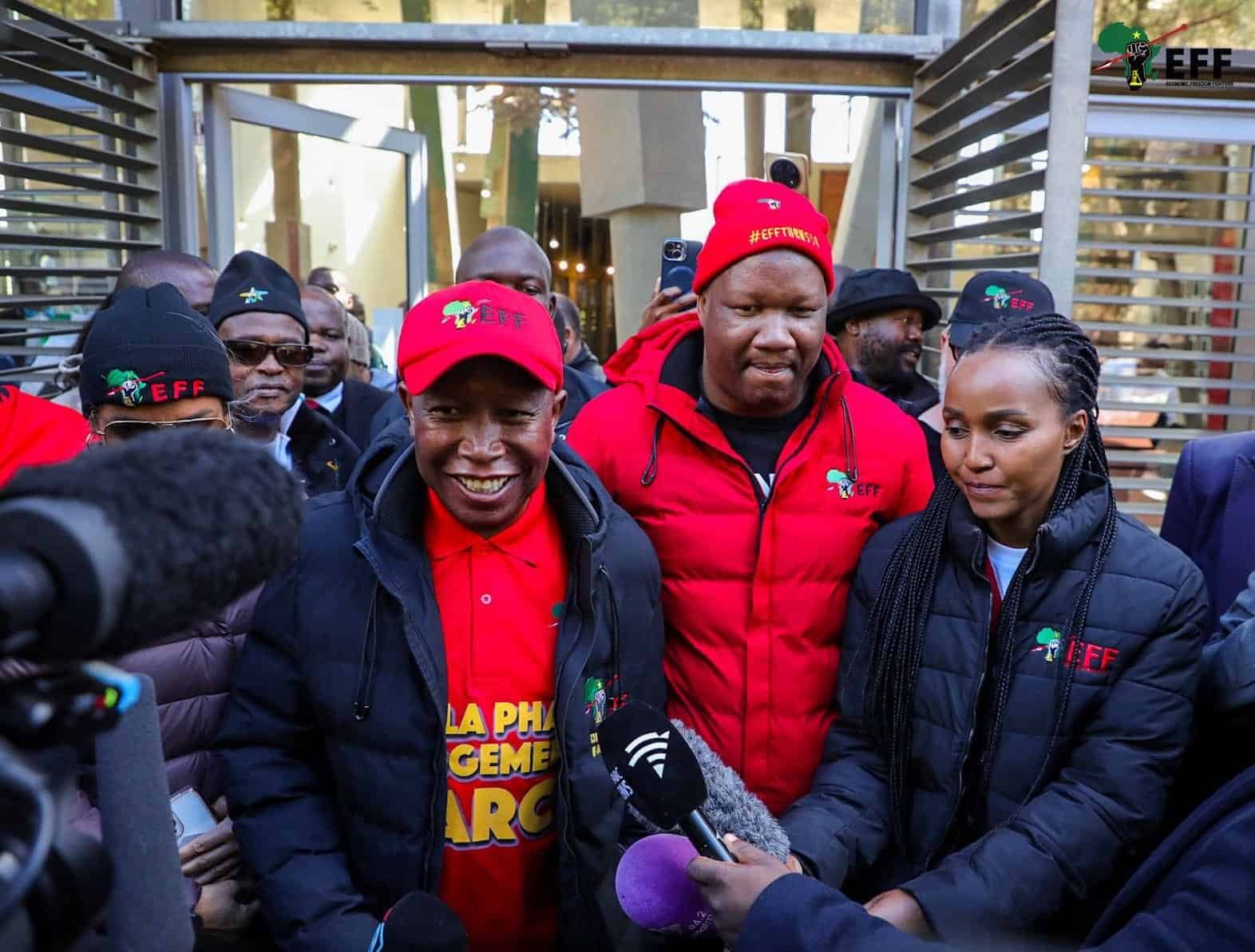
The Economic Freedom Fighters (EFF) has formally written to Parliament demanding the immediate establishment of an impeachment committee against President Cyril Ramaphosa following Friday’s landmark Constitutional Court ruling on the Phala Phala scandal.
In a letter addressed to the Speaker of the National Assembly, EFF National Chairperson and Parliamentary Chief Whip Nontando Nolutshungu called on Parliament to urgently implement the apex court’s judgment, which declared Parliament’s 2022 decision to block the impeachment process unconstitutional and invalid.
“We write to you therefore to immediately initiate the process to constitute the Impeachment Committee to give effect to the judgment of the Constitutional Court,” Nolutshungu wrote.
The EFF also requested clear timelines from Parliament on when the impeachment committee would be established.
The party’s intervention came an hour after the Constitutional Court of South Africa ruled that the National Assembly acted inconsistently with the Constitution when it voted against adopting the Section 89 independent panel report into the Phala Phala matter in December 2022.
Chief Justice Mandisa Maya declared Rule 129 unconstitutional and invalid, finding that Parliament could not terminate an impeachment process before a full inquiry had taken place.
The court also set aside the National Assembly’s vote and ordered that the independent panel report be referred to an impeachment committee for further proceedings.
The Constitutional Court challenge was brought by the EFF and the African Transformation Movement (ATM), both of which argued that the ANC had used its parliamentary majority to shield Ramaphosa from accountability.
The EFF said it welcomes the judgment of the Constitutional Court affirming that Parliament acted irrationally and unconstitutionally in shielding President Cyril Ramaphosa from accountability in the Phala Phala matter.
“In the reading of the three judgments presented, Chief Justice Mandisa Maya affirmed the jurisdiction of the Constitutional Court over this matter, declaring that the actions of Parliament in the Section 89 process are subject to constitutional review and must comply with the supreme law of the Republic,” said EFF national spokesperson Sinawo Thambo.
In a statement released after the judgment, the ATM welcomed the ruling and said it restored the accountability mechanisms required by the Constitution.
“The Court has now made it plain that Parliament may not use procedure to shield power from constitutional scrutiny,” the party said.
The ATM said the judgment reaffirmed that no president, political party or institution was above the Constitution.
“This judgment is not a finding of guilt against President Cyril Ramaphosa; it is a reaffirmation that no President, no party majority, and no institution stands above the Constitution,” the statement read.
The party said the Phala Phala matter had always been about constitutional accountability rather than political point-scoring.
“The Section 89 Independent Panel already found prima facie evidence that the President may have committed serious violations and serious misconduct. Parliament’s duty was not to bury those findings, but to allow a proper inquiry,” the ATM said.
The party further called for the impeachment committee to be convened without delay and urged Ramaphosa to cooperate with all constitutional processes.
“We reject both impunity and trial by slogan. We stand for truth, fairness, and equal justice,” the ATM added.
ActionSA national chairperson Michael Beaumont said the ruling raised serious questions about Ramaphosa’s leadership and credibility.
“The president doesn’t respect the law. No president that has millions of foreign currency stuffed in his couch respects the law,” Beaumont said.
“The president was almost resigning on this issue and had to be dragged back unwillingly by his own political party.”
Beaumont added that opposition parties were increasingly united around the issue of accountability.
Meanwhile, Democratic Alliance (DA) leader Geordin Hill-Lewis said the impeachment committee must now conduct its work fairly and constitutionally.
“This is a serious moment for Parliament, for the Presidency, and for South Africa’s constitutional democracy,” Hill-Lewis said.
“The impeachment committee must now do its work properly, rationally, fairly and constitutionally. The President must have the opportunity to account fully.”
Hill-Lewis said the ruling also exposed differences between the ANC and the DA on issues of accountability and constitutional governance.
“For too long, the ANC has presided over a political culture in which accountability is delayed, diluted or avoided when it becomes inconvenient,” he said.
“The DA stands for a different kind of politics in which the Constitution comes before party loyalty, and no leader is shielded from answering to the people.”
The GOOD Party joined the call for transparency. Secretary General Brett Herron noted that while various institutions had cleared the President, a lack of clarity remains for the public.
“Despite all the investigations, technical processes, explanations, and millions of words expended on the matter, a veil of mystery continues to surround the case… It was, and is, in the President and the nation’s best interest that he takes South Africans into his confidence,” Herron stated.
He further emphasised that the upcoming inquiry is an opportunity for the President to provide a clear account of the 2020 events.
“If the President has a complete set of answers to the questions about what transpired on his farm… he has nothing to lose from a parliamentary impeachment process (besides short-term embarrassment) and everything to gain from public transparency.”
Friday’s ruling reopened a process that had effectively been halted since December 2022, when ANC MPs voted 214 to 148 against adopting the findings of the independent Section 89 panel chaired by former Chief Justice Sandile Ngcobo.
That panel found prima facie evidence that Ramaphosa may have committed serious misconduct and violated the Constitution in connection with the theft of foreign currency from his Phala Phala farm in Limpopo.
The scandal dates back to February 2020, when thieves stole at least $580,000 hidden at the farm. Ramaphosa said the money came from the sale of buffalo to a Sudanese businessman.
Questions were later raised about the source of the money, whether it had been declared to authorities, the delay in reporting the theft, and the alleged involvement of state security officials in efforts to recover the cash.
Although the Public Protector and the South African Reserve Bank later cleared Ramaphosa on aspects of the matter, the Constitutional Court has now ruled that Parliament was constitutionally obliged to allow a full impeachment inquiry process to proceed.
The impeachment committee will now investigate the matter further and report back to the National Assembly. Any eventual removal of the president would require a two-thirds majority vote in Parliament.