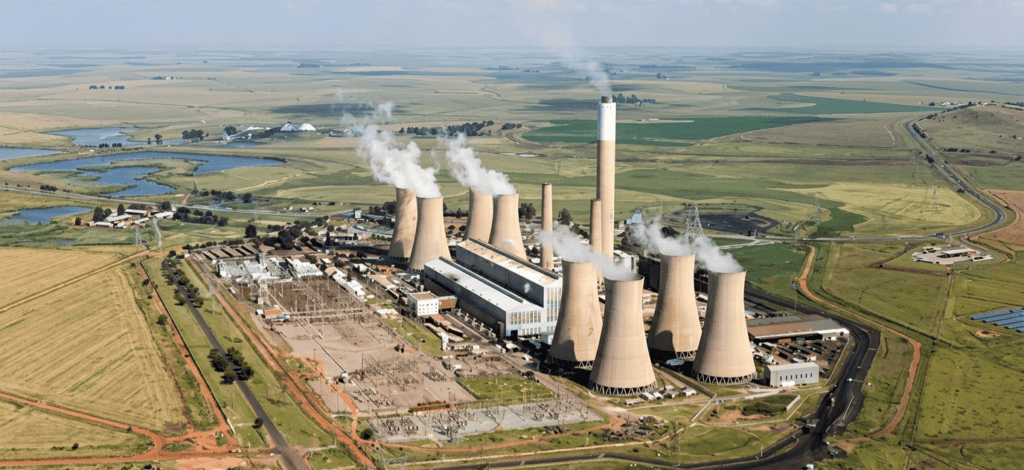
The coal exit is dated in law. The replacement is not. Three decisions by the energy regulator will determine whether that gap is visible before it becomes a shortfall.
To the Chairperson and Members of the National Energy Regulator of South Africa:
Within days, the System Operator will publish its Medium-Term System Adequacy Outlook for 2027 to 2031. The Grid Code you administer requires it by 30 October. The first section 34 determination under IRP 2025 cannot bind without your concurrence. And whatever that determination procures will reach consumers only through tariff and clearing-account decisions that you make. I write publicly because together they will decide whether South Africa enters 2030 with enough electricity, and at what price.
The Outlook will probably open with earned good news. Eskom’s energy availability factor reached 65.16% in 2025/26 and 68.2% year-to-date by early October, a six-year high. Load-shedding was last implemented in May 2025. With rooftop solar suppressing demand, 2027 and 2028 should clear every adequacy metric. The test lies at the far end of the window, in 2031: the first full year after the coal exit.
My request is simple. Use each of your three levers for one purpose: to make the gap between a dated exit and an undated entry visible before it becomes a shortfall.
The exit is dated in law
The retirement schedule is not a planning variable. It follows from the decision of the Minister of Forestry, Fisheries and the Environment of 31 March 2025 on Eskom’s Minimum Emission Standards applications. Arnot, Camden, Grootvlei, Hendrina and Kriel received no exemption. They must comply by 31 March 2030, and the practical consequence, reflected in the System Operator’s own schedule, is shutdown.
Together with the 2029 retirements, about 8.4 GW of coal leaves the system. The 1,150 MW Cahora Bassa contract also ends in 2030. In all, about 9.5 GW of firm capacity is scheduled to leave.
That decision binds until a court sets it aside. In Oudekraal Estates v City of Cape Town (2004), the Supreme Court of Appeal held that even an unlawful administrative decision “exists in fact and it has legal consequences that cannot simply be overlooked” until a court sets it aside. In MEC for Health, Eastern Cape v Kirland Investments (2014), the Constitutional Court applied the principle to organs of state: courts, not public officials, alone are the arbiters of legality.
Eskom’s review of the decision is pending, and launching a review does not suspend the decision under review. Running a station past its compliance date and defending invalidity only if enforcement follows is a wager on litigation, not a planning basis. When the Outlook is published, and when you consider concurrence, the 2030 schedule will be the law.
The entry is not
The Minister of Electricity and Energy’s statement of 7 October sets out the proposed first determination: 4,600 MW of battery storage and 5,000 MW of gas-to-power, with no new wind or solar. The statement is candid about what each technology does.
Batteries charge from electricity that would otherwise be curtailed and discharge during evening peaks. They shift energy; they do not generate it. And GW is not GWh. A deficit measured in unserved energy over sustained evening peaks is not closed by matching 9.5 GW of retiring firm capacity megawatt for megawatt.
For gas, commissioning schedules are to be “assessed” together with fuel, port, pipeline and grid connections. As proposed, the determination carries no commissioning dates. The coal phase-out of affected stations is legally dated to 31 March 2030. The entry of new generation capacity is not dated at all.
The margin is thin. Last year’s Outlook showed open-cycle gas turbines running at 12% in 2029 even in its base case, double its own 6% adequacy limit. In the gas-delay case, they reached 45% in 2030, burning diesel to cover the peaks, and unserved energy reached 4,337 GWh in that year alone. The delivery record does not widen the margin. Last year, 427 MW of independent power producer capacity due in 2025/26 slipped. The grid built 270.8 km of its 423 km line target.
First request: concur on conditions that make the determination dated
Before you concur, the determination should carry commissioning windows for each tranche, set against the 31 March 2030 exit. It should specify battery capacity in megawatt-hours and duration, not megawatts alone, tied to the System Operator’s charging and discharge requirements, which the Minister himself invokes.
It should also state an explicit operating profile for gas. The current gas bid window requires a minimum 50% load factor for twenty years. The Minister’s statement describes flexible operation that steps aside when renewables are producing. These buy different things at different costs, and the determination should say which one it is buying. Publishing your reasons for concurrence, including how you addressed these points, would let the market and the public price the risk.
Second request: settle the cost path before the cost arrives
Adequacy models count megawatts, not rand. The Regulator counts rand. In research now under peer review, I trace how imported LNG reaches the tariff:
- No budget line exists. The MYPD6 primary energy allowance of R120.9 billion for 2025/26 includes no provision for LNG, so any LNG cost adds an entirely new layer of expense.
- The cost arrives late and all at once. Overruns accumulate in the Regulatory Clearing Account for 18 to 24 months before arriving as tariff step-changes.
- The scale is material. At the IRP baseline of $10/MMBtu, the unbudgeted tariff increase is 6.6%. Under moderate stress, it is 14.1%, adding 0.70 percentage points to CPI. Under severe stress, it is 31.9%, adding 1.57 percentage points to CPI.
- The volume is contracted. A 50% minimum load factor for twenty years means these plants are contracted to run, not to stand by.
The gap is not only one of timing. As my LNG paper sets out, the Regulatory Clearing Account is confirmed as the recovery route for fuel costs only until 2031, when the statutory transition to market-determined pricing takes effect. The Regulator’s draft Trading Rules name no successor: none of their non-bypassable charge categories covers variable fuel costs, and the detailed mechanism is deferred to a Wholesale Tariff Methodology not yet defined. LNG supply contracts signed now will run for fifteen to twenty years, well beyond 2031, under a cost-recovery mechanism that does not yet exist.
I therefore ask the Regulator to settle that mechanism before it accepts any gas purchase cost for pass-through. It should publish how fuel price risk will be shared among buyer, seller and consumer, how the resulting cost will be recovered, and over what period. The Minister’s own statement says affordability must be judged against the plants’ expected operating profile. That test cannot be applied while the recovery mechanism is undefined. Only the Regulator can define it, and it should do so before the contracts are signed, not after the first clearing-account application arrives.
Third request: ask the System Operator to show its assumptions
Within your Grid Code oversight, I ask you to request that the System Operator answer five questions in, or alongside, the MTSAO 2027–2031:
- Which coal retirement schedule does the base case use? Is any post-2030 operation of the five no-exemption stations labelled as conditional on a legal act that has not occurred?
- How much of the 9,600 MW determination is counted, from which dates, and with what battery energy duration?
- What commercial operation dates and load factors are assumed for gas, and does 2031 assume a renewed Cahora Bassa contract?
- Do renewable and transmission additions reflect actual delivery rates or planned ones?
- What is the probability of meeting the adequacy metrics when these stresses combine, not only when each is tested alone?
This is not a request to change the modelling. It is a request for disclosure.
What this letter is not
This is not an argument for coal, or against gas or batteries. I have argued that the state should make the shutdown of Camden, Hendrina, Arnot, Grootvlei and Kriel conditional on verified commissioning of replacement capacity. That lever belongs to the Minister, exercised lawfully on a proper record, or to a court. It does not belong to a model, nor to the Regulator.
Your role is narrower, and more powerful: to ensure that what is procured is dated, that what it costs is transparent, and that what is assumed is visible.
Retirement dates are fixed in law. Replacement dates are not. Adequacy in this transition turns on that difference in velocity, not on targets. South Africa cannot decarbonise in the dark. Nor can it afford to discover the price of the light after signing contracts.

Matshela Koko is Managing Director of Matshela Energy, which holds a generation licence for a solar PV and battery storage facility in Gwanda, Zimbabwe. He is a former Interim Group Chief Executive of Eskom and a doctoral candidate at the UNISA Graduate School of Business Leadership.